
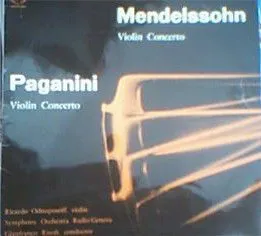
《帕格尼尼《D大调第1号小提琴协奏曲》 /门德尔松《e小调小提琴协奏曲》 /奥德诺波索夫小提琴 ,里沃利指挥 ,日内瓦管弦乐团,威海姆编曲 》
August Wilhelmj
,Niccolo Paganini
,Felix Mendelssohn
,Ricardo Odnoposoff
,Symphony Orchestra of Radio Geneva
,Gianfranco Rivoli
类型专辑
年份未知
简介
Violin Concerto (Mendelssohn)
Felix Mendelssohn'sViolin ConcertoinE minor,Op.64, is his last large orchestral work. It holds an important place in theviolinrepertoire and is one of the most popular and most frequently performedviolin concertosin history.A typical performance lasts just under half an hour.
Mendelssohn originally proposed the idea of the violin concerto toFerdinand David, a close friend and thenconcertmasterof theLeipzig Gewandhaus Orchestra. Although conceived in 1838, the work took another six years to complete and was notpremiereduntil 1845. During this time, Mendelssohn maintained a regular correspondence with David, who gave him many suggestions. The work itself was one of the foremost violin concertos of theRomanticera and was influential on many other composers.
Although the concerto consists of threemovementsin a standard fast–slow–fast structure and each movement follows a traditionalform, the concerto was innovative and included many novel features for its time. Distinctive aspects include the almost immediate entrance of the violin at the beginning of the work (rather than following an orchestral preview of the first movement's major themes, as was typical inClassical-era concertos) and thethrough-composedform of the concerto as a whole, in which the three movements are melodically and harmonically connected and playedattacca(each movement immediately following the previous one without any pauses).(citation needed)
The concerto was well received and soon became regarded as one of the greatest violin concertos of all time. The concerto remains popular to this day and has developed a reputation as an essential concerto for all aspiring concert violinists to master, and usually one of the first Romantic era concertos they learn. Many professional violinists have recorded the concerto and the work is regularly performed in concerts andclassical music competitions.
Mendelssohn also wrote a virtuosoConcerto for Violin and String Orchestra in D minorbetween 1821 and 1823, when he was 12 to 14 years old, at the same time that he produced histwelve string symphonies.This work was "rediscovered" and first recorded in 1951 byYehudi Menuhin.
History
Following his appointment in 1835 as principalconductorof theLeipzig Gewandhaus Orchestra,Mendelssohn named his childhood friendFerdinand Davidas the orchestra'sconcertmaster.The work's origins derive from this professional collaboration. In a letter dated 30 July 1838, Mendelssohn wrote to David: "I should like to write a violin concerto for you next winter. One in E minor runs through my head, the beginning of which gives me no peace."
The concerto took another six years to complete. There are many possible reasons for the delay, including self-doubt,histhird symphony and an unhappy period in Berlin after a request from KingFrederick William IV of Prussia.Nevertheless, Mendelssohn and David kept up a regular correspondence during this time,with Mendelssohn seeking technical and compositional advice. Indeed, this violin concerto was the first of many to have been composed with the input of a professional violinist, and would influence many future collaborations.The autographed score is dated 16 September 1844, but Mendelssohn was still seeking advice from David until its premiere.The concerto was first performed inLeipzigon 13 March 1845 with Ferdinand David as soloist. Mendelssohn was unable to conduct due to illness and the premiere was conducted by the Danish composerNiels Gade.Mendelssohn first conducted the concerto on 23 October 1845 again with Ferdinand David as soloist.
An autograph manuscript of the concerto re-emerged in 1989 in theBiblioteka JagiellonskainKraków, leading to some scholarly scepticism of the veracity ofBreitkopf & Härtel's 1862 edition of the published score. Some notable differences include the tempo character of the first movement being written as "Allegro con fuoco" rather than the commonplace "Allegro molto appassionato" as well as significant alterations of the solo violin's passage-work.
摘要:https://en.wikipedia.org/wiki/Violin_Concerto_(Mendelssohn)
Violin Concerto No. 1 (Paganini)
TheViolin Concerto No. 1,Op.6, was composed byNiccolò PaganiniinItaly, probably between 1817 and 1818.
Tonality
Paganini intended the Concerto to be heard in E-flat major: the orchestral parts were written in E-flat, and the solo part was written in D major with instructions for the violin to be tuned a semitone high (a technique known asscordatura) so that it would therefore sound in E-flat. This enables the soloist to achieve effects sounding in E-flat, which would not be possible with normal tuning. An example of this is the opening of the third movement, where the violin plays a rapid downward scale A-G-F♯-E-D, both bowed andpizzicato, which is possible on anopen D-string, but extremely difficult in the key of E-flat (i.e. playing B♭-A♭-G-F-E♭) because two strings would be required to play this downward scale, whereas only one string is required to play it in the key of D. In addition, having the orchestra playing in E-flat appears comparatively to mute the sound of the orchestra compared to the solo violin, because the orchestral string section plays less frequently on open strings, with the result that the solo violin part emerges more clearly and brightly from the orchestral accompaniment.
Leslie Howard's arrangement
Scholar and musicologistLeslie Howard(known for his work on Paganini's contemporaryFranz Liszt) has prepared for publication an edition of the concerto in the correct key of E-flat, with reference both to Paganini's manuscript and the first (not entirely correct) edition. Howard's edition is the first to be published in the correct key and with the solo part. (Paganini was famously secretive with the orchestral and solo parts of his compositions, often collecting them personally immediately after a performance, in order to avoid the possibility of other people copying his 'tricks' or performing his works; so the solo part of the concerto was not included in the original published score.)
Leslie Howard's edition was commissioned and published by theIstituto Italiano per la Storia della Musica(Rome, 2007), as Volume VIII of theEdizione Nazionale delle opere di Niccolò Paganini. This scholarly edition includes facsimiles of the score, the solo part, and also all the extra parts that were added from time to time.
摘要:https://en.wikipedia.org/wiki/Violin_Concerto_No.1(Paganini)