
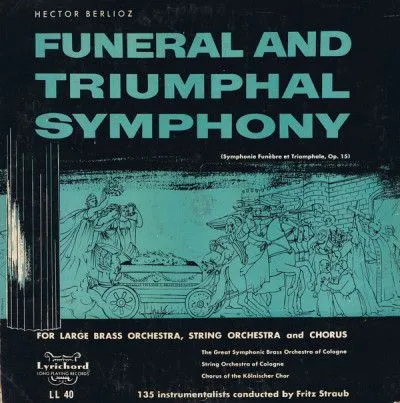
《柏辽兹《凯旋和葬礼大交响曲:次女高音或男高音,合唱队(女低音,女低音,男高音,男高音,男低音,男低音)和钢琴(bB大调)》 /施密特长号》
类型专辑
年份1953
简介
Grande symphonie funèbre et triomphale
Grande symphonie funèbre et triomphale(English:Grand Funeral and Triumphal Symphony),Op.15, is the fourth and lastsymphonyby the French composerHector Berlioz, first performed on 28 July 1840 in Paris. It is one of the earliest examples of a symphony composed formilitary band.
Introduction
The French government commissioned the symphony for the celebrations marking the tenth anniversary of theJuly Revolutionwhich had broughtLouis-Philippe Ito power, for which it was erecting theJuly Columnin thePlace de la Bastille. Berlioz had little sympathy for the régime, but welcomed the opportunity to write the work because the government had offered him 10,000 francs for it. TheSymphonie militaire(later renamedSymphonie funèbre et triomphale), rather than following the model Berlioz had established inRomeo and Juliet, represents a reversion to an earlier pre-Beethovenian style in the tradition of monumental French public ceremonial music.[1]Berlioz claimed to have completed the entire score in just 40 hours,[2]harvesting much of the musical material for thisGrande symphonie funèbre et triomphalefrom unfinished works. The first movement, the "Marche funèbre", was constructed from theFête musicale funèbre à la mémoire des hommes illustres de la France, a massive, seven-movement ceremonial piece begun in 1835 in the hopes of selling it to the French government. According toJulian Rushton, "Berlioz worked best on large projects; when he could see no future for them he preferred not to compose."[3]He apparently abandoned theFête musicale funèbrebecause he couldn't find a sponsor to commission it.
TheFunereal and TriumphalSymphony was originally scored for a military band of 200 players marching the procession accompanying the remains of those who had died fighting in the 1830 revolution on their way to reinterment beneath a memorial column erected on the site of theBastille. On the day of the parade, little of the 3rd movement could be heard over the cheering crowds on the column when the ceremony was about to end as it was about to be reprised while the 1st and 3rd movements were heard during the procession and the 2nd during the dedication proper; but the work was such a success at the dress rehearsal that it was performed twice more in August and became one of the composer's most popular works during his lifetime.[4]Berlioz revised the score in January 1842, adding an optional part for strings and a final chorus to a text byAntony Deschamps.Richard Wagnerattended a performance of this new version at the Salle Vivienne on 1 February 1842. On 5 February, he toldRobert Schumannthat he found passages in the last movement of Berlioz's symphony so "magnificent and sublime that they canneverbe surpassed."[5]
摘自:https://en.wikipedia.org/wiki/Grande_symphonie_fun%C3%A8bre_et_triomphale