
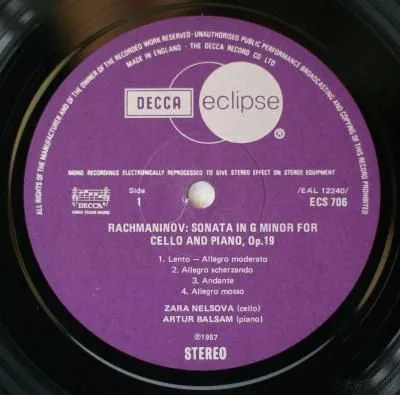
《拉赫玛尼诺夫&肖斯塔科维奇:大提琴奏鸣曲》
类型专辑
年份未知
简介
专辑介绍:© 1973, The Dacca Record Company Limited, London.
formal principles beneath their questing idiom.
Rachmaninov's Cello Sonata belongs to the period following his nervous breakdown and cure by the psychologist Dr. Dahl (1900). The most substantial fruit of the restoration of his self-confidence was, of course, the C minor Piano Concerto, but the years following the cure also saw the composition of the Cello Sonata (1901), the Cantata "Spring" (1902), the twelve songs of Opus 21 (1900—2) which includes such favourites as Lilacs and How fair this spot, the Chopin Variations for piano (1903), and the ten Piano Preludes of Opus 23 (1903—4). Rachmaninov's approach to the cello sonata medium, like that of Chopin before him, was inevitably that of a pianist, but he was sufficiently mindful of the true nature of chamber music to take pains to keep his two instruments as equal as possible. In this he was all but completely successful; only occasionally does the full and elaborate piano writing throw the stringed instrument into the background, and the work never takes on the character, as it might well have done with a composer of Rachmaninov's background, of a piano sonata with cello obbligato. It js full of heartfelt melody, though not quite of the expansive variety to be found in the C minor Piano Concerto of the same year; the tunes tena to fall more into eight-bar patterns, and here one may trace the influence of Brahms, the last important composer to write cello sonatas before Rachmaninov. The work was dedicated to the famous Cellist Anatole Brandukov, who took part in the first performances of several of the composer's works. As "art for art's sake" has been taboo in Russia ever since the revolution, Shostakovich, who was born in 1906, has spent his working life in trying to effect a compromise between the dictates of his own lively musical imagination and those of the communist authorities, who demand music for "the people". As a young man the conflict was not acute. His studentship at the St. Petersburg Conservatoire (under Glazunov and Steinberg) coincided with a period of comparative artistic liberty, when composers were almost as free to explore the twentieth century vocabulary as their colleagues in the western world. Even after the launching of the first five-year plan in 1929, with its renewed insistence that art had social tasks, Shostako 'icn managed to keep in official favour by choosing ideological subjects and titles without essentially "changing his tune", or in other words, without abandoning the contemporary idiom for an out-dated melodic and harmonic style, and without sacrificing his high-spirited, sometime satirical, humour in favour of a straight musical face. It was not till 1936, after a revival of his opera The Lady Macbeth of thf* Mtsensk District (first produced in 1934), that he found himself publicly castigated for paying only lipservice to "Socialist realism". From that time since he ha» tried (though not always with complete success in Soviet eyes) to "grapple witl. ideas of a philosophical order...to address a broad audience, and not a narrow circle...in clear, simple, and expressive language." The Sonata for Cello and Piano (Opus 40), however, dates from 1934 when he was twenty-eight and more musician than party member; in the circumstances it is not surprising to discover that such an authority as Professor Gerald Abraham has described it as among the best things Shostakovich has ever done. It is in four movements, all of which show a firm regard for classical
Franz Holetschek, piano.
Emanuel Brabec, cello.
4.Allegretto
3.Largo
2 Moderato con moto
1.Moderato
SHOSTAKOVICH: Sonata in D minor for cello and piano. Op. 40
Side Two
Artur Balsam, piano.
ZARA NELSOVA, cello.
4.Allegro mosso
3.Andante
2.Allegro scherzando
1.Lento — Allegro moderato
RACHMANINOV: Sonata in G minor for cello and piano. Op. 19
Side One
RACHMANINOV&SHOSTAKOVICH: CELLO SONATA
eclipse ECS 706