
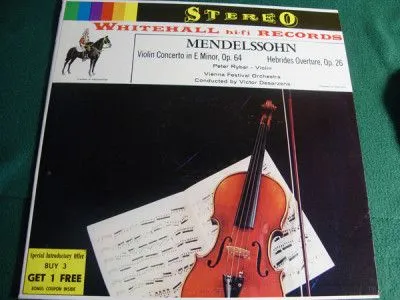
《门德尔松《e小调小提琴协奏曲》 《赫布里底群岛“芬格尔山洞” b小调为管弦乐队而作的音乐会序曲 第2序曲》 /维克多指挥 ,维也纳节日乐团 》
简介
Violin Concerto (Mendelssohn)
Felix Mendelssohn'sViolin ConcertoinE minor,Op.64, is his last large orchestral work. It holds an important place in theviolinrepertoire and is one of the most popular and most frequently performedviolin concertosin history.[1][2][3]A typical performance lasts just under half an hour.
Mendelssohn originally proposed the idea of the violin concerto toFerdinand David, a close friend and thenconcertmasterof theLeipzig Gewandhaus Orchestra. Although conceived in 1838, the work took another six years to complete and was notpremiereduntil 1845. During this time, Mendelssohn maintained a regular correspondence with David, who gave him many suggestions. The work itself was one of the foremost violin concertos of theRomanticera and was influential on many other composers.
Although the concerto consists of threemovementsin a standard fast–slow–fast structure and each movement follows a traditionalform, the concerto was innovative and included many novel features for its time. Distinctive aspects include the almost immediate entrance of the violin at the beginning of the work (rather than following an orchestral preview of the first movement's major themes, as was typical inClassical-era concertos) and thethrough-composedform of the concerto as a whole, in which the three movements are melodically and harmonically connected and playedattacca(each movement immediately following the previous one without any pauses).(citation needed)
The concerto was well received and soon became regarded as one of the greatest violin concertos of all time. The concerto remains popular to this day and has developed a reputation as an essential concerto for all aspiring concert violinists to master, and usually one of the first Romantic era concertos they learn. Many professional violinists have recorded the concerto and the work is regularly performed in concerts andclassical music competitions.
Mendelssohn also wrote a virtuosoConcerto for Violin and String Orchestra in D minorbetween 1821 and 1823, when he was 12 to 14 years old, at the same time that he produced histwelve string symphonies.[4]This work was "rediscovered" and first recorded in 1951 byYehudi Menuhin.[5]
History
Following his appointment in 1835 as principalconductorof theLeipzig Gewandhaus Orchestra,[6]Mendelssohn named his childhood friendFerdinand Davidas the orchestra'sconcertmaster.[7]The work's origins derive from this professional collaboration. In a letter dated 30 July 1838, Mendelssohn wrote to David: "I should like to write a violin concerto for you next winter. One in E minor runs through my head, the beginning of which gives me no peace."[8]
The concerto took another six years to complete. There are many possible reasons for the delay, including self-doubt,[9]histhird symphony[10]and an unhappy period in Berlin after a request from KingFrederick William IV of Prussia.[11]Nevertheless, Mendelssohn and David kept up a regular correspondence during this time,[8]with Mendelssohn seeking technical and compositional advice. Indeed, this violin concerto was the first of many to have been composed with the input of a professional violinist, and would influence many future collaborations.[10]The autographed score is dated 16 September 1844, but Mendelssohn was still seeking advice from David until its premiere.[7]The concerto was first performed inLeipzigon 13 March 1845 with Ferdinand David as soloist. Mendelssohn was unable to conduct due to illness and the premiere was conducted by the Danish composerNiels Gade.[10]Mendelssohn first conducted the concerto on 23 October 1845 again with Ferdinand David as soloist.[10]
An autograph manuscript of the concerto re-emerged in 1989 in theBiblioteka JagiellonskainKraków, leading to some scholarly scepticism of the veracity ofBreitkopf & Härtel's 1862 edition of the published score. Some notable differences include the tempo character of the first movement being written as "Allegro con fuoco" rather than the commonplace "Allegro molto appassionato" as well as significant alterations of the solo violin's passage-work.[12]
摘自:https://en.wikipedia.org/wiki/Violin_Concerto_(Mendelssohn)
The Hebrides(overture)
Felix Mendelssohn'sconcert overtureThe Hebrides(/ˈhɛbrɪdiːz/;German:Die Hebriden) was composed in 1830, revised in 1832, and published the next year as hisOp.26. Some consider it an earlytone poem.[1][2]
It was inspired by one of Mendelssohn's trips to the British Isles, specifically an 1829 excursion to the Scottish island ofStaffa, with its basalt sea cave known asFingal's Cave. It was reported that the composer immediately jotted down the opening theme for his composition after seeing the island. He at first called the workTo the Lonely IslandorZur einsamen Insel, but then settled on the present title. However, in 1834, the year after the first publication,Breitkopf & Härtelissued an edition with the nameFingalshöhle(Fingal's Cave) and this title stuck, causing some confusion.
Being a concert overture,The Hebridesdoes not precede a play oropera, but is instead a standalone composition in a form common for theRomantic period. Dedicated to KingFrederick William IV of Prussia, then Crown Prince of Prussia, the B minor work became part of the standard orchestral repertoire and retains this position to the present day.
Background
Mendelssohn's first visit to England in 1829 resulted from invitations bySir George Smartand thePhilharmonic Society.[3]Following his tour of England, Mendelssohn proceeded toScotland, where he began work on hisSymphony No. 3,Scottish.[4]He was engaged on a tour of Scotland with his travelling companion Karl Klingemann when he sent a postcard to his family with the opening phrase of the overture written on it. In a note to his sisterFanny, he said: "In order to make you understand how extraordinarily the Hebrides affected me, Isend you the following, which came into my head there."[5]The cave at that time was approximately 35 feet (11m) high and over 200 feet (61m) deep, and contained blackbasaltpillars.[5]
The work was completed on 16 December 1830[6]and was originally entitledDie einsame Insel(The Lonely Island). However, Mendelssohn later revised the score and renamed the pieceDie Hebriden(The Hebrides). Despite this, the title ofFingal's Cavewas also used: on the orchestral parts he labelled the musicThe Hebrides, but on the score Mendelssohn labelled the musicFingal's Cave.[5]This revision of the overture was premiered on 14 May 1832 inLondon[6]in a concert conducted byThomas Attwood, that also featured Mendelssohn'sOverture to A Midsummer Night's Dream. The final revision was completed by 20 June 1832.[6]and premiered on 10 January 1833 in Berlin under the composer's own baton.[7]