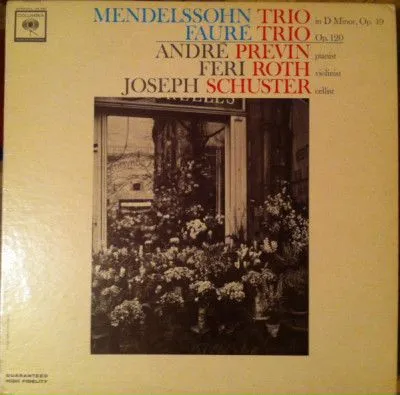
Piano Trio No. 1 (Mendelssohn)
Felix Mendelssohn'sPiano Trio No. 1inD minor,Op. 49, was completed on 23 September 1839 and published the following year. The work is scored for a standardpiano trioconsisting ofviolin,celloandpiano. The trio is one of Mendelssohn's most popularchamberworks and is recognized as one of his greatest along with hisOctet, Op. 20.
During the initial composition of the work, Mendelssohn took the advice of fellow composerFerdinand Hillerto revise the piano part. The revised version was in a moreromantic,Schumannesquestyle with the piano given a more important role in the trio. Indeed, the revised piece was reviewed by Schumann, who declared Mendelssohn to be "the Mozart of the nineteenth century, the brightest musician, who most clearly understands the contradictions of the age and is the first to reconcile them."[1]
Movements
The trio has fourmovements:
1.Molto allegro ed agitato(D minor)
2.Andante con moto tranquillo (B-flat major)
3.Scherzo: Leggiero e vivace (D major)
4.Finale: Allegro assai appassionato (D minor, ending inD major)
A typical performance lasts just under 30 minutes.
摘自:https://en.wikipedia.org/wiki/Piano_Trio_No.1(Mendelssohn)
Piano Trio (Fauré)
Gabriel Fauré'sPiano Trioin D minor,Op. 120 is one of the composer's late chamber works. The first public performance was given by the pianist Tatiana de Sanzévitch, with Robert Krettly and Jacques Patté, in May 1923 for theSociété Nationale de Musiquein honour of the composer's 78th birthday.[1]The following month it was performed by the celebrated trio ofAlfred Cortot,Jacques ThibaudandPablo Casals. The work is dedicated to MmeMaurice Rouvier, widow of the former prime minister.[2]
History
Fauré had retired as director of theParis Conservatoirein 1920. Although he had been reluctant to do so, it brought him more free time to devote to composition, and his final years were marked by the production of many substantial new works.[3]Jacques Durand, his publisher, suggested in January 1920 that Fauré should compose a trio for piano, violin, and cello, and in April he began work, at first in Paris, and later when staying with friends inArgelès-sur-Merin the south of France.[4]Work was temporarily halted by an attack ofpneumonia, after which Fauré went to his favourite resort,Annecy-le-Vieux, in August, resuming work on the piece.[5]His original plan had been a trio for piano, cello and either a clarinet or violin, but he quickly abandoned the clarinet option and wrote for the classical piano trio.[5]
Fauré wrote to his wife, who remained in Paris, "The trouble is that I cannot work for long at a time. My worst tribulation is a perpetual fatigue."[4]The musical scholarRoger Nicholscomments that the composer's fatigue is not detectable in the completed work, except to the extent that "there are no more notes than necessary, according to the well-known Mozartian formula". After returning to Paris Fauré completed the trio in mid-February 1923. The premiere was given at a concert of theSociété Nationale de Musiqueon 12 May by given by three young graduates of the Conservatoire: Robert Krettly, violin, Jacques Patté, cello, and Tatiana Sanzévitch, piano. Fauré was ill, and could not attend. Durand published the work the same year.[4]The Parisian newspaperComoediacommented enthusiastically after the first performance, greeting "a beautiful work that enriches the chamber music repertory". The reviewer praised "the elegant clarity, the equilibrium of thought and the serenity" of Fauré's recent compositions, and commented on the composer's success in playing the most disparate musical ideas off against each other.[1]Fauré was present at the performance the following year, given by theCortot-Thibaud-CasalsTrio.[6]
Structure
There are three movements
Allegro ma non troppo
Andantino
Allegro vivo
The playing time of the trio is about 18 minutes.[2]
摘自:https://en.wikipedia.org/wiki/Piano_Trio_(Faur%C3%A9)