
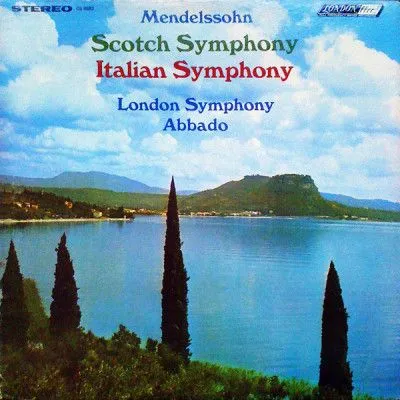
《门德尔松《第3交响曲,a小调为管弦乐队而作“苏格兰”》 《第4交响曲“意大利”》 /阿巴多指挥 ,伦敦交响乐团 》
类型专辑
年份1968
简介
Symphony No. 3 (Mendelssohn)
TheSymphony No. 3in A minor,Op.56, known as theScottish, is a symphony byFelix Mendelssohn, composed between 1829 and 1842.4
Composition
Mendelssohn was initially inspired to compose this symphony during his first visit to Britain in 1829.After a series of successful performances in London, Mendelssohn embarked on a walking tour of Scotland with his friend Karl Klingemann.On 30 July, Mendelssohn visited the ruins of Holyrood Chapel atHolyrood Palacein Edinburgh, where, as he related to his family in a letter, he received his initial inspiration for the piece:
"In the deep twilight we went today to the palace were Queen Mary lived and loved...The chapel below is now roofless. Grass and ivy thrive there and at the broken altar where Mary was crowned Queen of Scotland. Everything is ruined, decayed, and the clear heavens pour in. I think I have found there the beginning of my 'Scottish' Symphony."
Alongside this description, Mendelssohn enclosed in his letter a scrap of paper with the opening bars of what would become the symphony's opening theme.[6]A few days later Mendelssohn and his companion visited the western coast of Scotland and the island of Staffa, which in turn inspired the composer to startthe Hebrides.After completing the first version ofthe Hebrides, Mendelssohn continued to work on his initial sketches of what would become Symphony No. 3 while touring Italy.However, he struggled to make progress, and after 1831 set the piece aside.
It is not known exactly when Mendelssohn resumed work on the symphony (sketches suggest he may have returned to the first movement in the late 1830s) but he was certainly working in earnest on the piece by 1841 and completed the symphony in Berlin on 20 January 1842.Although it was the fifth and final of Mendelssohn's symphonies to be completed, it was the third to be published, and has subsequently been known as Symphony No. 3.Intriguingly, despite describing the work as his 'Scottish Symphony' to his family in 1829, by the time the work was published in 1842 Mendelssohn never publicly called attention to the symphony's Scottish inspiration, and it is debatable whether he intended the finished work to be considered 'Scottish'.Ever since the Scottish provenance became known following the composer's death, however, audiences have found it hard not to hear the piece as evoking the wild Romantic landscapes of the north - even if such picturesque associations have caused audiences to overlook the many other musical qualities of this symphony.
摘自:https://en.wikipedia.org/wiki/Symphony_No.3(Mendelssohn)
Symphony No. 4 (Mendelssohn)
TheSymphony No. 4in A major,Op.90, commonly known as theItalian,[1]is an orchestral symphony written by German composerFelix Mendelssohn.History
The work has its origins (as had the composer'sScottish3rd SymphonyandThe Hebridesoverture) in the tour of Europe which occupied Mendelssohn from 1829 to 1831. Its inspiration is the colour and atmosphere of Italy, where Mendelssohn made sketches but left the work incomplete. Below is a snippet of a letter he wrote to his father:
This is Italy! And now has begun what I have always thought... to be the supreme joy in life. And I am loving it. Today was so rich that now, in the evening, I must collect myself a little, and so I am writing to you to thank you, dear parents, for having given me all this happiness.[2]
In February he wrote from Rome to his sisterFanny,
TheItaliansymphony is making great progress. It will be the jolliest piece I have ever done, especially the last movement. I have not found anything for the slow movement yet, and I think that I will save that for Naples.
TheItalian Symphonywas finished in Berlin on 13 March 1833, in response to an invitation for a symphony from theLondon (now Royal) Philharmonic Society; he conducted the first performance himself in London on 13 May 1833 at a London Philharmonic Society concert. The symphony's success, and Mendelssohn's popularity, influenced the course of British music for the rest of the century.[3]TheGermania Musical Societyof Boston gave the first performance in the United States, on 1 November 1851, withCarl Bergmannconducting.[4]
Mendelssohn himself, however, remained dissatisfied with the composition, which cost him, he said, some of the bitterest moments of his career; he revised it in 1834[5]and even planned to write alternative versions of the second, third, and fourth movements. He never published the symphony, and it appeared in print only in 1851;[6]thus it is numbered as his "Symphony No. 4", even though it was in fact the third he composed.