
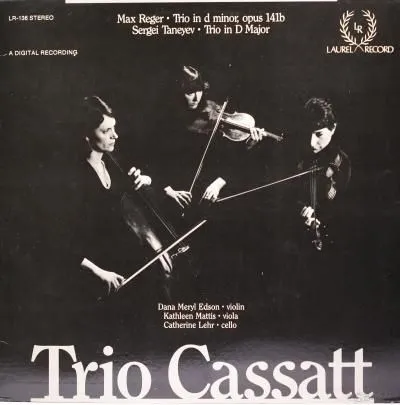
《雷格&塔涅耶夫三重奏》
类型专辑
年份未知
简介
专辑介绍:MUSIC NOTES BY JAMES WIERZBICKI
Taneyev’s Trio in D Major stands at the beginning of a long list of chamber music works characterized by easily perceivable structures, straightforward but nonetheless propulsive rhythms and melodies clearly conceived with their potential for motivic treatment in mind. Taneyev’s interest in archaic contrapuntal devices is most evident in the second movement, Scherzo, molto vivace. Instead of re-appearing in its original form after the first of the two trio sections, the opening material is presented “alia riversa,” that is, in inversion, with all the intervals played upside-down and the violin and cello exchanging parts. The development section of the first movement, Allegro, contains fugal episodes based on interval combinations drawn from both the first and second themes; similarly, the finale Allegro molto includes in its rondo format two fugal sections based on the eighth-note figure played by the violin in the movement’s second measure. Only the lyrical third movement, Adagio ma non troppo, is relatively free of imitative counterpoint, but even here the methodic aspects of Taneyev’s compositional style are apparent, for the opening violin melody is an inversion of what the cello so vigorously offered at the beginning of the Scherzo, and the episode in A Major, just before the coda, is a subtle re-ordering of the pitches that make up the first movement’s second theme. Of course, as plain as these ‘learned devices” are upon analysis of the score, they are no more blatant in Taneyev’s Trio than they are in comparable pieces by Bach, Mozart or Schubert. As with those composers who served as his models, Taneyev put his craftsmanship entirely at the service of his art, and therein lies his distinction.
Sergei Ivanovich Taneyev (1856-1915) completed his Trio in D Major for violin, viola and cello in 1880, about a year and a half after he took over the classes in harmony and orchestration formerly taught by Tchaikovsky at the Moscow Conservatory. Tchaikovsky was obviously familiar with Taneyev’s abilities in those fields, for he had served as Taneyev’s principal composition instructor ever since Taneyev entered the Conservatory, at age nine, in 1866. But to the general public, Taneyev was known only as a pianist — a student of Nikolai Rubinstein, he had made his debut in January of 1875 with Brahms’ Concerto in d minor, and in December of that same year he presented the Moscow premiere of Tchaikovsky’s Concerto in b-flat minor. Taneyev had worked diligently under Tchaikovsky’s tutelage; and by the time of his appointment to the Conservatory faculty, he had written two movements of a string quartet, a march for two pianos and eight other instruments, various short piano pieces, several choruses and songs, a pair of concert overtures, two movements of a piano concerto, a symphony in e minor and three movements of a second symphony in b-flat minor. None of this music had been performed, for Taneyev was as severe a critic of his work as was his composition teacher. It was not until the summer of 1880 that Taneyev made his official debut as a composer —the occasion was the unveiling in Moscow of a memorial to Pushkin, and the piece was a cantata for chorus and orchestra. In his article on Taneyev in the sixth edition of Grove’s Dictionary of Music and Musicians, David Brown notes that Taneyev’s approach to composition was marked by “patient diligence" and “a compositional skill unsurpassed by any Russian composer of his period.” Indeed, it was not only his resistance to the Russian nationalist movement that set Taneyev apart from Mussorgsky, Borodin, Rimsky-Korsakov and other of his contemporaries, but also — and more significant — his consistent use of Classical forms and traditional contrapuntal formulas. In his student days, Taneyev paid far more attention to the music of Bach, Palestrina and Josquin than did most of his classmates. After serving as director of theMoscow Conservatory from 1885 to 1889, he continued to teach the counterpoint class there, and in 1909 he published a voluminous treatise titled Invertible Counterpoint in the Strict Style. When he died (in June of 1915, as a result of pneumonia contracted while attending the funeral of his pupil Scriabin), he was working on what would have been an equally thorough study of canonic technique. “Taneyev’s scores are among the most orderly... in Russian music,” Brown writes; his involvement with counterpoint “fortified his skill, resulting in textures which, however complex, are always engineered with precision and polish.”
MAX REGER (1873-1916) was attracted early in life to the discipline of counterpoint. His first formal musical training came from Adalbert Lindner, a church organist in Weiden, the small town in Bavaria where Reger spent his childhood and early adulthood. Lindner introduced his pupil to the full range of repertoire from the 18th and 19th centuries, but it was the keyboard music of Bach, in particular the two- and three-part inventions, that most securely held Reger’s attention. After studying with Hugo Riemann at Wiesbaden, Reger composed prolifically, concertized widely as pianist and organist and held teaching positions at Munich and Leipzig. In 1911 he took over the music directorship of the court orchestra at Meiningen. Though the specific content of his mature works owes much to the chromatic harmony of Wagner and the rhythmic pulse of Brahms, the working out of materials almost invariably follows the procedures of imitation, variation and development perfected by the Baroque master in whose footsteps Reger literally walked during his years in Leipzig. The Trio in d minor, Opus 141b dates from 1915, a year before Reger’s death from heart failure at age forty three. (Its companion piece is a Serenade in G Major, Opus 77, for flute, violin and viola, composed in 1904, which consists of two identically titled and scored works, in the similarly related keys of D Major and a minor)In the first movement, Allegro, each instrument plays all twelve pitches within the space of five measures, and the chromatic density of the writing continues unabated until the waltz-like secondary theme, in F Major, is introduced. (As with Taneyev’s Trio, the development section is largely fugal, only here the points of imitation are closer together and the permutations of the motivic materials are more diverse).The second movement Andante molto sostenuto con variazioni, is a clear-cut set of variations on a twelve-bar theme in A Major; the first three variations deal with rhythmic expansion of the initial violin melody, the fourth features excursions into dark harmonic regions, the fifth is in essence a recapitulation of the theme in the parallel minor, the sixth is an interlude — equally somber — in d minor, the seventh is a reflective, quiet summary of all that came before. Canon and fugue dominate the finale, Vivace, and the melody of longer notes that balance the skittishness of the moto perpetuo figures is identical in contour to the principal theme of the opening movement.
Trio Cassatt’s name is a reflection of the performers’ interest in honoring both the arts and American women in the arts. Mary Cassatt was a nineteenth century painter born in Pittsburgh who lived most of her life in Paris. Besides being an important artist in her own right, she was credited with bringing French Impressionism to an America which was young in its appreciation of European painting.
University, studying with Janos Starker and Fritz Magg. She has been a soloist with severed orchestras including many appearances with the Saint Louis Symphony and is well known as a recitalist.Recently she appeared as principal cellist of the Orquesto Sinfonica de alapa in Mexico, an international festival orchestra. She has recorded a work written for her by jazz flugelhorn performer Chuck Mangione entitled “El Gato Triste" for the Mercury label.
Kathleen Mattis, violist, was appointed at the age of 21 to her present position of Associate Principal Viola with the Saint Louis Symphony Orchestra. She studied with Eudice Shapiro and Milton Thomas at the University of Southern California, graduating magnu cum laude. Her teachers also included Charles and Heidi Castleman. She has performed as soloist and chamber musician throughout the St. Louis area as well as on both coasts, including solo appearances with the Saint Louis Symphony. In 1976 she was appointed principal violist of the New York String Orchestra under the direction of Alexander Schneider and since 1978 has been principal violist with the Opera Theatre of St. Louis. She has recorded for Vox Productions. Ms. Mattis is currently on the faculty of the Saint Louis Conservatory. Catherine Lehr, cellist, joined the Saint Louis Symphony Orchestra in 1975 as Assistant Principal Cello. She attended theEastman School of Music as a student of Ronald Leonard and later earned her Master of Music degree at Indiana
Dana Meryl Edson, violinist, received her bachelor and master of music degrees from the Juilliard School of Music where she was a student of Dorothy Delay and a chamber music student of Robert Mann and Felix Galimir. She also studied for three years in the Netherlands with Hermann Krebbers, concertmaster of the Concertgebouw Orchestra of Amsterdam. She has performed with the Hague Philharmonic and the Amsterdam Sinfonietta, and was a member of Contemporary Music Ensemble of Holland and the Netherlands String Ensemble. Coming to St. Louis in 1980, she joined the first violin section of the Saint Louis Symphony and has appeared as soloist with the Saint Louis Symphony. Ms. Edson is the concertmaster of the Orchestra & Chorus of St. Louis.
Catherine Lehr, cellist
Kathleen Mattis, violist
Dana Meryl Edson, violinist
IV.Finale: allegro molto (6:30)
III.Adagio ma non troppo (7:20)
II.Scherzo: molto vivace (5:16)
I.Allegro (9:30)
SERGEI TANEYEV: Trio in D Major
SIDE 2. (29:00)
III. Vivace (3:27)
II.Andante molto sostenuto con variazioni (9:33)
I.Allegro (9:11)
MAX REGER: Trio in d minor, Opus 141B
SIDE 1. (22:25)
雷格&塔涅耶夫三重奏