
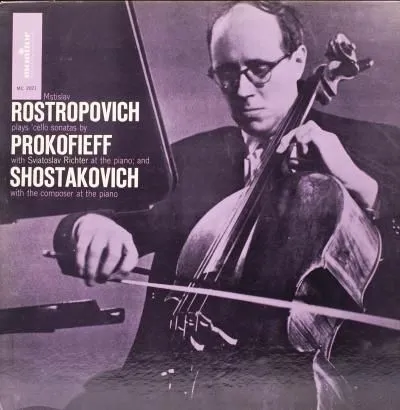
《普罗科菲耶夫&肖斯塔科维奇:大提琴奏鸣曲》
类型专辑
年份未知
简介
专辑介绍:suddenly just as one is enjoying the themes.
pyrotechniques, comes back to the first theme. The end comes almost too
It leads into the middle section (or bridge) which, after some breathtaking
minor tonality (as in the first movement). The theme is crisp, light and gay.
primarily B minor.The last movement (Allegretto) immediately establishes the D
Shostakovich's writing. The tonality is
pages of
tragic in its deep feeling. It certainly contains some of the most beautiful
A minor.The third movement (Largo) is sombre and intensely moving, almost
The movement develops typical “scherzo" elements and ends, as it began, in
cello introduces accented eighth notes against the waltz theme in the piano part.
second movement (Moderato con moto) is a fast waltz of lightness and gaiety. The
very sombre mood. The movement ends as it began on a clear D minor chord.The
notes in the piano and the cello having the first theme but now establishing a
melody of great depth and feeling. The movement ends (Largo) with detached bass
up in intensity and subsides to the second main theme —a sustained
of the Cello Sonata is announced by the cello in a lyric D minor. This builds
for cello and piano which remained in manuscript.)The opening theme (moderato)
Op. 40. (In 1923-24 he had composed three pieces (Fantasy, Prelude, Scherzo)
and 6 string quartets. In 1934 he wrote his only sonata for cello and piano,
cellos. By 1958 he had written another Trio, Op. 67, a Piano Quintet, Op. 57
and cello (unpublished) and Op. 11 an Octet for 4 violins, 2 violas and 2
serious music) since his early compositions. Op. 8 was a Trio for piano, violin
music has interested Shostakovich (as it has almost every other composer of
SHOSTAKOVICH: Sonata for Violoncello and Piano, Op. 40.The genre of chamber
Hall of the Moscow Conservatory. Both performances were by Rostropovich and Richter.
Composers. In March of 1950 it was performed at a public concert in the Small
on December 6, 1949 at a private concert sponsored by the Union of Soviet
remained unfinished. The Sonata, Op. 119, was composed in 1949 and first performed
for Cello, Op. 132 and the solo Cello Sonata, Op. 134. The latter two works
after the Sonata, Op. 119, came the second Cello Concerto, Op. 125, the Concertino
friendship with Rostropovich stimulated his enthusiasm for music for the cello:
asserted — brightly dynamic, enforced with thicker chords and rich ornaments.ProkofiefFs
of the finale. So, in the conclusion of the sonata again the main epic form is
accompanying them with one of the scherzo components of the secondary section
of the first movement “by expansion", with rhythmical changes,
achieves a particular significance; the composer develops the principal theme
compositions, the coda of the finale, in which the main themes are repeated,
but more effectively harmonized.As in the majority of Prokofieff’s cyclic
second theme of the subordinate section, related to the main theme of the scherzo
half-joking dance-like effect; especially appealing with its soft humor is the
the work. However, in the secondary section again one hears the echoes of a
structures; thus also with the new lyrical episode appearing in the middle of
“cantabile” melody developed in the same way with typical Prokofieff-like harmonic
section of the scherzo. Such is, first of all, the main part of the finale —the
predominant, stem from the main themes of the first movement and the middle
the sonata (Allegro ma non troppo), lyrical-romantic lines, which are again
laughable and care-free dance-like main themes of the scherzo.In the finale of
the cello. And at the end, as in a ballet production, appear the infectiously
delightfully romantic color of the melody strengthened by the singing timbre of
alternating with colorful, chromatic notes, beautiful modulations, generally
characteristic methods of the later works of Pro-kofieff: wide intervals
spirit of the love music of Romeo or The Duenna. Here, we can recognize the
movement (Andante ddice) which charms with the passion of its lyricism in the
unexpectedly, the beautiful “love scene": the middle section of the
mischievousness, there appears,
the scherzo, after all the lightness and
effects (staccato, skips, alternating pizzicato and arco) and sharp rhythms. In
Juliet. The humor is heightened by piquant harmonic details, clever timbre
third jesting theme which recalls to mind the laughing Mercutio in Romeo and
four-beat dance. And finally, like an echo of a festive dance, one hears the
but at the same time keeps the rhythm of a
scherzo is full of elegant wit: it is quite singable . . .
nature which are similar to children's folksongs.The second theme of the
Children. The main themes of this section consist of little songs of dance-like
second movement (Moderato) — a clever scherzo in the manner of Music for
sonata.On the other hand, the most memorable section of the sonata is the
flying arpeggios of the piano). This is the most dramatic moment in the whole
working out of the first movement (the cello combines with the turbulent,
particularly, develops dramatically and occupies the central part in the
morose-sad subject — is presented in the second subordinate theme. This theme,
lyrical mood. This is the secondary theme. Another aspect of the lyricism — a
classical form, contructed in a free polyphonic style, indicates a lighter
further on, the next clear melody in
Tales of the Old Grandmother. But,
chords and changing harmonies . . . One is reminded of the tender fantasy of
expressive, recitative phrases, capricious passage effects, restless pizzicato
grave). There is much here reminiscent of Russian folk-lore material:
mysterious — pervades the beginning of the first part of the sonata (Andante
melodies instead.The quality of a fairy-tale — calmly majestic or somewhat
composer develops them to a relatively small extent, constantly unfolding new
lightness. It is delightful to find a generous number of themes . . . The
express a calm, lyrical mood; the second, in contrast, a youthful, carefree
to those in the suite.The sonata is in three movements: the first and third
Op. 122. In the sonata there are impressions of childhood scenes corresponding
same time as the suite Winter Bonfire (known in America as Winter Holiday)It
follows: (translated from the Russian.)The Cello Sonata was begun about the
"Prokofieff , Israel Nestiev writes about the Cello Sonata, Op. 119 as
Piano, Op. 119.In a volume published in Moscow in 1957, entitled merely
PROKOFIEFF: Sonata for Violoncello and
DMITRI SHOSTAKOVICH, piano
MSTISLAV ROSTROPOVICH, cello
4.Allegretto
3.Largo
2.Moderato con moto
1.Modoroto
and Piano
SHOSTAKOVICH:SONATA, Op. 40 for Violoncello
SVIATOSLAV RICHTER, piano
MSTISLAV ROSTROPOVICH, cello
- Allegro, ma non troppo
2.Moderato
1.Andante grave
and Piano
PROKOFIEFF:SONATA, Op. 119 for Violoncello
PROKOFIEFF & SHOSTAKOVICH:CELLO SONATA
monitor MC2021 1958