
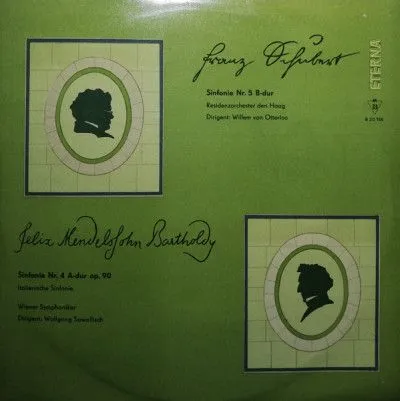
《门德尔松《第4交响曲“意大利”》 /舒伯特《降B大调第5交响曲》 /奥特卢指挥、萨瓦利施指挥 ,维也纳交响乐团,海牙住所管弦乐团 》
Felix Mendelssohn
,Franz Schubert
,Willem Van Otterloo
,Wolfgang Sawallisch
,Vienna Symphony Orchestra
,Residenzorchester Den Haag
类型专辑
年份1961
简介
Symphony No. 5 (Schubert)
Franz Schubert'sSymphony No. 5inB♭major,D.485, was written mainly in September 1816 and completed on October 3, 1816.[1]It was finished six months after the completion of hisprevious symphony.
Musical analysis
There are four movements:
1.Allegro(B♭major,cut time2/2) (299 bars)
2.Andante con moto(E♭major,6/8time) (141 bars)
3.Menuetto.Allegro molto(G minor,3/4time (88 bars), with a Trio inG major(40 bars) )
4.Allegro vivace(B♭major,2/4time) (394 bars)
I. Allegro
This is Schubert's first symphony to not start with a slow introduction. What starts the movement is a four-bar structural upbeat similar to the one that begins the finale of hisFourth Symphonybefore the mainthemestarts on bar 5.[3]The main is a simple risingarpeggiowith adotted rhythmthat dominates all of the themes of the exposition. The first movement is a slightly unusualsonata formsince therecapitulationbegins, as in the first movement ofMozart’ssonata facile(and Schubert'sTrout Quintet), in thesubdominant, not in the main key of the piece as is more usual. Schubert had previously used this device in hisSecond Symphony.
II. Andante con moto
The slow movement opens with a theme in two repeated stanzas. Following that, here is amodulationto C♭that is very characteristic of Schubert, even at age 19. The return to the main theme is straight, passing through G minor on the way; there is a repetition of the distant modulation afterwards, though to G♭this time and with a more immediate return.
III. Menuetto. Allegro molto
The menuetto has thechromaticismthough not thepolyphonyof the menuetto ofWolfgang Amadeus Mozart'sSymphony No. 40. The progression used mid-way through the movement to modulate is borrowed almost directly from Mozart— using the same approach (a gradual layering of instruments) to adominant seventh chord. The trio is quiet throughout, and only gradually accumulates instruments, beginning with only bassoon and strings, and with a subtle suggestion of a pastoral mood over held lower string notes.
IV. Allegro vivace
The finale is the shortest of the four movements.
摘自:https://en.wikipedia.org/wiki/Symphony_No.5(Schubert)
Symphony No. 4 (Mendelssohn)
TheSymphony No. 4in A major,Op.90, commonly known as theItalian,[1]is an orchestral symphony written by German composerFelix Mendelssohn.
History
The work has its origins (as had the composer'sScottish3rd SymphonyandThe Hebridesoverture) in the tour of Europe which occupied Mendelssohn from 1829 to 1831. Its inspiration is the colour and atmosphere of Italy, where Mendelssohn made sketches but left the work incomplete. Below is a snippet of a letter he wrote to his father:
This is Italy! And now has begun what I have always thought... to be the supreme joy in life. And I am loving it. Today was so rich that now, in the evening, I must collect myself a little, and so I am writing to you to thank you, dear parents, for having given me all this happiness.[2]
In February he wrote from Rome to his sisterFanny,
TheItaliansymphony is making great progress. It will be the jolliest piece I have ever done, especially the last movement. I have not found anything for the slow movement yet, and I think that I will save that for Naples.
TheItalian Symphonywas finished in Berlin on 13 March 1833, in response to an invitation for a symphony from theLondon (now Royal) Philharmonic Society; he conducted the first performance himself in London on 13 May 1833 at a London Philharmonic Society concert. The symphony's success, and Mendelssohn's popularity, influenced the course of British music for the rest of the century.[3]TheGermania Musical Societyof Boston gave the first performance in the United States, on 1 November 1851, withCarl Bergmannconducting.[4]
Mendelssohn himself, however, remained dissatisfied with the composition, which cost him, he said, some of the bitterest moments of his career; he revised it in 1834[5]and even planned to write alternative versions of the second, third, and fourth movements. He never published the symphony, and it appeared in print only in 1851;[6]thus it is numbered as his "Symphony No. 4", even though it was in fact the third he composed.