
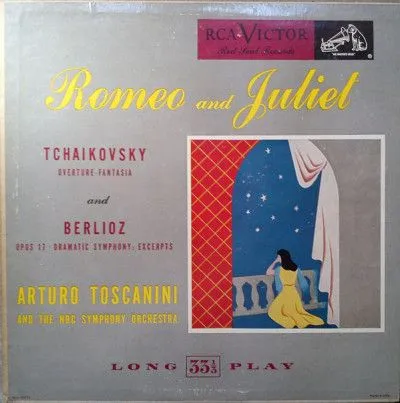
《柴可夫斯基《罗密欧与朱丽叶,根据莎士比亚的戏剧而作的幻想序曲(b小调)》 /柏辽兹《罗密欧与朱丽叶,为独唱(女低音,男高音,男低音)小合唱队(女低音,男高音,男低音)及管弦乐队而作的戏剧交响曲》 /托斯卡尼尼指挥 ,NBC交响乐团 》
简介
Romeo and Juliet(Tchaikovsky)
Romeo and Juliet, TH 42, ČW 39, is an orchestral work composed byPyotr Ilyich Tchaikovsky. It is styled anOverture-Fantasy, and is based onShakespeare'splay of the same name. Like other composers such asBerliozandProkofiev, Tchaikovsky was deeply inspired by Shakespeare and wrote works based onThe TempestandHamletas well.
Unlike Tchaikovsky's other major compositions,Romeo and Julietdoes not have anopus number.[1]It has been given thealternative cataloguedesignations TH 42[2]and ČW 39.[3]
Musical structure
Although styled an 'Overture-Fantasy' by the composer, the overall design is asymphonic poeminsonata formwith an introduction and an epilogue. The work is based on three main strands of the Shakespeare story. The first strand, written inF-sharp minor, followingMily Balakirev's suggestion, is the introduction representing the saintlyFriar Laurence. Here there is a foreboding of doom from the lower strings.[citation needed]The Friar Laurence theme is heard in F minor, with plucked strings, before ending up in E minor. The introduction ischorale-like.
Eventually a single first inversionB minorchord is passed back and forth between strings and woodwinds grows into the second strand in Bminor, the agitated theme of the warring Capulets and Montagues, including a reference to the sword fight, depicted by crashing cymbals. There are agitated, quick sixteenth notes. The forceful irregular rhythms of the street music point ahead toIgor Stravinskyand beyond.[citation needed]The action suddenly slows, the key changing from B minor to D-flat (as suggested by Balakirev) and we hear the opening bars of the "love theme", the third strand, passionate and yearning in character but always with an underlying current of anxiety.[citation needed]
The love theme signifies the couple first meeting and the scene at Juliet's balcony. The English horn and viola represent Romeo, while the flutes represent Juliet. Then the battling strand returns, this time with more intensity and build-up, with the Friar Laurence Theme heard with agitation. The strings enter with a lush, hovering melody over which the flute and oboe eventually soar with the love theme once again, this time loud and inD major, signaling the development section and theirconsummatedmarriage, and finally heard in E major, and two large orchestra hits withcymbalcrashes signal the suicide of the two lovers. A final battle theme is played, then a soft, slow dirge inB majorensues, withtimpaniplaying a repeatedtripletpattern, andtubaholding a B natural for 16 bars. The woodwinds play a sweet homage to the lovers, and a final allusion to the love theme brings in the climax, beginning with a hugecrescendoB natural roll of the timpani, and the orchestra playshomophonicshouts of a B major chord before the final bar, with full orchestra belting out a powerful B natural to close the overture.
摘自:https://en.wikipedia.org/wiki/Romeo_and_Juliet_(Tchaikovsky)
Roméo et Juliette(Berlioz)
Roméo et Julietteis asymphonie dramatique,a large-scalechoral symphonyby FrenchcomposerHector Berlioz, which was first performed on 24November 1839. Thelibrettowas written byÉmile Deschamps, and the completed work was assigned the catalogue numbersOp.17 andH.79. It is based onShakespeare'splayRomeo and Juliet; it is regarded as one of Berlioz's finest works, and it is among the most original in form.[1]The score is Berlioz's most comprehensive and detailedprogrammaticpiece.
摘自:https://en.wikipedia.org/wiki/Rom%C3%A9o_et_Juliette_(Berlioz)