
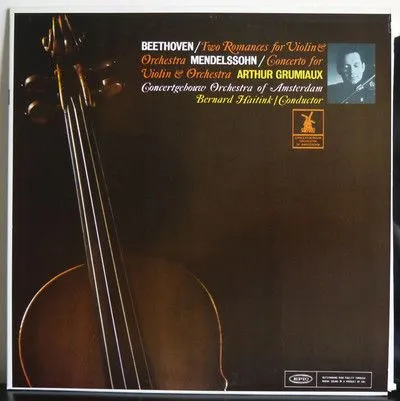
《贝多芬《G大调为小提琴和管弦乐队而作的第1浪漫曲》 《F大调为小提琴,为管弦乐队而作的第2浪漫曲》 /门德尔松《e小调小提琴协奏曲》 /》
简介
Romance for violin and orchestra no. 1 Op. 40 (Beethoven)
TheRomancefor violin and orchestra No.1 inG major,Op. 40, was composed byLudwig van Beethoven, one of two such compositions, the other beingRomance No. 2inF major, Op. 50. It was written in 1802, four years after the second Romance, and was published 1803, two years before the publication of the second. Thus, this romance was designated as Beethoven's first.
The Romance, Op. 40, is scored for violin solo and an orchestra of strings, two oboes, two bassoons, two horns and flute. The composition consists of a single movement markedAdagio cantabile.
摘自:https://en.wikipedia.org/wiki/Romance_for_violin_and_orchestra_no._1_Op.40(Beethoven)
Romance for violin and orchestra no. 2 Op. 50 (Beethoven)
TheRomancefor violin and orchestra No. 2 inF major,Op. 50, is the second of two such compositions byLudwig van Beethoven. It was written in 1798 but not published until 1805 (by which time Beethoven had completed and published the other work,Romance No. 1inG major, Op. 40). The accompaniment is for flute and a pair each of oboes, bassoons and horns, with strings. The length is about eight minutes, Beethoven gives the tempo "Adagio Cantabile"[1]
Aballetbased on this work, titledBeethoven Romance, was premiered byNew York City Balleton 2 February 1989.
摘自:https://en.wikipedia.org/wiki/Romance_for_violin_and_orchestra_no._2_Op.50(Beethoven)
Violin Concerto (Mendelssohn)
Felix Mendelssohn'sViolin ConcertoinE minor,Op.64, is his last large orchestral work. It holds an important place in theviolinrepertoire and is one of the most popular and most frequently performedviolin concertosin history.[1][2][3]A typical performance lasts just under half an hour.
Mendelssohn originally proposed the idea of the violin concerto toFerdinand David, a close friend and thenconcertmasterof theLeipzig Gewandhaus Orchestra. Although conceived in 1838, the work took another six years to complete and was notpremiereduntil 1845. During this time, Mendelssohn maintained a regular correspondence with David, who gave him many suggestions. The work itself was one of the foremost violin concertos of theRomanticera and was influential on many other composers.
Although the concerto consists of threemovementsin a standard fast–slow–fast structure and each movement follows a traditionalform, the concerto was innovative and included many novel features for its time. Distinctive aspects include the almost immediate entrance of the violin at the beginning of the work (rather than following an orchestral preview of the first movement's major themes, as was typical inClassical-era concertos) and thethrough-composedform of the concerto as a whole, in which the three movements are melodically and harmonically connected and playedattacca(each movement immediately following the previous one without any pauses).(citation needed)
The concerto was well received and soon became regarded as one of the greatest violin concertos of all time. The concerto remains popular to this day and has developed a reputation as an essential concerto for all aspiring concert violinists to master, and usually one of the first Romantic era concertos they learn. Many professional violinists have recorded the concerto and the work is regularly performed in concerts andclassical music competitions.
Mendelssohn also wrote a virtuosoConcerto for Violin and String Orchestra in D minorbetween 1821 and 1823, when he was 12 to 14 years old, at the same time that he produced histwelve string symphonies.[4]This work was "rediscovered" and first recorded in 1951 byYehudi Menuhin.[5]
摘自:https://en.wikipedia.org/wiki/Violin_Concerto_(Mendelssohn)