
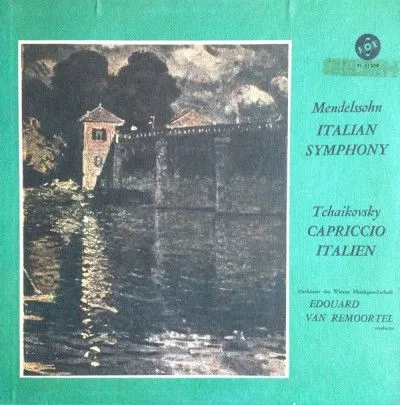
《柴可夫斯基《意大利随想曲》 /门德尔松《第4交响曲“意大利”》 /雷莫特尔指挥 ,维也纳音乐协会乐团 》
Pyotr Ilyich Tchaikovsky
,Felix Mendelssohn
,Edouard Van Remoortel
,Orchester Der Wiener Musikgesellschaft
类型专辑
年份1961
简介
Symphony No. 4 (Mendelssohn)
TheSymphony No. 4in A major,Op.90, commonly known as theItalian,[1]is an orchestral symphony written by German composerFelix Mendelssohn.
History
The work has its origins (as had the composer'sScottish3rd SymphonyandThe Hebridesoverture) in the tour of Europe which occupied Mendelssohn from 1829 to 1831. Its inspiration is the colour and atmosphere of Italy, where Mendelssohn made sketches but left the work incomplete. Below is a snippet of a letter he wrote to his father:
This is Italy! And now has begun what I have always thought... to be the supreme joy in life. And I am loving it. Today was so rich that now, in the evening, I must collect myself a little, and so I am writing to you to thank you, dear parents, for having given me all this happiness.[2]
In February he wrote from Rome to his sisterFanny,
TheItaliansymphony is making great progress. It will be the jolliest piece I have ever done, especially the last movement. I have not found anything for the slow movement yet, and I think that I will save that for Naples.
TheItalian Symphonywas finished in Berlin on 13 March 1833, in response to an invitation for a symphony from theLondon (now Royal) Philharmonic Society; he conducted the first performance himself in London on 13 May 1833 at a London Philharmonic Society concert. The symphony's success, and Mendelssohn's popularity, influenced the course of British music for the rest of the century.[3]TheGermania Musical Societyof Boston gave the first performance in the United States, on 1 November 1851, withCarl Bergmannconducting.[4]
Mendelssohn himself, however, remained dissatisfied with the composition, which cost him, he said, some of the bitterest moments of his career; he revised it in 1834[5]and even planned to write alternative versions of the second, third, and fourth movements. He never published the symphony, and it appeared in print only in 1851;[6]thus it is numbered as his "Symphony No. 4", even though it was in fact the third he composed.
摘自:https://en.wikipedia.org/wiki/Symphony_No.4(Mendelssohn)
Capriccio Italien
TheCapriccio Italien,Op.45, is afantasyfororchestracomposed between January and May 1880 byPyotr Ilyich Tchaikovsky. A typical performance of the piece lasts about 15 minutes.
Background
TheCapricciowas inspired by a trip Tchaikovsky took to Rome with his brotherModestas respite from the composer's disastrous marriage withAntonina Miliukova. It was in Rome, however, that the observant Tchaikovsky calledRaphaela "Mozartof painting."
While in Rome, he wrote to his friendNadezhda von Meck:
I have already completed the sketches for an Italian fantasia on folk tunes for which I believe a good fortune may be predicted. It will be effective, thanks to the delightful tunes which I have su cceeded in assembling partly from anthologies, partly from my own ears in the streets.
ConductorJoAnn Fallettasays:
We are hearing foreigners' views of Italy. . . . [however,]Capriccio Italienhas great power, even though it's practically a pops piece, Tchaikovsky knows what the instruments can do in a virtuoso way. He brings them to their limit in the most thrilling fashion. He has a gift for mixing families of instruments just right – like cantabile strings along with mighty brass. I hear the ballet element in everything Tchaikovsky writes, in his sense of rhythm. You can practically dance to both these scores!
The piece, initially called Italian Fantasia afterMikhail Glinka's Spanish pieces,was originally dedicated to the virtuosic cellistKarl Davydovand premiered inMoscowon 18 December 1880, withNikolai Rubinsteinconducting theImperial Russian Musical Society.
Structure
TheCapricciois scored for: 3flutes(3rd doubling onpiccolo), 2oboes,English horn, 2clarinetsin A, 2bassoons, 4hornsin F, 2cornetsin A, 2trumpetsin E, 3trombones(2 tenor, 1 bass),tuba, 3timpani,triangle,tambourine,cymbals,bass drum,glockenspiel,harpandstrings.
After a brief bugle call, inspired by a bugle call Tchaikovsky heard daily in his rooms at the Hotel Constanzi, next door to the barracks of theRoyal Italian Cuirasseurs,a stoic, heroic, unsmiling melody is played by the strings. Eventually, this gives way to music sounding as if it could be played by an Italian street band, beginning in the winds and ending with the whole orchestra.Next, a lively march ensues, followed by a livelytarantella, aCicuzza.
The brothers were there duringCarnival, and, despite calling it "a folly," the composer was able to soak up Italian street music and folk songs which he then incorporated into hisCapriccio.This enables some "bright primary colors and uncomplicated tunefulness."