
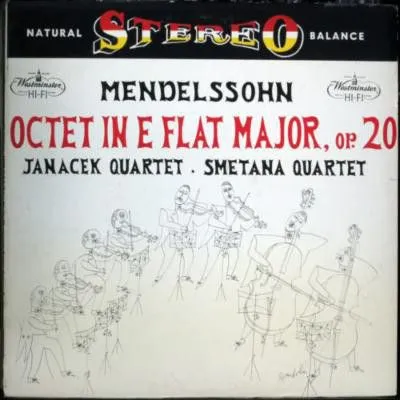
《门德尔松《降E大调八重奏》 /诺瓦克小提琴 ,福尼采克小提琴 ,库斯特基小提琴 ,斯科拉小提琴 ,克拉托赫维尔中提琴 ,斯凯帕中提琴 ,克拉夫卡大提琴 ,科胡特大提琴》
Felix Mendelssohn
,Antonín Kohout
,Lubomír Kostecký
,Adolf Sykora
,Karel Krafka
,Jiri Travnicek
,Jiří Novák
,Jiří Kratochvíl
,Milan Škampa
类型专辑
年份1959
简介
Octet (Mendelssohn)
Felix Mendelssohn'sOctetinE-flat major,Op.20, was composed in the autumn of 1825 and completed on October 15,when the composer was 16. He wrote theoctetas a birthday gift for his friend and violin teacherEduard Ritz[de]; it was slightly revised in 1832 before the first public performance on 30 January 1836 at theLeipzigGewandhaus.Conrad Wilsonsummarizes much of its reception ever since: "Its youthful verve, brilliance and perfection make it one of the miracles of nineteenth-century music."
Structure
The work comprises fourmovements:
Allegro moderato ma con fuoco(E-flat major)
Andante(C minor)
Scherzo: Allegro leggierissimo(G minor)
Presto(E-flat major)
A typical performance of the work lasts around thirty minutes, with the first movement usually comprising roughly half of this.
The scherzo, later scored for orchestra as a replacement for the minuet in the composer'sFirst Symphonyat its premiere, is believed to have been inspired by a section ofGoethe'sFaustentitled "Walpurgis Night's Dream".Fragments of this movement recur in the finale, as a precursor to the "cyclic" technique employed by later 19th-century composers. The entire work is also notable for its extended use of counterpoint, with the finale, in particular, beginning with an eight-part fugato. In this section, Mendelssohn quotes the melody of "And he shall reign forever and ever" from the "Hallelujah Chorus" ofHandel'sMessiah.
The work has been compared toLouis Spohr's 1823Double Quartet No. 1 in D minor, Op. 65.
Instrumentation
The original score is for a doublestring quartetwith fourviolinsand pairs ofviolasandcellos. Mendelssohn instructed in the public score, "This Octet must be played by all the instruments in symphonic orchestral style. Pianos and fortes must be strictly observed and more strongly emphasized than is usual in pieces of this character."
The piece is sometimes played by full string sections using more players for each part as well as an addeddouble basspart which usually (but not always) doubles the second cello part an octave lower. For example,Arturo Toscaninicreated such a version for a performance with theNBC Symphony Orchestrain 1947. More recently in 2009, conductorYoon Jae Leemade a transcription of the first, second, and last movements for full orchestra.
The composer also transcribed the piece as a piano duet with violin and celload. lib.and orchestrated the third movement Scherzo (with compositional alterations) as an alternative third movement to hisSymphony No. 1 in C minor.