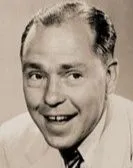
Johnny Mercer 强尼·莫瑟
强尼·莫瑟
J.Mercer / J.莫瑟地区美国
类型个人
职业作曲、作词
艺人资料
John Herndon Mercer(November 18, 1909 – June 25, 1976) was an Americanlyricist,songwriter, andsinger. He was also arecord label executivewho co-foundedCapitol Recordswith music industry businessmanBuddy DeSylvaandGlenn E. Wallichs.
He is best known as aTin Pan Alleylyricist, but he also composed music. He was also a popular singer who recorded his own songs as well as songs written by others. From the mid-1930s through the mid-1950s, many of the songs Mercer wrote and performed were among the most popular hits of the time. He wrote the lyrics to more than 1,500 songs, including compositions for movies andBroadway shows. He received nineteenAcademy Awardnominations, and won fourBest Original Song Oscars.
Early life
Mercer was born inSavannah,Georgia. His father, George Anderson Mercer, was a prominent attorney and real-estate developer, and his mother, Lillian Elizabeth (néeCiucevich), George Mercer's secretary and second wife, was the daughter of aCroatianimmigrant father and a mother with Irish ancestry. Lillian's father was a merchant seaman who ran the Union blockade during the U.S. Civil War.
Mercer was George's fourth son, first by Lillian. His great-grandfather was Confederate GeneralHugh Weedon Mercerand he was a direct descendant ofAmerican Revolutionary WarGeneralHugh Mercer, a Scottish soldier-physician who died at the Battle of Princeton. Mercer was also a distant cousin of GeneralGeorge S. Patton.[3]The construction ofMercer Housein Savannah was started by General Hugh Weedon Mercer in 1860 (although never finished by him; the next owners of the house finished it); it was later the home ofJim Williams, whose trial for murder was the centerpiece ofJohn Berendt's bookMidnight in the Garden of Good and Evil.Neither the General, nor Mercer himself, ever lived there. His mother's father was born inLastovo,Croatiain 1834 to mother Ivana Cucevic and father Marijo Dundovic.
Mercer liked music as a small child and attributed his musical talent to his mother, who would sing sentimental ballads. Mercer's father also sang, mostly old Scottish songs. His aunt told him he was humming music when he was six months old and later she took him to see minstrel and vaudeville shows where he heard "coon songs" and ragtime.[4]The family's summer home "Vernon View" was on the tidal waters and Mercer's long summers there among mossy trees, saltwater marshes, and soft, starry nights inspired him years later.
Mercer's exposure to black music was perhaps unique among the white songwriters of his generation. As a child, Mercer had African-American playmates and servants, and he listened to the fishermen and vendors about him, who spoke and sang in the dialect known as "Geechee". He was also attracted to black church services. Mercer later stated, "Songs always fascinated me more than anything."[6]He had no formal musical training but was singing in a choir by six and at 11 or 12 he had memorized almost all of the songs he had heard and became curious about who wrote them. He once asked his brother who the best songwriter was, and his brother saidIrving Berlin, among the best ofTin Pan Alley.
Despite Mercer's early exposure to music, his talent was clearly in creating the words and singing, not in playing music, though early on he had hoped to become a composer. In addition to the lyrics that Mercer memorized, he was an avid reader and wrote adventure stories. His attempts to play the trumpet and piano were not successful, and he never could read musical scores with any facility, relying instead on his own notation system.
As a teenager in the Jazz Era, he was a product of his age. He hunted for records in the black section of Savannah and played such early black jazz greats asMa Rainey,Bessie Smith, andLouis Armstrong. His father owned the first car in town, and Mercer's teenage social life was enhanced by his driving privilege, which sometimes verged on recklessness.[9]The family would motor to the mountains nearAsheville, North Carolinato escape the Savannah heat and there Mercer learned to dance (fromArthur Murrayhimself) and to flirt with Southern belles, his natural sense of rhythm helping him on both accounts. (Later, Mercer wrote a humorous song called "Arthur Murray Taught Me Dancing in a Hurry".)
Mercer attended the exclusiveWoodberry Forest Schoolin Virginia until 1927. Although not a top student, he was active in literary and poetry societies and as a humor writer for the school's publications. In addition, his exposure to classic literature augmented his already rich store of vocabulary and phraseology. He began to scribble ingenious, sometimes strained, rhymed phrases for later use. Mercer was also the class clown and a prankster, and member of the "hop" committee that booked musical entertainment on campus.
Mercer was already somewhat of an authority on jazz at an early age. His yearbook stated, "No orchestra or new production can be authoritatively termed 'good' until Johnny's stamp of approval has been placed upon it. His ability to 'get hot' under all conditions and at all times is uncanny."Mercer began to write songs, an early effort being "Sister Susie, Strut Your Stuff", and quickly learned the powerful effect songs had on girls.
Given his family's proud history and association withPrinceton, New Jersey, andPrinceton University,Mercer was destined for school there until his father's financial setbacks in the late 1920s changed those plans. He went to work in his father's recovering business, collecting rent and running errands, but soon grew bored with the routine and with Savannah, and looked to escape.
Career
Starting out
Mercer moved to New York in 1928, when he was 19. The music he loved,jazzandblues, was booming inHarlemandBroadwaywas bursting with musicals and revues fromGeorge Gershwin,Cole Porter, andIrving Berlin.Vaudeville, though beginning to fade, was still a strong musical presence. Mercer's first few jobs were as a bit actor (billed as John Mercer). Holed up in a Greenwich Village apartment with plenty of time on his hands and a beat-up piano to play, Mercer soon returned to singing and lyric writing.[14]He secured a day job at a brokerage house and sang at night. Pooling his meager income with that of his roommates, Mercer managed to keep going, sometimes on little more than oatmeal. One night he dropped in onEddie Cantorbackstage to offer a comic song, but although Cantor didn't use the song, he began encouraging Mercer's career.[15]Mercer's first lyric, for the song "Out of Breath (and Scared to Death of You)", composed by friend Everett Miller, appeared in a musical revueThe Garrick Gaietiesin 1930. Mercer met his future wife at the show, chorus girl Ginger Meehan. She had earlier been one of the many chorus girls pursued by the young croonerBing Crosby. Through Miller's father, an executive at the prominent music publisher T. B. Harms, Mercer's first song was published.[16]It was recorded byJoe Venutiand his New Yorkers.
The 20-year-old Mercer began to hang out with other songwriters and to learn the trade. He traveled to California to undertake a lyric writing assignment for the musicalParis in the Springand met his idolsBing CrosbyandLouis Armstrong. Mercer found the experience sobering and realized that he much preferred free-standing lyric writing to writing on demand for musicals. Upon his return, he got a job as staff lyricist for Miller Music for a 25-a-week draw which give him a base income and enough prospects to win over and marry Ginger in 1931.The new Mrs. Mercer quit the chorus line and became a seamstress, and to save money the newlyweds moved in with Ginger's mother inBrooklyn. Johnny did not inform his own parents of his marriage until after the fact, perhaps in part because he knew that Ginger being Jewish would not sit comfortably with some members of his family, and he worried they would try to talk him out of marrying her. In 1932, Mercer won a contest to sing with thePaul Whitemanorchestra, but it did not help his situation significantly. He made his recording debut, singing with Frank Trumbauer's Orchestra, on April 5 of that year. Mercer then apprenticed withYip Harburgon the score forAmericana,a Depression-flavored revue famous for "Brother, Can You Spare a Dime?" (not a Mercer composition), which gave Mercer invaluable training. After several songs which didn't catch fire, during his time with Whiteman, he wrote and sang "Pardon My Southern Accent". Mercer's fortunes improved dramatically with a chance pairing with Indiana-bornHoagy Carmichael, already famous for the standard "Stardust", who was intrigued by the "young, bouncy butterball of a man from Georgia."[18]The two spent a year laboring over "Lazybones", which became a hit one week after its first radio broadcast, and each received a large royalty check of 1250.[19]A regional song in pseudo-black dialect, it captured the mood of the times, especially in rural America. Mercer became a member ofASCAPand a recognized "brother" in theTin Pan Alleyfraternity, receiving congratulations fromIrving Berlin,George Gershwin, andCole Porteramong others. Paul Whiteman lured Mercer back to his orchestra (to sing, write comic skits and compose songs), temporarily breaking up the working team with Carmichael.
During the golden age of sophisticated popular song of the late Twenties and early Thirties, songs were put into revues with minimal regard for plot integration. The 1930s saw a shift from revues to stage and movie musicals using song to further the plot. Demand diminished accordingly for the pure stand-alone songs that Mercer preferred. Thus, although he had established himself in the New York music world, when he was offered a job inHollywoodto compose songs and perform in low-budget musicals forRKO, he accepted and followed idolBing Crosbywest.
Hollywood years
It was only when Mercer moved to Hollywood in 1935 that his career was assured.
Writing songs for movies offered two distinct advantages. The use of sensitive microphones for recording and of the lip-synching of pre-recorded songs liberated songwriters from dependence on the long vowel endings and long sustained notes required for live performance. Performers such asFred AstaireandGinger Rogerscould now sing more conversationally and more nonchalantly. Mercer, as a singer, was attuned to this shift and his style fit the need perfectly.
Mercer's first Hollywood assignment was not the Astaire-Rogers vehicle of which he had dreamed but a B-movie college musical,Old Man Rhythm,to which he contributed two undistinguished songs and even worse acting. His next project,To Beat the Band,was another flop, but it did lead to a meeting and a collaboration withFred Astaireon the moderately successful Astaire song "I'm Building Up to an Awful Let-Down".
Nearly overwhelmed by the glitter of Hollywood, Mercer found his beloved jazz and nightlife lacking. As he wrote, "Hollywood was never much of a night town. Everybody had to get up too early... the movie people were in bed with the chickens (or each other)."[22]Mercer was now in Bing Crosby's hard-drinking circle and enjoyed Crosby's company and hipster talk. Unfortunately, Mercer also began to drink more at parties and was prone to vicious outbursts when under the influence of alcohol, contrasting sharply with his ordinarily genial and gentlemanly behavior.[23]Often he would assuage the guilt he felt for this behavior by sending roses the following day to the friend or acquaintance he had treated unkindly while drunk.
Mercer's first big Hollywood song "I'm an Old Cowhand from the Rio Grande" was inspired by a road trip throughTexas(he wrote both the music and the lyric). It was performed by Crosby in the filmRhythm on the Rangein 1936, and from thereon the demand for Mercer as a lyricist took off. His second hit that year was "Goody Goody". In 1937, Mercer began employment with the Warner Brothers studio, working with the veteran composerRichard Whiting(Ain't We Got Fun?), soon producing his standard, "Too Marvelous for Words", followed by "Hooray for Hollywood". After Whiting's sudden death from a heart attack, Mercer joined forces withHarry Warrenand created "Jeepers Creepers", which earned Mercer his firstOscar nomination for Best Song(1938). It was given a memorable recording byLouis Armstrong. Another hit with Warren in 1938 was "You Must Have Been a Beautiful Baby". The pair also created "Hooray for Spinach", a comic song produced for the filmNaughty but Nicein 1939.
During a lull at Warners, Mercer revived his singing career. He joined Bing Crosby's informal minstrel shows put on by the "Westwood Marching and Chowder Club", which included many Hollywood luminaries and brought together Crosby andBob Hope.[25]A duet "Mr. Crosby and Mr. Mercer" was recorded and became a hit in 1938.
In 1939, Mercer wrote the lyrics to a melody byZiggy Elman, a trumpet player withBenny Goodman. The song was "And the Angels Sing" and, although recorded byBing CrosbyandCount Basie, it was the Goodman version with vocal byMartha Tiltonand memorableklezmerstyle trumpet solo by Elman that became the Number One hit. Years later, the title was inscribed on Mercer's tombstone.
Mercer was invited to theCamel Caravanradio show in New York to sing his hits and create satirical songs with theBenny Goodmanorchestra, then becoming the emcee of the nationally broadcast show for several months. Two more hits followed shortly, "Day In, Day Out" and "Fools Rush In", and Mercer in short order had five of the top ten songs on the popular radio showYour Hit Parade.Mercer also started a short-lived publishing company during his stay in New York. On a lucky streak, Mercer undertook a musical withHoagy Carmichael, butWalk with Music(originally calledThree After Three) was a bomb, with story quality not matching that of the score. Another disappointment for Mercer was the selection ofJohnny Burkeas the long-term songwriter for the Hope-Crosby "Road" pictures. Still, Mercer was thirty and his life and career were riding high.
Shortly thereafter, Mercer met an ideal musical collaborator in the form ofHarold Arlenwhosejazzandblues-influenced compositions provided Mercer's sophisticated, idiomatic lyrics a perfect musical vehicle. Now Mercer'slyricsbegan to display the combination of sophisticated wit and southern regional vernacular that characterize some of his best songs. Their first hit was "Blues in the Night" (1941), whichArthur Schwartzclaimed was "probably the greatest blues song ever written."
They went on to compose "One for My Baby (and One More for the Road)" (1941), "That Old Black Magic" (1942),[28]andCome Rain or
Come Shine" (1946) among others.
Frank Sinatra was particularly successful with the first two and Bing Crosby with the third. "Come Rain" was Mercer's only Broadway hit, composed for the showSt. Louis WomanwithPearl Bailey. "On the Atchison, Topeka and the Santa Fe" with music by Harry Warren, was a big smash forJudy Garlandin the 1946 filmThe Harvey Girls, and earned Mercer the first of his fourAcademy Awards for Best Song, after eight unsuccessful nominations.
Mercer re-united with Hoagy Carmichael with "Skylark" (1941),[28]and theOscar-winning"In the Cool, Cool, Cool of the Evening" (1951). WithJerome Kern, Mercer createdYou Were Never LovelierforFred AstaireandRita Hayworthin the movie of the same name,[28]as well as "I'm Old Fashioned".
Mercer foundedCapitol Recordsin Hollywood in 1942, with the help of producerBuddy DeSylvaand record store owner Glen Wallichs.[1]He also co-foundedCowboy Records.
Mercer by the mid-1940s enjoyed a reputation as one of the premier Hollywood lyricists. He was adaptable, listening carefully and absorbing a tune and then transforming it into his own style. LikeIrving Berlin, he was a close follower of cultural fashion and changing language, which in part accounted for the long tenure of his success. Mercer preferred to have the music first, taking it home and working on it. He claimed composers had no problem with this method provided that he returned with the lyrics. Only with Arlen and Whiting did Mercer occasionally work side-by-side.
Mercer was often asked to write new lyrics to already popular tunes. The lyrics to "Laura", "Midnight Sun", and "Satin Doll" were all written after the melodies had become hits. He was also asked to compose English lyrics to foreign songs, the most famous example being "Autumn Leaves". based on the French "Les Feuilles Mortes".
Radio programs
In 1943,Johnny Mercer's Music Shopwas a summer replacement forThe Pepsodent Showon NBC.[30]Mercer was the star, and singersElla Mae MorseandJo Staffordwere regulars on the program, with musical support fromThe Pied PipersandPaul Westonand his orchestra.[31]The Chesterfield Music Shop, a similar program in a 15-minute version, was broadcast in 1944.
1950s–1970s
In the 1950s, the advent of rock and roll and the transition of jazz into "bebop" cut deeply into Mercer's natural audience, and dramatically reduced venues for his songs. His continual string of hits came to an end but many great songs were still to come. Mercer wrote for someMGMfilms, includingSeven Brides for Seven Brothers(1954) andMerry Andrew(1958). He collaborated on three Broadway musicals in the 1950s—Top Banana(1951),Li'l Abner(1956), andSaratoga(1959).
Mercer made occasional television appearances. In the 1953–1954 season, he guest starred as himself onABC'sJukebox Jury,a musical/quiz program on which celebrities judge the latest releases from the recording companies.[32]In 1954, he appeared onNBC'sThe Donald O'Connor Show.
His more successful songs of the 1950s include "The Glow-Worm" (sung by theMills Brothers) and "Something's Gotta Give". In 1961, he wrote the lyrics to "Moon River" for Audrey Hepburn inBreakfast at Tiffany'sand forDays of Wine and Roses,both with music by Henry Mancini, and Mercer received his third and fourth Oscars for Best Song. The back-to-back Oscars were the first time a songwriting team had achieved that feat.[33]Mercer, also with Mancini, wrote "Charade" for the 1963Cary Grant-Audrey Hepburnromantic thrillerwith the same name. TheTony Bennettclassic "I Wanna Be Around" was written by Mercer in 1962, as was the Sinatra hit "Summer Wind" in 1965.
An indication of the high esteem in which Mercer was held can be observed in that in 1964 he became the only lyricist to have his work recorded as a volume ofElla Fitzgerald's celebratedSongbookalbumsfor theVervelabel. Yet Mercer always remained humble about his work, attributing much to luck and timing. He was fond of telling the story of how he was offered the job of doing the lyrics forJohnny Mandel's music onThe Sandpiper,only to have the producer turn his lyrics down. The producer offered the commission toPaul Francis Websterand the result was "The Shadow of Your Smile" which became a huge hit, winning the1965 OscarforBest Original Song. However, Mercer and Mandel did collaborate on the 1964 song,Emily, from the motion picture,The Americanization of EmilystarringJulie Andrews.
In 1969, Mercer helped publishersAbe OlmanandHowie Richmondfound theNational Academy of Popular Music's Songwriters Hall of Fame. In 1971, Mercer presented a retrospective of his career for the "Lyrics and Lyricists Series" in New York, including an omnibus of his "greatest hits" and a performance byMargaret Whiting. It was recorded live asAn Evening with Johnny Mercer.[34]In 1974, he collaborated on the West End productionThe Good Companions. He also recorded two albums of his songs in London in 1974, with the Pete Moore Orchestra and with the Harry Roche Constellation, later compiled into a single album and released as...My Huckleberry Friend: Johnny Mercer Sings the Songs of Johnny Mercer.
Personal life
In 1931, Mercer married Ginger Meehan, a chorus girl, later a seamstress; and in 1940, when he was 30, the Mercers adopted a daughter, Amanda ("Mandy"). In 1960, Mandy married Bob Corwin, pianist for Peggy Lee, Anita O'Day, Carmen McRae, and Mercer's long time accompanist. They had a son Jim Corwin in 1961.
In 1941, shortly after the death of his father, Mercer began an affair with 19-year-oldJudy Garlandwhile she was engaged to composerDavid Rose. Garland married Rose to stop the affair, but the effect on Mercer lingered, adding to the emotional depth of his lyrics. Their affair revived later. Mercer stated that his song "I Remember You" was the most direct expression of his feelings for Garland.
Death
Mercer died on June 25, 1976, from an inoperable brain tumor in theBel Airneighborhood ofLos Angeles, California. Mercer was buried in Savannah's historicBonaventure Cemetery.[37]The simple line drawing caricature adorning hismemorial benchis in fact a reproduction of a self-portrait.
Singing style
Well regarded also as asinger, with a folksy quality, Mercer was a natural for his own songs such as "Ac-Cent-Tchu-Ate the Positive", "On the Atchison, Topeka and the Santa Fe", "One for My Baby (and One More for the Road)", and "Lazybones". He was considered a first-rate performer of his own work.
It has been said that he penned "One for My Baby (and One More for the Road)"—one of the greattorch lamentsof all times—on a napkin while sitting at the bar atP. J. Clarke'swhen Tommy Joyce was the bartender. The next day Mercer called Joyce to apologize for the line "So, set 'em up, Joe," explaining "I couldn't get your name to rhyme."
ATCO Records issuedTwo of a Kindin 1961, a duet album byBobby Darinand Johnny Mercer withBilly Mayand his Orchestra, produced byAhmet Ertegün.
Posthumous success
Self-portrait and signature of Johnny Mercer from bench at his grave inBonaventure CemeteryinSavannah, Georgia.
In his last year, Mercer became fond of pop singerBarry Manilow, in part because Manilow's first hit record was of a song titled "Mandy", which was also the name of Mercer's daughter Amanda. After Mercer's death in 1976 from a brain tumor, his widow, Ginger Mehan Mercer, arranged to give some unfinished lyrics he had written to Manilow to possibly develop into complete songs. Among these was a piece titled "When October Goes", a melancholy remembrance of lost love. Manilow applied his own melody to the lyric and issued it as a single in 1984, when it became a top 10 Adult Contemporary hit in the United States. The song has since become a jazz standard, with notable recordings byRosemary Clooney,Nancy Wilson, andMegon McDonough, among other performers.
In 1980, the Songwriters Hall of Fame established the annualJohnny Mercer Awardas its highest honor, for songwriters with a history of outstanding creative works.[38]Mercer was honored by theUnited States Postal Servicewith his portrait placed on astampin 1996. Mercer's star on theHollywood Walk of Fameat 1628 Vine Street[39]is a block away from the Capitol Records building at 1750 Vine Street.
In 1983, Mercer earned a posthumous nomination for aTony Award for Best Original Scorefor his original lyrics and for Gene de Paul's original music and score with new songs byAl KashaandJoel Hirschhornfor the stage musicalSeven Brides for Seven Brothersat the37th Tony Awards,[40]but lost toAndrew Lloyd WebberandT. S. EliotforCats.
Mercer was given tribute inJohn Berendt's 1994 bookMidnight in the Garden of Good and Evil.The1997 movie by Clint Eastwoodbased on Berendt's novel features prominentlyHoagy Carmichael/Johnny Mercer song "Skylark", sung byk.d. lang. Themovie soundtrackis a tribute album to Johnny Mercer, containing 14 Mercer songs performed by a variety of jazz and pop recording artists.
For the occasion of Mercer's 100th birthday in 2009Clint Eastwoodproduced a documentary film on Johnny Mercer's life and work calledThe Dream's on Me(Turner Classic Movies). After airing on Turner Classic Movies, the film was nominated for aPrimetime Emmyin the category of Outstanding Nonfiction Special.
The Complete Lyrics of Johnny Mercerwas published byKnopf[41]in October 2009.The Complete Lyricscontains the texts to nearly 1,500 of his lyrics, several hundred of them appearing in print for the first time.
In November 2009, a bronze statue of Mercer was unveiled in Ellis Square inSavannah, Georgia, his hometown and birthplace. It was commissioned by the Friends of Johnny Mercer.
The Johnny Mercer Collections, including his papers and memorabilia, are preserved in the library ofGeorgia State Universityin Atlanta. GSU occasionally holds events showcasing Mercer's works.
from:http://www.wikizero.biz/index.php?q=aHR0cHM6Ly9lbi53aWtpcGVkaWEub3JnL3dpa2kvSm9obm55X01lcmNlcg