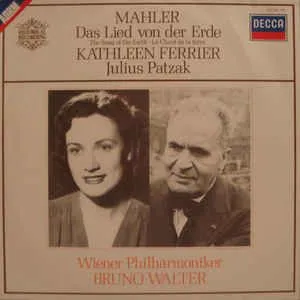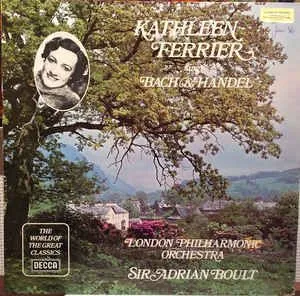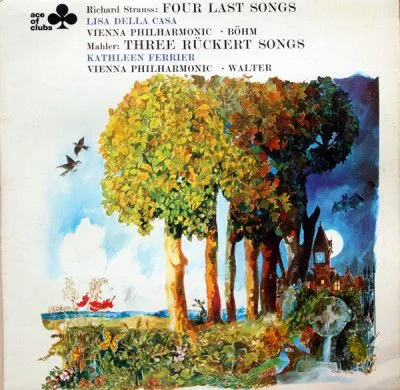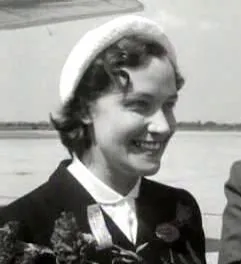
Kathleen Ferrier 凯瑟琳·费里尔
凯瑟琳·费里尔
K·Ferrier / K·费里尔类型个人
职业女高音
艺人资料
Kathleen Mary Ferrier,CBE(22 April 1912– 8 October 1953) was an Englishcontraltosinger who achieved an international reputation as a stage, concert and recording artist, with a repertoire extending from folksong and popular ballads to the classical works ofBach,Brahms,MahlerandElgar. Her death from cancer, at the height of her fame, was a shock to the musical world and particularly to the general public, which was kept in ignorance of the nature of her illness until after her death.
The daughter of a Lancashire village schoolmaster, Ferrier showed early talent as a pianist, and won numerous amateur piano competitions while working as a telephonist with the General Post Office. She did not take up singing seriously until 1937, when after winning a prestigious singing competition at the Carlisle Festival she began to receive offers of professional engagements as a vocalist. Thereafter she took singing lessons, first with J.E. Hutchinson and later with Roy Henderson. After the outbreak of the Second World War Ferrier was recruited by the Council for the Encouragement of Music and the Arts (CEMA), and in the following years sang at concerts and recitals throughout the UK. In 1942 her career was boosted when she met the conductor Malcolm Sargent, who recommended her to the influential Ibbs and Tillett concert management agency. She became a regular performer at leading London and provincial venues, and made numerous BBC radio broadcasts.
In 1946, Ferrier made her stage debut, in the Glyndebourne Festival premiere of Benjamin Britten's opera The Rape of Lucretia. A year later she made her first appearance as Orfeo in Gluck's Orfeo ed Euridice, a work with which she became particularly associated. By her own choice, these were her only two operatic roles. As her reputation grew, Ferrier formed close working relationships with major musical figures, including Britten, Sir John Barbirolli, Bruno Walter and the accompanist Gerald Moore. She became known internationally through her three tours to the United States between 1948 and 1950 and her many visits to continental Europe.
Ferrier was diagnosed with breast cancer in March 1951. In between periods of hospitalisation and convalescence she continued to perform and record; her final public appearance was as Orfeo, at the Royal Opera House in February 1953, eight months before her death. Among her many memorials, the Kathleen Ferrier Cancer Research Fund was launched in May 1954. The Kathleen Ferrier Scholarship Fund, administered by the Royal Philharmonic Society, has since 1956 made annual awards to aspiring young professional singers.
The news of Ferrier's death came as a considerable shock to the public. Although some in musical circles knew or suspected the truth, the myth had been preserved that her absence from the concert scene was temporary.The opera critic Rupert Christiansen, writing as the 50th anniversary of Ferrier's death approached, maintained that "no singer in this country has ever been more deeply loved, as much for the person she was as for the voice she uttered". Her death, he continued, "quite literally shattered the euphoria of the Coronation" (which had taken place on 2 June 1953). Ian Jack, editor of Granta, believed that she "may well have been the most celebrated woman in Britain after the Queen." Among the many tributes from her colleagues, that of Bruno Walter has been highlighted by biographers: "The greatest thing in music in my life has been to have known Kathleen Ferrier and Gustav Mahler—in that order." Very few singers, Lord Harewood writes, "have earned so powerful a valedictory from so senior a colleague." At a memorial service at Southwark Cathedral on 14 November 1953 the Bishop of Croydon, in his eulogy, said of Ferrier's voice: "She seemed to bring into this world a radiance from another world."
From time to time commentators have speculated on the directions Ferrier's career might have taken had she lived. In 1951, while recovering from her mastectomy, she received an offer to sing the part of Brangäne in Wagner's opera Tristan und Isolde at the 1952 Bayreuth Festival. According to Christiansen she would have been "glorious" in the role, and was being equally sought by the Bayreuth management to sing Erda in the Ring cycle.Christiansen further suggests that, given the changes of style over the past 50 years, Ferrier might have been less successful in the 21st century world: "We dislike low-lying voices, for one thing—contraltos now sound freakish and headmistressy, and even the majority of mezzo-sopranos should more accurately be categorised as almost-sopranos". However, she was "a singer of, and for, her time—a time of grief and weariness, national self-respect and a belief in human nobility". In this context "her artistry stands upright, austere, unfussy, fundamental and sincere".
Shortly after Ferrier's death an appeal was launched by Barbirolli, Walter, Myra Hess and others, to establish a cancer research fund in Ferrier's name. Donations were received from all over the world. To publicise the fund a special concert was given at the Royal Festival Hall on 7 May 1954, at which Barbirolli and Walter shared the conducting duties without payment. Among the items was a rendition of Purcell's When I am laid in earth, which Ferrier had often sung; on this occasion the vocal part was played by a solo cor anglais. The Kathleen Ferrier Cancer Research Fund helped establish the Kathleen Ferrier Chair of Clinical Oncology at University College Hospital, in 1984. As of 2012, it was continuing to fund oncology research.
As the result of a separate appeal, augmented by the sales proceeds of a memoir edited by Neville Cardus, the Kathleen Ferrier Memorial Scholarship Fund was created to encourage young British and Commonwealth singers of either sex. The Fund, which has operated from 1956 under the auspices of the Royal Philharmonic Society, initially provided an annual award covering the cost of a year's study to a single prizewinner. With the advent of additional sponsors, the number and scope of awards has expanded considerably since that time; the list of winners of Ferrier Awards includes many singers of international repute, among them Felicity Palmer, Yvonne Kenny, Lesley Garrett and Bryn Terfel. The Kathleen Ferrier Society, founded in 1993 to promote interest in all aspects of the singer's life and work, has since 1996 awarded annual bursaries to students at Britain's major music colleges. In 2012, the Society organised a series of events to commemorate the centenary of Ferrier's birth and in February 2012 Ferrier was one of ten prominent Britons honoured by the Royal Mail in the "Britons of Distinction" stamps set. Another was Frederick Delius.
A biographic documentary film, Kathleen Ferrier, also known as La vie et l'art de Kathleen Ferrier – Le chant de la terre was directed by Diane Perelsztejn and produced by ARTE France in 2012. It featured interviews with her near relatives, friends and colleagues to produce a fresh view of her life and contributions to the arts. Kathleen Ferrier Crescent, in Basildon, Essex, is named in her honour.
From:<a href="<a href=" https:="" en.wikipedia.org="" wiki="" '="">https://en.wikipedia.org/wiki/'>https://en.wikipedia.org/wiki/Kathleen Ferrier