Christoph von Dohnányi 克利斯托夫·冯·多纳伊
克利斯托夫·冯·多纳伊
C·V·Dohnányi / C·V·多纳伊地区德国
类型个人
职业指挥
艺人资料
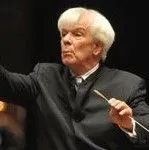
Christoph von Dohnányi ( born 8 September 1929) is a German conductor. Dohnányi was born in Berlin, Germany to jurist Hans von Dohnányi and Christine Bonhoeffer. His uncle on his mother's side, and also his godfather, was Dietrich Bonhoeffer, a Lutheran pastor and theologian/ethicist. His grandfather was the pianist and composer Ernő Dohnányi, also known as Ernst von Dohnányi. His father, uncle and other family members participated in the German Resistance movement against Nazism, and were arrested and detained in several Nazi concentration campsbefore being executed in 1945, when Christoph was 15 years old. Dohnányi's older brother is Klaus von Dohnányi, a German politician and former mayor ofHamburg. After World War II, Dohnányi studied law in Munich, but in 1948 he transferred to the Hochschule für Musik und Theater München to study composition, piano and conducting. At the opera in Munich, he was a stage extra, coached singers, and was a house pianist. He received the Richard Strauss Prize from the city of Munich, and then went to Florida State University to study with his grandfather. His first position as assistant was at the Frankfurt Opera, appointed by Georg Solti, where he also served as a ballet and opera coach. He was general musical director of the Lübeck Opera from 1957 to 1963, then Germany's youngest GMD. He also served as chief conductor of the Staatsorchester Kassel. He also served as chief conductor of the WDR Symphony Orchestra Cologne. In 1968, he succeeded Solti as general music director and later "director" at the Frankfurt Opera and served in both capacities until 1977. He took the positions of intendant and chief conductor with the Hamburg State Opera in 1977, and relinquished those posts in 1984. As director of the Frankfurt Opera and with his team including Gerard Mortier (Director of Théâtre de la Monnaie, Brussels, Salzburg Festival, Opéra de Paris), Peter Mario Katona (Director of Casting at ROH Covent Garden) and Klaus Schultz, Dramaturg in Munich (Bayerische Staatsoper) and Berlin (Philharmonic Orchestra), then General Manager of the Stadttheater Aachen, Nationaltheater Mannheim, and Gärtnerplatztheater in Munich, the balance in programming of traditional opera performance and innovative Musiktheater, promoting the idea of Regietheater, established Frankfurt opera as a leading house at that time. He continued this concept in Hamburg. Dohnányi's fame stems largely from his relationship with the Cleveland Orchestra that spanned two decades. He made his conducting debut with the orchestra in December 1981, and soon after was appointed music director designate from 1982 to 1984 and consequently served as music director from the 1984-85 season until August 2002. At the time of Dohnányi's appointment, he was relatively unknown compared to previous musical director George Szell, with whom the Cleveland Orchestra "achieved what was probably the highest executant standard of any orchestra in the world" according to music critic Theodore Libbey. Dohnányi and Szell had a similar micro-managerial conducting style, and in Dohnányi's tenure with the Cleveland Orchestra, the orchestra pursued an active touring and recording schedule, being often described as the finest in the United States, "more or less on a par with the august philharmonics of Vienna and Berlin", according to theNew York Times. In spite of such praise, Dohnányi's name was often mentioned only after Szell's in concert reviews. Dohnányi remarked in the late 1980s, "We give a great concert...and George Szell gets a great review." Dohnányi was named the first ever "Music Director Laureate of the Cleveland Orchestra" upon his retirement in 2002. During his tenure, Severance Hall in Cleveland underwent a substantial extension and renovation, bringing back the Norton Memorial Organ that had been banned from stage during George Szell's tenure. As Music Director he initiated the foundation of The Cleveland Orchestra Youth Orchestra. The Cleveland Orchestra Youth Chorus was founded as well, both organisations being active in Northeast Ohio for the education in and enhancement of symphonic music. From 1998 to 2000 Dohnányi was also Artistic Advisor of the Orchestre de Paris. In 1994, Dohnányi became the principal guest conductor of London's Philharmonia Orchestra, and in 1997 their Principal Conductor. In April 2007, Dohnányi was one of eight conductors of British orchestras to endorse the 10-year classical music outreach manifesto, "Building on Excellence: Orchestras for the 21st Century", to increase the presence of classical music in the UK, including giving free entry to all British schoolchildren to a classical music concert.In 2008, he stepped down from the Philharmonia principal conductorship and now holds the title with the orchestra of "Honorary Conductor for Life". After retiring as music director of the Cleveland Orchestra, Dohnányi has been a guest conductor with the Boston Symphony, New York Philharmonic, Philadelphia Orchestra, Pittsburgh Symphony, Chicago Symphony and Los Angeles Philharmonic, as well as the Cleveland Orchestra. He has performed frequently at the Tanglewood Music Festival with the Boston Symphony Orchestra. A regular collaboration has developed with the Israel Philharmonic Orchestra since the 1990s. In 2004, Dohnányi returned to Hamburg, Germany where he maintained a residence for many years, to become chief conductor of the NDR Symphony Orchestra. He concluded his NDR tenure after the 2009-2010 season. He has been a frequent guest conductor in concert with the Vienna Philharmonic and at the Vienna State Opera. With the Philharmonia Orchestra, Dohnányi performed throughout Europe at such venues as the Musikverein in Vienna, the Salzburg Festival, Amsterdam'sConcertgebouw, the Lucerne Festival, and Paris's Théâtre des Champs Elyseés. For several seasons, Dohnányi and the Philharmonia Orchestra were in residence at theThéâtre du Châtelet in Paris, performing new productions of Richard Strauss's operas Arabella, Die Frau ohne Schatten and Die schweigsame Frau, Arnold Schoenberg'sMoses und Aron, Igor Stravinsky's Oedipus Rex and Engelbert Humperdinck's Hänsel und Gretel. At the Opernhaus Zürich, Dohnányi led new productions of Moses and Aron, Oedipus Rex (with Béla Bartók's Bluebeard's Castle), Strauss's Die Schweigsame Frau, Ariadne auf Naxos, Salome, Elektra, and Die Frau ohne Schatten, Mozart'sIdomeneo, Giuseppe Verdi's Un Ballo in Maschera, and Richard Wagner's The Flying Dutchman.