米克·弗利特伍德 (Mick Fleetwood)
米克·弗利特伍德
M·Fleetwood / M·弗利特伍德类型个人
艺人资料
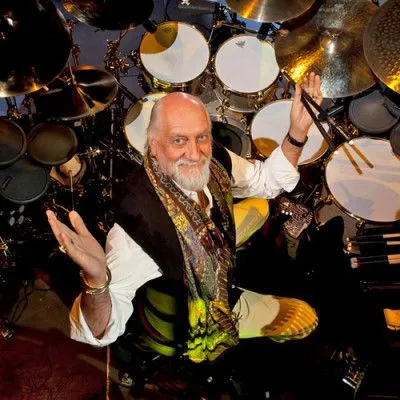
Michael John Kells Fleetwood (born 24 June 1947) is a British musician and actor, best known for his role as the drummer and co-founder of the rock band Fleetwood Mac. Fleetwood, whose surname was merged with that of the group's bassist John "Mac" McVie to form the name of the band, was inducted into the Rock and Roll Hall of Fame in 1998.
Born in Redruth, Fleetwood lived in Egypt and Norway for many of his childhood years as his father travelled with the Royal Air Force. Choosing to follow his musical interests, Fleetwood travelled to London at the age of 15, eventually combining with Peter Green, Jeremy Spencer and Bob Brunning, at Green's behest, to become the first incarnation of Fleetwood Mac. Fleetwood would remain the only member to stay with the band through its ever-changing line-up.
After several album releases and line-up changes, the group moved to the United States in 1974 in an attempt to boost the band's success. Here Fleetwood invited Lindsey Buckingham and Stevie Nicks to join. Buckingham and Nicks contributed to much of Fleetwood Mac's later commercial success, including the celebrated album Rumours, while Fleetwood's own determination to keep the band together was essential to the band's longevity He has also enjoyed a solo career, published written works, and flirted briefly with acting and vinification.
Michael John Kells Fleetwood was born in Redruth, second child to John Joseph Kells Fleetwood and Bridget Maureen (née Brereton) Fleetwood. His elder sister Susan Fleetwood, who died of cancer in 1995, became an actress.In early childhood Fleetwood and his family followed his father, a Royal Air Force fighter pilot,to Egypt. After about six years, they moved to Norway where his father was posted on a NATO deployment. He attended school there and became fluent in Norwegian.
Biographer Cath Carroll describes the young Fleetwood as "a dreamer, an empathetic youth" who, though intelligent, did not excel academically. According to his own autobiography, Fleetwood had an extremely difficult and trying time academically at the English boarding schools he attended, including King's School, Sherborne, Gloucestershire, and Wynstones School, also in Gloucestershire. He performed poorly on exams, which he attributes to his persistent inability to commit facts to memory. He nevertheless enjoyed acting during school, often in drag, and was a competent fencer. At 6'6", he was an imposing figure, and sported a beard and long hair for much of his life. "Mick was very aristocratic," recalls Ken Caillat, a sound engineer on Rumours. "The way he formed sentences was impeccable. When he spoke, everyone stopped and listened. He was quiet and wise, and he had a great sense of humour. He loved to laugh, but he was also a straight shooter."
Diverting from academic pursuits, Fleetwood took up the drums at a young age, grateful to his parents for their recognition that it was in music that he may find a future and their purchasing for him of a small "Gigster" drum kit when he was thirteen. His family encouraged his artistic side, his father composed poetry and was an amateur drummer himself. Fleetwood's early drumming was inspired by Cliff Richards' drummer in The Shadows, Tony Meehan, as well as that of the Everly Brothers. With his parents' support, he dropped out of school aged 15; and, in 1963, moved to London to pursue a career as a drummer. At first he stayed with his sister in Notting Hill. After a brief stint working at Liberty in London, he found his first opportunity in music.
Keyboard player Peter Bardens lived only a few doors away from Fleetwood's first home in London, and upon hearing of the proximity of an available drummer, Bardens gave Fleetwood his first gig in Bardens' band 'The Cheynes' in July 1963, thus seeding the young drummer's musical career. It would take him from The Cheynes – with whom he supported early gigs by the Rolling Stones and the Yardbirds – to stints in The Bo Street Runners, where he replaced original drummer Nigel Hutchinson, who had enjoyed brief television fame on Ready Steady Go!. However by April 1965, when Fleetwood joined the band, it was fading into obscurity. By February 1966 Bardens, who had left the group, called on Fleetwood to join his new band, the 'Peter Bs', which soon expanded to become 'Shotgun Express' (with Rod Stewart). Peter Green, who was a guitarist in the Peter Bs, left to join John Mayall & the Bluesbreakers, followed by Fleetwood in April 1967. His new band already featured John McVie.
Green became a supportive bandmate who helped Fleetwood in his early experimentation with the drum kit.[ In his personal life meanwhile, Fleetwood soon became infatuated with model Jenny Boyd, the sister of whom, Pattie Boyd, would be wife to both George Harrison and Eric Clapton. He was, however, dismissed from the Bluesbreakers for repeated insobriety during gigs. Both Fleetwood and McVie were heavy drinkers, and their combined efforts were too much for Mayall and the band to cope with.Green, feeling trapped within the Bluesbreakers, also left in June 1967. Recalling "his favourite rhythm section, 'Fleetwood Mac'" – Mick Fleetwood and John McVie – Green elected to invite both to join him in his new band, Fleetwood Mac. Though McVie hesitated briefly due to financial reasons, both joined Green by the summer of 1967 with a record contract on the horizon.
The initial incarnation of Fleetwood Mac performed its first gig in August 1967 at the seventh annual Windsor Jazz and Blues Festival, playing a Chicago-style blues.McVie, initially hesitant to commit, was later prompted to leave the Bluesbreakers and join Fleetwood Mac full-time when the former adopted a horns section with which he disagreed. He replaced the initial bassist, Bob Brunning. McVie, Fleetwood, Green and guitarist Jeremy Spencer thus formed the first fixed line-up of Fleetwood Mac.
The band's first album, Peter Green's Fleetwood Mac, was released in 1968, and the band toured the United States for the first time, though Green was reluctant to do so for fear of gun crime. Upon their return, they recorded a second album, Mr. Wonderful under simply "Fleetwood Mac" with Green's name dropped. A guest musician on the album, Christine Perfect, became close with the group and she and McVie were married in 1968. A third guitarist, Danny Kirwan, was also added to the line-up. Despite the success of their third album, Then Play On, and a string of hit singles including "Albatross" and "Man of the World", Green himself drifted away from the band, struggling both creatively and with increasing use of LSD. He later joined a Christian religious group.
Fleetwood himself later remarked on the growing stature of Green's difficulties: "I think there is certainly some credence given to the idea that Peter's condition could in some way be blamed on a bad acid trip he had in Germany ... I don't think it did him much good." He also recalled in 1995 that "Peter basically ceased to see the light with Fleetwood Mac and had aspirations of playing for nothing in strange places—none of which really happened. He made several interesting albums after he left, then basically took a left turn in terms of his psyche. He pulled out of the mainstream and chose to stay at home. He doesn't play much anymore, which is certainly a shame, because he's my mentor, and he's the reason that Fleetwood Mac became what we became."
摘自:<a href="<a href=" https:="" en.wikipedia.org="" wiki="" '="">https://en.wikipedia.org/wiki/'>https://en.wikipedia.org/wiki/Mick Fleetwood