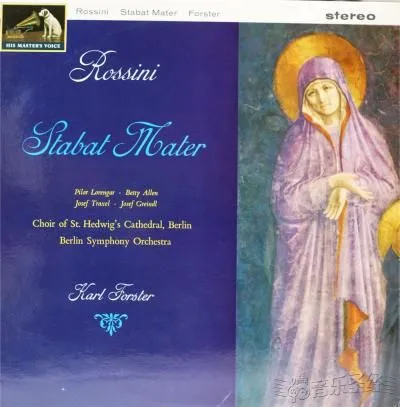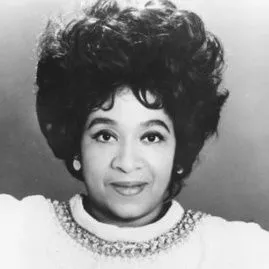
Betty Allen 贝蒂·艾伦
贝蒂·艾伦
B·Allen / B·艾伦类型个人
职业女低音
艺人资料
Betty Allen (17 March 1927 – 22 June 2009) was a renowned American operatic mezzo-soprano who had an active international singing career during the 1950s through the 1970s. In the latter part of her career her voice acquired a contralto-like darkening, which can be heard on her recording of Sergei Prokofiev’s Alexander Nevsky with conductor Eugene Ormandy and the Philadelphia Orchestra. She was known for her collaborations with American composers, such as Leonard Bernstein, Aaron Copland, David Diamond, Ned Rorem, and Virgil Thomsonamong others. Allen was part of the first generation of black opera singers to achieve wide success and is viewed as part of an instrumental group of performers who helped break down the barriers of racial prejudice in the opera world. She was greatly admired by Bernstein and the conductor notably chose her to be the featured soloist for his final performances as music director of the New York Philharmonic in 1973. After her singing career ended, she became a lauded voice teacher and arts administrator. Early life and education She was born Elizabeth Louise Allen, (or Betty Lou) in Campbell, Ohio, near Youngstown. Her father was a college educated math teacher who worked in a steel mill as racial prejudice prevented him from being hired in the public school system during the 1930s. Her mother earned extra money for the family by washing other people's laundry. When she was 12, Allen's mother died of cancer. Afterwords her father fell into depression and alcoholism, causing Allen to leave home as a young teanager by her own choice. She spent the rest of her youth living in foster homes. In 1943 Allen entered Wilberforce College in Xenia, Ohio, where she majored in languages. While there she was encouraged to pursue a singing career by tenor Theodor Heimann. Heimann also got her involved with the school's choir, whose membership also included a young Leontyne Price. Price and Allen became friends while singing in the choir together. After graduating she entered Connecticut's Hartford School of Music in 1947 on a scholarship where she earned a bachelor's degree in vocal performance. After graduating she moved to New York City where she continued with further studies under Sarah Peck More, Paul Ulanowsky, and Zinka Milanov. Early singing career:1950s Allen's first major performance came in 1951 while studying at the Tanglewood Music Festival's Berkshire Music Center. At Tanglewood, she was chosen by Leonard Bernstein to be the mezzo-soprano soloist in a presentation of his Jeremiah Symphony with the Boston Symphony Orchestra. She made her opera début the following year as the Commère in Virgil Thomson’s Four Saints in Three Acts at the August Wilson Theatre in a production mounted by the American National Theater and Academy. She later recorded that role for the opera's first complete recording. In 1952 she won the Marian Anderson Award after winning its namesake's singing competition in Philadelphia. Allen's next forray into opera came on June 6, 1954 when she participated in the world premiere of Sam Raphling's Tin Pan Alley on a radio broadcast on WNYC. On July 1, 1954 she sang the part of Prince Orlofsky in a concert version of Johann Strauss II's Die Fledermaus at the Lewisohn Stadiumunder conductor Tibor Kozma On October 28, 1954 she made her New York City Opera (NYCO) debut as Queenie in Show Boat. She spent the rest of the 1954-1955 season performing in a tour of France and North Africa after being selected by the National Music League and the Jeunesses Musicales International to participate in an artist exchange program between the United States and France. In January 1955 Allen sang the part of the Israelite Messenger in Handel's Judas Maccabaeus with tenor Walter Carringer in the title role, theInterracial Fellowship Chorus, and conductor Harold Aks. With The Dessoff Choirs and conductor Paul Boepple she was a soloist in Claudio Monteverdi's Vespro della Beata Vergine 1610 in a concert sponsored by the Baron Carlo de Ferraris Salzano, Consul General of Italy at Carnegie Hallon April 28, 1955. She then spent the next several months on a European recital tour where she was received warmly. On January 14, 1957 Allen excited much attention for her portrayal of the title heroine in Arthur Honegger's Judith in a concert performance of the work with the American Concert Choir and Orchestra under conductor Margaret Hillis at Town Hall. Critic Edward Downes said of her performance, "Allen sang the music of the first two acts without apparent effort. Her voice had a rich, true mezzo-soprano quality with a brilliant top, and dark reedy chest tones. It was so beautifully placed and focused that it gave the impression of being larger than it was. Her piano and even pianissimo singing had the velvet quality that carries so beautifully through an auditorium. She was a figure of regal dignity, yet she showed dramatic temperament, too."In December 1957 she was a soloist in the Oratorio Society of New York's performances of Handel's Messiah. In January 1958 Allen made her New York recital debut at Town Hall to a warm reception. The following March she gave a critically acclaimed performance of Ernest Chausson's Chanson perpétuelle and Maurice Ravel's Chansons madécasses with the New York Chamber Music Ensemble and pianistLeonid Hambro. In December 1958 she sang the world premiere of Julia Perry's Stabat Mater in a pairing with the setting by Antonio Vivaldi.
<a href="<a href=" https:="" en.wikipedia.org="" wiki="" '="">https://en.wikipedia.org/wiki/'>https://en.wikipedia.org/wiki/Betty Allen