Carl Friedrich Abel 卡尔·弗里德里希·阿贝尔
卡尔·弗里德里希·阿贝尔
C·F·Abel / C·F·阿贝尔地区德国
类型个人
职业作曲
艺人资料
德国作曲家,维奥尔琴演奏家。他的父亲也是一位维奥尔琴与大提琴演奏家。早年曾在莱比锡师从巴赫学习作曲,之后经过巴赫的推荐阿贝尔来到德累斯顿加入哈塞的宫廷乐队,并且在那里呆了15年。1758年他来到伦敦,与J.C.巴赫合作举行“巴赫-阿贝尔”音乐会,在当时的伦敦音乐界扮演重要的角色,许多海顿的作品在“巴赫-阿贝尔”音乐会上得到首演。由于生性奢靡与酗酒,阿贝尔于1787年于伦敦去世。阿贝尔自己的作品也很多,他为低音维奥尔琴写的奏鸣曲是这一乐器的重要保留曲目。他的一部交响曲被当时的出版商误认为莫扎特的第3交响曲而修订出版,结果后来才被人发现,原来所谓莫扎特的第3交响曲是莫扎特为了学习而抄写的阿贝尔的交响曲。可是由于莫扎特交响曲的前后编号已经深入人心,这个错误恐怕只能永远继续下去了。
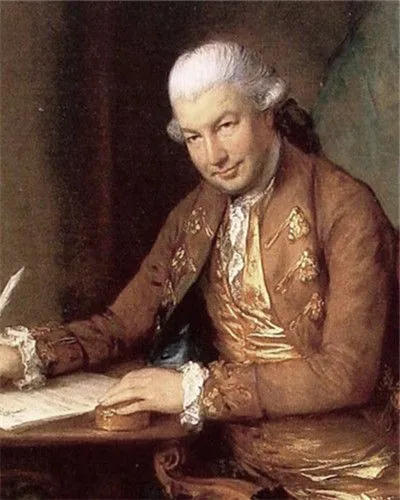
Carl Friedrich Abel From Wikipedia, the free encyclopedia Portrait of Carl Friedrich Abel by Thomas Gainsborough, 1777 Carl Friedrich Abel (22 December 1723 – 20 June 1787) was a German composer of the Classical era. He was a renowned player of the viola da gamba, and composed important music for that instrument. Abel was born in Köthen, a small German city, where his father, Christian Ferdinand Abel, had worked for years as the principal viola da gamba and celloplayer in the court orchestra. In 1723 Abel senior became director of the orchestra, when the previous director, Johann Sebastian Bach moved to Leipzig. The young Abel later boarded at Leipzig's Thomasschule, where he was taught by Bach. On Bach's recommendation in 1743 he was able to join Johann Adolph Hasse's court orchestra at Dresden where he remained for fifteen years. In 1759 (or 1758 according to Chambers),[1] he went to England and became chamber-musician to Queen Charlotte, in 1764.He gave a concert of his own compositions in London, performing on various instruments, one of which was a five-string cello known as a pentachord, which had been recently invented by John Joseph Merlin.[6] In 1762, Johann Christian Bach, the eleventh son of J.S. Bach, joined him in London, and the friendship between him and Abel led, in 1764 or 1765, to the establishment of the famous Bach-Abel concerts, England's first subscription concerts. In those concerts, many celebrated guest artists appeared, and many works of Haydn received their first English performance. For ten years the concerts were organized by Mrs. Theresa Cornelys, a retired Venetian opera singer who owned a concert hall at Carlisle House in Soho Square, then the height of fashionable events. In 1775 the concerts became independent of her, to be continued by Abel and Bach until Bach's death in 1782. Abel still remained in great demand as a player on various instruments new and old. He traveled to Germany and France between 1782 and 1785, and upon his return to London, became a leading member of the Grand Professional Concerts at the Hanover Square Roomsin Soho. Throughout his life he had enjoyed excessive living, and his drinking probably hastened his death, which occurred in London on 20 June 1787.[citation needed] He was buried in the churchyard of St Pancras Old Church. One of Abel's works became famous due to a misattribution: in the 19th century, a manuscript symphony in the hand of Wolfgang Amadeus Mozart, was catalogued as his Symphony no. 3 in E flat,K. 18, and was published as such in the first complete edition of Mozart's works by Breitkopf & Härtel. Later, it was discovered that this symphony was actually the work of Abel, copied by the boy Mozart—evidently for study purposes—while he was visiting London in 1764. That symphony was originally published as the concluding work in Abel's Six Symphonies, Op. 7.