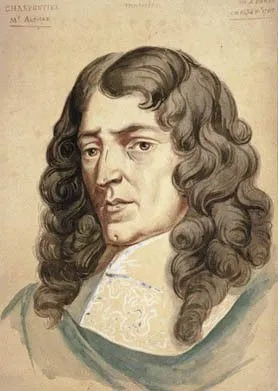
Marc Antoine Charpentier 马克·安托万·夏庞蒂埃
马克·安托万·夏庞蒂埃
M·A·Charpentier / M·A·夏庞蒂埃地区法国
类型个人
职业作曲
艺人资料
法国作曲家。出生于巴黎附近。早年接受良好的教育,18岁时在巴黎学习法律,不过1个学期后他放弃了学习。大概1667年他来到罗马,跟随卡里西米学习音乐。经过了2、3年后回国。之后担任洛林公爵夫人的私人乐师长达17年之久。尽管夏庞蒂埃没有在路易十四的宫廷中担任职务,但他的才华使他在巴黎的音乐界中占有重要的地位。夏庞蒂埃的一生生活在吕利的阴影与打压之下,他死后很快就被世人遗忘。直到20世纪,他的音乐才重新被发掘并为世人所知,被称为最有天赋和多才多艺的法国作曲家。
Marc-Antoine Charpentier, (born 1643, in or near Paris, France—died Feb. 24, 1704, Paris), most important French composer of his generation and the outstanding French composer of oratorios.
Charpentier went to Rome in about 1667, where he is believed to have studied composition, perhaps with Giacomo Carissimi. On his return to France about three years later he became chapelmaster to the dauphin but lost that position through Jean-Baptiste Lully’s influence. He composed the music for a new version of Molière’s The Forced Marriage (first performed 1672) and collaborated with him again in The Imaginary Invalid (1673). After Molière’s death Charpentier continued to work for the Théâtre Français until 1685. He produced his greatest stage work, Médée, to Thomas Corneille’s text, in 1693. From perhaps 1670 to 1688 he had as his patron Marie de Lorraine, known as Mademoiselle de Guise, and from 1679 he composed music for the dauphin’s chapel (Lully died in 1687). In 1692 he became composition teacher to the Duke d’Orleans and in 1698 was made music master at the Sainte-Chapelle in Paris.
In his sacred tragedies written for the Jesuit community in Paris, Charpentier established the oratorio in France. In such oratorios as the Filius prodigus (Prodigal Son), Sacrificium Abrami, and his masterpiece, Le Reniement de saint Pierre (The Denial of St. Peter), he successfully integrates the Italian style of Carissimi with his native French style. His work is marked by its lyricism, skilled polyphony, and sensitive use of harmonic resources. In addition to his oratorios and stage works (16 operas, many pastorals), Charpentier composed 12 masses; elaborate motets with chorus, solos, and orchestra for the dauphin’s chapel; a Te Deum; a Magnificat; and other works.
From:https://www.britannica.com/biography/Marc-Antoine-Charpentier