妮娜·西蒙 (Nina Simone)
妮娜·西蒙
N·Simone / N·西蒙地区美国
类型个人
职业作曲、钢琴
艺人资料
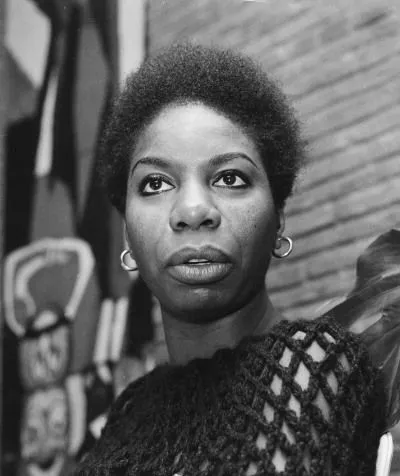
Nina Simone (/ˈniːnə sɪˈmoʊn/; born Eunice Kathleen Waymon; February 21, 1933– April 21, 2003) was an American singer, songwriter, pianist, arranger, and activist in the Civil Rights Movement. Simone employed a broad range of musical styles including classical, jazz, blues, folk, R&B, gospel, and pop.
Born in North Carolina, the sixth child of a preacher, Waymon aspired to be a concert pianist. With the help of a few supporters in her hometown of Tryon, North Carolina, she enrolled in the Juilliard School of Music in New York.
Waymon then applied for a scholarship to study at the prestigious Curtis Institute of Music in Philadelphia, where she was denied admission despite a well-received audition. Waymon became fully convinced this rejection had been entirely due to racial discrimination. Years later, two days before her death, the Curtis Institute of Music bestowed on her an honorary degree.
To make a living, Eunice Waymon changed her name to "Nina Simone". The change related to her need to disguise herself from family members, having chosen to play "the devil's music" or "cocktail piano" at a nightclub in Atlantic City. She was told in the nightclub that she would have to sing to her own accompaniment, and this effectively launched her career as a jazz vocalist.
Simone recorded more than 40 albums, mostly between 1958, when she made her debut with Little Girl Blue, and 1974. She had a hit in the United States in 1958 with "I Loves You, Porgy".
Simone's musical style fused gospel and pop with classical music, in particular Johann Sebastian Bach, and accompanied expressive, jazz-like singing in her contralto voice. In 2018, Simone will be inducted into the Rock and Roll Hall of Fame.
Simone was born Eunice Kathleen Waymon in North Carolina and raised in Tryon, North Carolina. The sixth of eight children in a poor family, she began playing piano at the age of three; the first song she learned was "God Be With You, Till We Meet Again". Demonstrating a talent with the instrument, she performed at her local church. But her concert debut, a classical recital, was given when she was 12. Simone later said that during this performance, her parents, who had taken seats in the front row, were forced to move to the back of the hall to make way for white people. She said that she refused to play until her parents were moved back to the front, and that the incident contributed to her later involvement in the civil rights movement.
Simone's mother, Mary Kate Waymon (née Irvin, November 20, 1901 – April 30, 2001), was a Methodist minister and a housemaid. Simone's father, Rev. John Devan Waymon (June 24, 1898 – October 24, 1972), was a handyman who at one time owned a dry cleaning business, but also suffered bouts of ill health. Simone's music teacher helped establish a special fund to pay for her education. Subsequently, a local fund was set up to assist her continued education. With the help of this scholarship money she was able to attend Allen High School for Girls in Asheville, North Carolina.
After her graduation, Simone spent the summer of 1950 at the Juilliard School, as a student of Carl Friedberg, preparing for an audition at the Curtis Institute of Music in Philadelphia. Her application, however, was denied. As her family had relocated to Philadelphia in the expectation of her entry to Curtis, the blow to her aspirations was particularly heavy, and she suspected that her application had been denied because of racial prejudice. Discouraged, she took private piano lessons with Vladimir Sokoloff, a professor at Curtis, but never re-applied to the institution. She took a job as a photographer's assistant, but also found work as an accompanist at Arlene Smith's vocal studio and taught piano from her home in Philadelphia.
To fund her private lessons, Simone performed at the Midtown Bar & Grill on Pacific Avenue in Atlantic City, whose owner insisted that she sing as well as play the piano, which increased her income to $90 a week. In 1954, she adopted the stage name "Nina Simone". "Nina" was from niña, a nickname given to her by a boyfriend named Chico, and "Simone" was taken from the French actress Simone Signoret, whom she had seen in the 1952 movie Casque d'Or. Knowing her mother would not approve of playing the "Devil's Music", she used her new stage name to remain undetected. Simone's mixture of jazz, blues, and classical music in her performances at the bar earned her a small but loyal fan base.
In 1958, she befriended and married Don Ross, a beatnik who worked as a fairground barker, but quickly regretted their marriage. Playing in small clubs in the same year, she recorded George Gershwin's "I Loves You, Porgy" (from Porgy and Bess), which she learned from a Billie Holiday album and performed as a favor to a friend. It became her only Billboard top 20 success in the United States, and her debut album Little Girl Blue soon followed on Bethlehem Records. Simone lost more than $1 million in royalties (notably for the 1980s re-release of her version of the jazz standard "My Baby Just Cares for Me") and never benefited financially from the album's sales because she had sold her rights outright for $3,000.
After the success of Little Girl Blue, Simone signed a contract with Colpix Records and recorded a multitude of studio and live albums. Colpix relinquished all creative control to her, including the choice of material that would be recorded, in exchange for her signing the contract with them. After the release of her live album Nina Simone at Town Hall, Simone became a favorite performer in Greenwich Village. By this time, Simone performed pop music only to make money to continue her classical music studies and was indifferent about having a recording contract. She kept this attitude toward the record industry for most of her career.
Simone married a New York police detective, Andrew Stroud, in 1961. He later became her manager and the father of her daughter Lisa, but he abused Simone psychologically and physically.
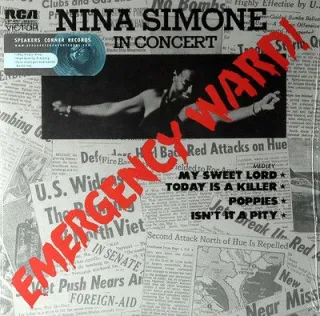
In 1964, Simone changed record distributors from the American Colpix to the Dutch Philips, which also meant a change in the contents of her recordings. She had always included songs in her repertoire that drew upon her African-American origins (such as "Brown Baby" by Oscar Brown and "Zungo" by Michael Olatunji in her album Nina at the Village Gate in 1962). On her debut album for Philips, Nina Simone in Concert (live recording, 1964), for the first time she openly addressed the racial inequality that was prevalent in the United States with the song "Mississippi Goddam", her response to the June 12, 1963, murder of Medgar Evers and the September 15, 1963, bombing of the 16th Street Baptist Church in Birmingham, Alabama, that killed four young black girls and partially blinded a fifth girl who survived. She remarked that the title and the song itself was, "like throwing 10 bullets back at them", becoming one of many other protest songs written by Simone. The song was released as a single, and it was boycotted in certain southern states. Specifically, promotional copies were smashed by a Carolina radio station and returned to Simone's record label. Simone later recalled how "Mississippi Goddam" was her "first civil rights song" and that the song came to her "in a rush of fury, hatred and determination". The song was a direct challenge to widely held beliefs that race relations could change gradually and called for more immediate developments, "me and my people are just about due". It was a key moment in her political radicalization. "Old Jim Crow", on the same album, addressed the Jim Crow laws.
From then on, a civil rights message was standard in Simone's recording repertoire, becoming a part of her live performances. During the rise of her political activism, the release of her musical work grew more infrequent. Simone performed and spoke at many civil rights meetings, such as at the Selma to Montgomery marches. Simone advocated violent revolution during the civil rights period, rather than Martin Luther King's non-violent approach, and she hoped that African Americans could, by armed combat, form a separate state. Her message to the public signified the transition from the non-violent approach to social change that was advocated by Martin Luther King into the more militant state that was implemented by Malcolm X and the associates of the Black Nationalist Movement. Nevertheless, she wrote in her autobiography that she and her family regarded all races as equal.
Simone moved from Philips to RCA Victor during 1967. She sang "Backlash Blues", written by her friend and Harlem Renaissance leader, Langston Hughes, on her first RCA album, Nina Simone Sings the Blues (1967). On Silk & Soul (1967), she recorded Billy Taylor's "I Wish I Knew How It Would Feel to Be Free" and "Turning Point". The album 'Nuff Said! (1968) contains live recordings from the Westbury Music Fair, April 7, 1968, three days after the assassination of Martin Luther King Jr. She dedicated the whole performance to him and sang "Why? (The King Of Love Is Dead)", a song written by her bass player, Gene Taylor, directly after the news of King's death had reached them. In the summer of 1969, she performed at the Harlem Cultural Festival in Harlem's Mount Morris Park.
Together with Weldon Irvine, Simone turned Lorraine Hansberry's unfinished play To Be Young, Gifted and Black into a civil rights song. Hansberry had been a personal friend whom Simone credited with cultivating her social and political consciousness. She performed the song live on the album Black Gold (1970). A studio recording was released as a single, and renditions of the song have been recorded by Aretha Franklin (on her 1972 album Young, Gifted and Black) and by Donny Hathaway.
When reflecting on this period in her autobiography, she writes "I felt more alive then than I feel now because I was needed, and I could sing something to help my people…."
In an interview for Jet magazine, Simone stated that her controversial song "Mississippi Goddam" hurt her career. She claimed that the music industry reprimanded her by boycotting her records. Hurt and disappointed, Simone left the US in September 1970, flying to Barbados and expecting Stroud to communicate with her when she had to perform again. However, Stroud interpreted Simone's sudden disappearance, and the fact that she had left behind her wedding ring, as an indication of a desire for a divorce. As her manager, Stroud was in charge of Simone's income.
Simone recorded her last album for RCA, It Is Finished, in 1974, and did not make another record until 1978, when she was persuaded to go into the recording studio by CTI Records owner Creed Taylor. The result was the album Baltimore, which, while not a commercial success, was fairly well received critically and marked a quiet artistic renaissance in Simone's recording output. Her choice of material retained its eclecticism, ranging from spiritual songs to Hall & Oates' "Rich Girl." Four years later Simone recorded Fodder on My Wings on a French label.
During the 1980s, Simone performed regularly at Ronnie Scott's Jazz Club in London, where she recorded the album Live at Ronnie Scott's in 1984. Although her early on-stage style could be somewhat haughty and aloof, in later years, Simone particularly seemed to enjoy engaging her audiences sometimes by recounting humorous anecdotes related to her career and music and by soliciting requests. In 1987, the original 1958 recording of "My Baby Just Cares for Me" was used in a commercial for Chanel No. 5 perfume in Britain. This led to a re-release of the recording, which stormed to number 4 on the UK's NME singles chart, giving her a brief surge in popularity in the UK.
When Simone returned to the United States, she learned that a warrant had been issued for her arrest for unpaid taxes (as a protest against her country's involvement with the Vietnam War), and returned to Barbados to evade the authorities and prosecution. Simone stayed in Barbados for quite some time and she had a lengthy affair with the Prime Minister, Errol Barrow. A close friend, singer Miriam Makeba, then persuaded her to go to Liberia. Later, she lived in Switzerland and the Netherlands, before settling in France in 1993. During a 1998 performance in Newark, she announced, "If you're going to come see me again, you've got to come to France, because I ain't coming back."
Simone published her autobiography, I Put a Spell on You, in 1992. She recorded her last album, A Single Woman, in 1993, where she depicted herself as the "single woman". She continued to tour through the 1990s but rarely traveled without an entourage. During the last decade of her life, Simone had sold more than one million records, making her a global catalog best-seller.
Simone had been diagnosed with bipolar disorder in the late 1980s. In 1993, she settled near Aix-en-Provence in Southern France. She had suffered from breast cancer for several years before she died in her sleep at her home in Carry-le-Rouet, Bouches-du-Rhône on April 21, 2003. Her funeral service was attended by singers Miriam Makeba and Patti LaBelle, poet Sonia Sanchez, actors Ossie Davis and Ruby Dee, and hundreds of others. Simone's ashes were scattered in several African countries. She is survived by her daughter, Lisa Celeste Stroud, an actress and singer, who took the stage name Simone, and has appeared on Broadway in Aida.
From:<a href="<a href=" https:="" en.wikipedia.org="" wiki="" '="">https://en.wikipedia.org/wiki/'>https://en.wikipedia.org/wiki/Nina Simone