
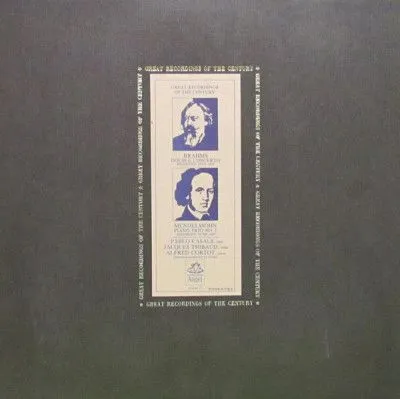
门德尔松《d小调第1号为钢琴,小提琴和大提琴而作的三重奏》 /勃拉姆斯《a小调为小提琴大提琴和乐队而作的协奏曲》 /科尔托钢琴 ,蒂博小提琴 ,卡萨尔斯大提琴 ,科尔托指挥 ,巴塞罗那卡萨尔斯乐团
Felix Mendelssohn
,Johannes Brahms
,Jacques Thibaud
,Alfred Cortot
,Pablo Casals
,Orquesta Casals de Barcelona
GenreAlbum
Year1960
Introduction
Double Concerto (Brahms)
TheDouble ConcertoinA minor,Op.102, byJohannes Brahmsis aconcertoforviolin,celloandorchestra. The orchestra consists of 2 flutes, 2 oboes, 2 clarinets, 2 bassoons, 4 horns, 2 trumpets, timpani and strings.
Origin of the work
The Double Concerto was Brahms' final work for orchestra. It was composed in the summer of 1887, and first performed on 18 October of that year in theGürzenich[de]in Cologne, Germany.[1]Brahms approached the project with anxiety over writing for instruments that were not his own.[2]He wrote it for the cellistRobert Hausmann, a frequentchamber musiccollaborator,[3]and his old but estranged friend, theviolinistJoseph Joachim. The concerto was, in part, a gesture of reconciliation towards Joachim, after their long friendship had ruptured following Joachim's divorce from his wifeAmalie.[4][5](Brahms had sided with Amalie in the dispute.)
The concerto makes use of the musical motif A–E–F, a permutation of F–A–E, which stood for a personal motto of Joachim,Frei aber einsam("free but lonely").[6]Thirty-four years earlier, Brahms had been involved in a collaborative work using the F-A-E motif in tribute to Joachim: theF-A-E Sonataof 1853.
Structure
The composition consists of three movements in the fast–slow–fast pattern typical of classical instrumental concerti:
Allegro(A minor)
Andante(D major)
Vivace non troppo(A minor → A major)
摘自:https://en.wikipedia.org/wiki/Double_Concerto_(Brahms)
Piano Trio No. 1 (Mendelssohn)
Felix Mendelssohn'sPiano Trio No. 1inD minor,Op. 49, was completed on 23 September 1839 and published the following year. The work is scored for a standardpiano trioconsisting ofviolin,celloandpiano. The trio is one of Mendelssohn's most popularchamberworks and is recognized as one of his greatest along with hisOctet, Op. 20.
During the initial composition of the work, Mendelssohn took the advice of fellow composerFerdinand Hillerto revise the piano part. The revised version was in a moreromantic,Schumannesquestyle with the piano given a more important role in the trio. Indeed, the revised piece was reviewed by Schumann, who declared Mendelssohn to be "the Mozart of the nineteenth century, the brightest musician, who most clearly understands the contradictions of the age and is the first to reconcile them."
Movements
The trio has fourmovements:
1.Molto allegro ed agitato(D minor)
2.Andante con moto tranquillo (B-flat major)
3.Scherzo: Leggiero e vivace (D major)
4.Finale: Allegro assai appassionato (D minor, ending inD major)
A typical performance lasts just under 30 minutes.
Molto allegro ed agitato
The first movement is insonata form, without anintroduction. It begins with acantabilemain theme played by the cello, with the piano providing asyncopatedaccompaniment. The violin then joins the cello with a distorted version of the theme. Further variations of the main theme fill the transition to the second theme, also introduced by the cello, which is inA major. Mendelssohn combines both themes in thedevelopment, which is predominantly inD minor, the key in which the movement also ends. In therecapitulation, Mendelssohn adds a violincounter-melodyto support the return of the original theme.
摘自:https://en.wikipedia.org/wiki/Piano_Trio_No.1(Mendelssohn)