
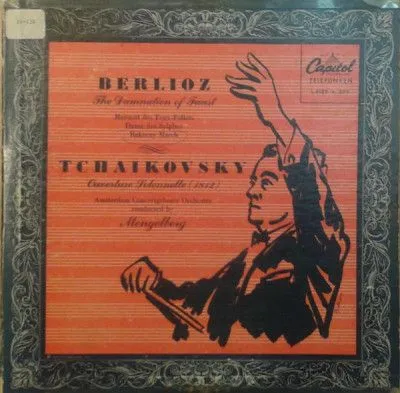
柴可夫斯基《1812序曲》 /柏辽兹《浮士德的天谴》 /门格尔伯格指挥 ,阿姆斯特丹交响乐团
GenreAlbum
Year1951
Introduction
La damnation de Faust
La damnation de Faust(English:The Damnation of Faust),Op. 24 is a work for four solo voices, full seven-part chorus, large children's chorus and orchestra[1]by the French composerHector Berlioz. He called it a "légende dramatique" (dramatic legend).[2]It was first performed at theOpéra-Comiquein Paris on 6December 1846.
Background and composition history
The French composer was inspired by a translation ofGoethe's dramatic poemFaustand produced a musical work that, like the masterpiece on which it is based, defies easy categorisation. Conceived at various times as a free-formoratorioand as anopera(Berlioz ultimately called it a "légende dramatique") its travelogue form and cosmic perspective have made it an extreme challenge to stage as an opera. Berlioz himself was eager to see the work staged, but once he did, he conceded that the production techniques of his time were not up to the task of bringing the work to dramatic life. Most of the work's fame has come through concert performances.
Berlioz readGoethe'sFaust, Part Onein 1828, inGérard de Nerval's translation; "this marvellous book fascinated me from the first", he recalled in hisMemoirs. "I could not put it down. I read it incessantly, at meals, in the theatre, in the street." He was so impressed that asuiteentitledEight Scenes from Faustbecame his Opus 1 (1829), though he later recalled all the copies of it he could find. He returned to the material in 1845, to make a larger work, with some additional text byAlmire Gandonnièreto Berlioz's specifications, that he first called a "concert opera", and as it expanded, finally a "dramatic legend".
He worked on the score during his concert tour of 1845, adding his own text for "Nature immense, impénétrable et fière"—Faust's climactic invocation of all nature—and incorporating theRákóczi March, which had been a thunderous success at a concert inPest, Hungary, on 15 February 1846.[3]
摘自:https://en.wikipedia.org/wiki/La_damnation_de_Faust
1812 Overture
The Year 1812 Solemn Overture, Op. 49, popularly known as the1812 Overture,[1]is aconcert overtureinE♭majorwritten in 1880 byRussiancomposerPyotr Ilyich Tchaikovskyto commemoratethe successful Russian defenseagainstNapoleon's invadingGrande Arméein 1812.
The overture debuted in Moscow on 20 August 1882,[2]conducted byIppolit Al'taniunder a tent near the then-unfinishedCathedral of Christ the Saviour, which also memorialized the 1812 defense of Russia.[3]Tchaikovsky himself conducted another performance at the dedication ofCarnegie HallinNew York City.[4]That was one of the first times a major European composer visited the United States.[5]
The 15-minute overture is best known for its climactic volley ofcannonfire, ringingchimes, and abrassfanfarefinale. It has also become a common accompaniment tofireworksdisplays on the United States'Independence Day. The1812 Overturewent on to become one of Tchaikovsky's most popular works, along with his ballet scores toThe Nutcracker,The Sleeping Beauty, andSwan Lake.[6]