
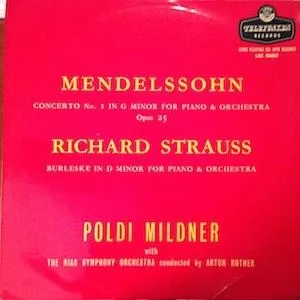
施特劳斯《讽刺剧,d小调为钢琴和管弦乐队而作》 /门德尔松《g小调为钢琴和管弦乐队而作音乐会曲 第1协奏曲》 /米尔德娜钢琴 ,罗特指挥 ,柏林RIAS交响乐团
GenreAlbum
Year1960
GenresPop
Introduction
Piano Concerto No. 1 (Mendelssohn)
Mendelssohn'sPiano Concerto No. 1inG minor,Op.25, was written in 1830–31, around the same time as hisfourth symphony("Italian"), and premiered inMunichin October 1831. This concerto was composed in Rome during a travel in Italy after the composer met a pianist in Munich. Mendelssohn attended one party after another in Munich in October 1831, the month of the premiere, but he also playedchamber musicand taughtdouble counterpoint. He performed the piece himself at the premiere, which also included performances of hisSymphony No. 1and the Overture fromMidsummer Night's Dream.[1]He had already written a piano concerto in A minor with string accompaniment (1822) and two concertos with two pianos (1823–24).
Structure
The three connected movements use several relatively new formal techniques in their brief span — for example, the piano enters very soon after the opening of the first movement, with little of an orchestraltuttito contrast with.[2]The concerto quickly obtained popularity, and contains many sections of improvisation, one of Mendelssohn's specialities; it is scored for 2 flutes, 2 oboes, 2 clarinets, 2 bassoons, 2 horns, 2 trumpets, timpani and strings.
1.Molto allegro con fuocoin G minor
2.Andantein E major
3.Presto—Molto allegro e vivacein G major
Molto allegro con fuoco
The piano enters after only a few bars of orchestral introduction. It was standard procedure in theclassical-eraconcerto to precede the solo's entrance by a tutti, for various reasons - the length and purpose of these introductions differed, some offering a hint of what was to follow and some giving out almost all the movement's material, but none was so brief as this: in this sense, this was one of the first concertos of theRomanticage. (The obvious exceptions – Mozart'sJeunehommeconcertoand Beethoven'sfourthandfifthpiano concertos – allowed the piano to enter very briefly just at the start, but then proceeded as usual, the soloist silent.) The rest of the movement is fairly typical of concertos in its use of a modifiedsonata form, with a second, contrasting lyrical theme first heard from the piano over repeated accompaniment, and later on wind. As the movement closes a transition takes the movement not to a full close, but instead, with a brass fanfare and a piano continuation of the same, to the border of the Andante.
摘要:https://en.wikipedia.org/wiki/Piano_Concerto_No.1(Mendelssohn)
Burleske
TheBurleske in D minoris a composition for piano and orchestra written byRichard Straussin 1885-86, when he was 21.
Original title and dedication
The work's original title wasScherzo in D minor, and it was written forHans von Bülow, who had appointed Strauss assistant conductor of the Meiningen Orchestra.[1]However, von Bülow considered it a "complicated piece of nonsense" and refused to learn it. He said the piano part was "Lisztian" and "unplayable", particularly for a pianist with a small handspan (Strauss says that von Bülow could barely reach an octave).[2]Strauss rehearsed the work with the Meiningen Orchestra, conducting and playing the solo part himself, but then set it aside. He wrote to von Bülow: "[G]iven an outstanding (!) pianist, and a first-rate (!) conductor, perhaps the whole thing will not turn out to be the unalloyed nonsense I took it for after the first rehearsal. After the first run-through, I was totally discouraged."[1]
Renaming, rededication and premiere
In 1889, Strauss became acquainted withEugen d'Albert, who liked the work, although he suggested some cuts and changes to the piano part.[3]Strauss rededicated the revised work to d'Albert, who premiered it under its new titleBurleske, at a convention of the General German Music Association[2]atEisenachon 21 June 1890, in the same concert as the premiere of Strauss'sDeath and Transfiguration.[2][3]The word "Burleske" translates as "farce"[4]or "mockery".[1]
Reaction
Von Bülow was still not impressed. In a letter toJohannes Brahmsin January 1891, he wrote: "Strauss'sBurleskedecidedly has some genius in it, but in other respects it is horrifying."[3]Despite this, he conducted the work that month in Berlin, with Eugen d'Albert as soloist.[2]
Strauss was offered a handsome sum by a publisher for the rights to the work, but he was still not convinced of its merits, so he declined. He was no doubt influenced in his own opinion of the work by von Bülow's opinion of it. A quarter of a century later he wrote about von Bülow: "For anyone who ever heard him playBeethovenor conductWagner, who attended one of his piano lessons or observed him in orchestra rehearsal, he inevitably became the model of all the shining virtues of a performing artist, and his touching sympathy for me, his influence on the development of my artistic abilities, were the decisive factors in my career."[2]