
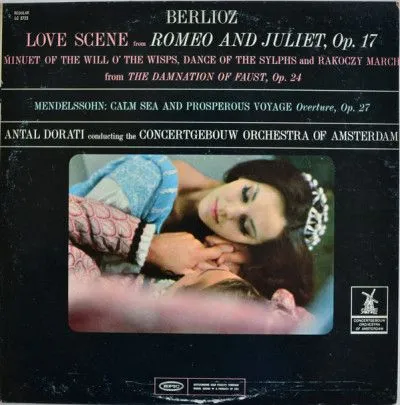
门德尔松《平静的海与幸福的航行(音乐会序曲,D大调为管弦乐队而作)(根据约翰·沃尔夫冈·冯·歌德的诗歌而作 )第3序曲》 /柏辽兹《罗密欧与朱丽叶,为独唱(女低音,男高音,男低音)小合唱队(女低音,男高音,男低音)及管弦乐队而作的戏剧交响曲》 《浮士德的天谴》 /
GenreAlbum
Year1961
Introduction
Roméo et Juliette(Berlioz)
Roméo et Julietteis asymphonie dramatique,a large-scalechoral symphonyby FrenchcomposerHector Berlioz, which was first performed on 24November 1839. Thelibrettowas written byÉmile Deschamps, and the completed work was assigned the catalogue numbersOp.17 andH.79. It is based onShakespeare'splayRomeo and Juliet; it is regarded as one of Berlioz's finest works, and it is among the most original in form.The score is Berlioz's most comprehensive and detailedprogrammaticpiece.
摘自:https://en.wikipedia.org/wiki/Rom%C3%A9o_et_Juliette_(Berlioz)
La damnation de Faust
La damnation de Faust(English:The Damnation of Faust),Op. 24 is a work for four solo voices, full seven-part chorus, large children's chorus and orchestra[1]by the French composerHector Berlioz. He called it a "légende dramatique" (dramatic legend).[2]It was first performed at theOpéra-Comiquein Paris on 6December 1846.
Background and composition history
The French composer was inspired by a translation ofGoethe's dramatic poemFaustand produced a musical work that, like the masterpiece on which it is based, defies easy categorisation. Conceived at various times as a free-formoratorioand as anopera(Berlioz ultimately called it a "légende dramatique") its travelogue form and cosmic perspective have made it an extreme challenge to stage as an opera. Berlioz himself was eager to see the work staged, but once he did, he conceded that the production techniques of his time were not up to the task of bringing the work to dramatic life. Most of the work's fame has come through concert performances.
Berlioz readGoethe'sFaust, Part Onein 1828, inGérard de Nerval's translation; "this marvellous book fascinated me from the first", he recalled in hisMemoirs. "I could not put it down. I read it incessantly, at meals, in the theatre, in the street." He was so impressed that asuiteentitledEight Scenes from Faustbecame his Opus 1 (1829), though he later recalled all the copies of it he could find. He returned to the material in 1845, to make a larger work, with some additional text byAlmire Gandonnièreto Berlioz's specifications, that he first called a "concert opera", and as it expanded, finally a "dramatic legend".
He worked on the score during his concert tour of 1845, adding his own text for "Nature immense, impénétrable et fière"—Faust's climactic invocation of all nature—and incorporating theRákóczi March, which had been a thunderous success at a concert inPest, Hungary, on 15 February 1846.
摘自:https://en.wikipedia.org/wiki/La_damnation_de_Faust#External_links
Calm Sea and Prosperous Voyage(Mendelssohn)
Calm Sea and Prosperous Voyage(Meeresstille und glückliche Fahrt), Op. 27, is an orchestralconcert overturebyFelix Mendelssohninspired by the same verses that inspiredBeethoven's 1815cantata of the same title(and indeed inspired by Beethoven's version, which is in the samekey,D major)[citation needed]. Mendelssohn's work was first performed on 7 September 1828 inBerlin.
The titles ofGoethe's two poems are not synonymous: in the days before steam, a totally calm sea was cause for alarm; it is only when the wind at last rises that the ship can continue on its journey.[1]Mendelssohn's version concludes with a fanfare of trumpets suggesting the ship's final arrival at its port of destination.
Scored forpiccolo, 2flutes, 2oboes, 2clarinets, 2bassoons,double bassoon,serpent, 2horns, 3trumpets,timpaniandstrings,[2]the piece is programmatic for its reference of the two poems by Goethe. These two poems were extremely popular, and at the time of the premiere, Mendelssohn could have assumed that the audience would have been familiar with both poems and able to follow the programme of the music with minimal aid. The work is a concert overture - meaning that it is not intended as a prelude to a larger work such as an opera (as 'overture', deriving from the French for 'opening', more often implies). Instead, the piece is performed as an independent piece in a symphonic concert. The term overture here refers to the use of melody and form. However, it could also be considered as an early form oftone poem.
Edward Elgarquotes a theme from the overture in the 13th variation of hisEnigma Variationsto represent one of his "friends pictured within" on a ship bound for Australia or New Zealand.
摘自:https://en.wikipedia.org/wiki/Calm_Sea_and_Prosperous_Voyage_(Mendelssohn)