
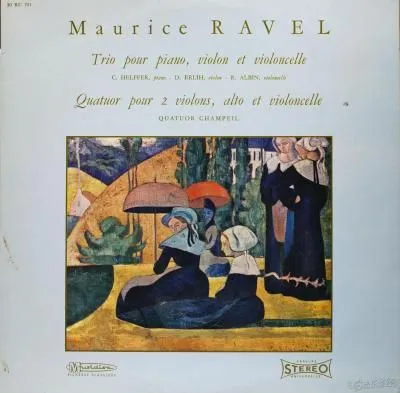
拉威尔:三重奏和四重奏
GenreAlbum
YearUnknown
Introduction
专辑介绍:that cannot be transcended.
conveying the bewitching spell and sober subtility of the work with a faithfulness
The interpreters helped here by a flawless recording, show their skill in
himself than in his chamber-music.
intellectual family of Baudelaire and Mallarmé, he has never more unbosomed
two works helps to penetrate the heart of Ravel’s genius. Belonging to the
full possession of all his means of expression. The fact of joining together these
When he wrote the Trio, Ravel nearly forty years old, was on the contrary in
but which appears in it much more clearly than in my former compositions.”
F answers a will of musical construction not perfectly achieved without any doubt,
has invented his own personal expression. He himself says later on “My quartet in
twenty seven in 1902. This is a proof among others of the precocity with which he
musical styles. For Ravel, on the contrary, he was to compose his when he was but
more Beethoven, have approached the quatuor only after having ruled over the other
worth from the musician. It is well known that the great Classics Mozart and even
alto, and one violoncello) demands the highest mastership and the most inward
one which, by reason of the homogeneousness of its language (two violins, one
Among all the musical styles his Quartet for string instruments is perhaps the
die after a chirurgical intervention on the 7th of March 1937.
which causes him brain troubles, though his intellect remains untouched. He is to
Then after 1932 he is obliged to renounce composition on account of an accident
finds as ingenious than entirely personal. He composes his reknowned Trio in 1914.
“Quatuor in F” already composed, both reveal a skillful genius and harmonic
unjustly refused to him, in 1903, though the “Pavan for a dead Infant” and
studies only receive for reward the second “Prix de Rome“. The first prize is
Debussy and Fauré. Entering in the Conservatory of Paris in 1889, his brillant
Bom in Ciboure in 1875, Maurice RAVEL is one of the Masters of modern music with
Manuel Recasens, violoncelle
Maurice Husson, alto
Georges Balbon, violon
Jean Champeil, violon
4.Vif et agité 5'07
3.Très lent 8'4j.
2.Assez-vif - très rythmé 6'o2
1.Allegro moderato /30
QUATUOR POUR 2 VIOLONS, ALTO ET VIOLONCELLE
FACE B
Roger Albin, violoncelle
Devy Erlih, violon
Claude Helfer, piano
4.Final M
3.Passacaille 6*33
2.Pantoum 4*25
1.Modéré 8'50
TRIO POUR PIANO, VIOLON ET VIOLONCELLE
FACE A
Maurice RAVEL (1875-1937)
COLLECTION RICHESSE CLASSIQUE