
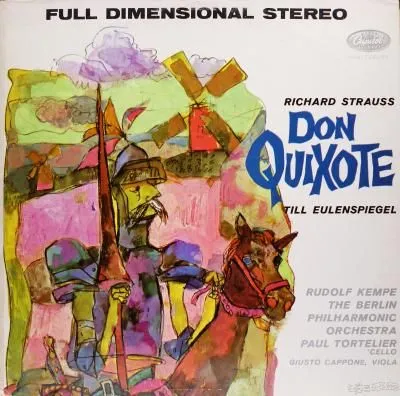
理查·施特劳斯:唐吉诃德
GenreAlbum
Year未知
Introduction
专辑介绍:1959
Malcolm Rayment Notes ©Malcolm Rayment,
but his pranks have gained him immortality.
introduction, but ends in a blaze of high spirits. Till may have been hanged
hanged. The epilogue begins as did the
and he is
of death is passed (a falling seventh on trombones, tuba, horns and bassoons)
sudden end when he is arrested. Till tries to mock at his judges, but sentence
song.Till becomes more and more reckless, but his escapades are brought to a
them, and goes off singing a jaunty street
arguments. Till expresses his opinion of these professors by making a face at
thesis to them, inciting them to a debate in which they get tangled up in their
bassoon and contra bassoon). Almost immediately Till is heard expounding a
gathering of learned professors (the passage beginning on bass clarinet,
short-lived, for the opportunity for a new piece of trickery presents itself —a
finds himself in love. When he is repulsed he flies into a rage. This is
immediately in amorous adventures. But the tables are now turned on him, for he
(downward glissando on a solo violin) and off he goes, only to indulge
trumpets, horns, and solo violins shows. Soon he tears off his disguise
is not altogether confident about this adventure, as the “fear” motive on
as Till disguises himself as a priest and gives a mock, yet serious, sermon. He
but Till has made his escape.The music now changes from six-eight to two-four
tradespeople. Somewhat belatedly a night-watchman’s rattle is heard in protest,
the place, and altogether creating confusion and even panic among the
marketplace on horseback, overturning stalls, scattering pots and pans all over
a large crash on the cymbals) he is off on his first escapade, tearingthrough a
mischievous character, his themes taking on many disguises; but soon (following
with other subsidiary themes.At first we are given a picture of Till’s
are the principal ideas varied on each reappearance, but they are also combined
recognizable. This is not a rondo in the strict classical sense, for not only
theme, are to appear in numerous varied forms while remaining easily
is played on the small clarinet. This motive, and to a lesser extent the horn
notes t>f the harmonic series. After a climax Till’s character-istic motive
horn solos in all music. It is based on, but does not entirely consist of, the
motive; but first we hear his horn theme — incidentally one of the most famous
time’ atmosphere. The opening phrase is to give rise to Till’s most important
exploits fall naturally into rondo form.The work begins with a “once upon a
Strauss to describe the adventures of Don Quixote and Sancho Panza. so Till’s
supposed to have lived in the fourteenth century. Just as variation form serves
place the following autumn. The hero in this case is a practical joker who is
Eulenspiegel's Merry Pranks in the spring of 1895; the first performance took
Introduction, but these lead to a quiet and peaceful ending.Strauss wrote Till
Quixote, fully restored to sanity, lies dying. There are reminiscences of the
returns home. He does so with a heavy heart.Finale. It is years later and Don
Quixote is quickly defeated and, as the result of the conditions of the combat,
making him give up his eccentric mode of life. The ruse is successful, for Don
Quixote to a combat in the hope of bringing him to his senses, and thereby
friend of the hero disguises himself as another knight errant, challenging Don
Quixote’s adventures have created much consternation in the countryside, so a
with complete success, the “wizards” being routed.Variation X. By this time Don
bassoons). Don Quixote takes them for wizards. This time his attack is crowned
two harmless monks engaged in learned ecclesiastical conversation (two
a prayer of thanks for their escape.Variation IX. Next our heroes come across
soon succeed in capsizing it. They scramble ashore, dripping wet, and offer up
that it has been put there for his use to rescue someone. They get into it, but
without oars moored to a river bank; he immediately comes to the conclusion
the pair have never left the ground.Variation VIII. Don Quixote finds a rowboat
wind machine is used here, but a constant tonic pedal in the bass shows us that
fanned with huge bellows and imagine that they are flying through the air. A
allow themselves to be blindfolded and seated on a wooden horse. They are
that she is under some evil enchantment.Variation VII. Here our two heroes
life. He explains away her appearance as a rather ugly peasant girl by the fact
hopes that producing a Dulcinea will bring an end to this uncongenial way of
as the country-dance-like vulgarization of the Dulcinea theme shows. Sancho
Moreover, she is far from being the beautiful maiden of the knight’s imagination—
one of three girls riding on asses whom Don Quixote and Sancho Panza meet.
the night by his armour.Variation VI. "Dulcinea” at last appears. She is
appears, depicts Don Quixote keeping vigil in true knightly tradition throughout
V. This eloquent monologue for solo ’cello, during which the Dulcinea theme
seen that he is not seriously hurt, goes to sleep, emitting a loud snore.Variation
unconscious. Sancho Panza goes to the aid of his wounded master, but having
He charges, but the short-lived combat only results in his being knocked
statue of the Madonna, which he sees as an unfortunate maiden being abducted.
silent.Variation IV. Don Quixote comes across a band of pilgrims carrying a
in the work). He brushes aside Sancho’s philosophy, angrily telling him to keep
a glorious picture of their chosen vocation (one of the most beautiful passages
Quixote, however, is made of sterner stuff; he is not to be dissuaded, and paints
especially since their ventures so far have brought nothing but bruises. Don
Sancho Panza. the subject being a life of chivalry. Sancho questions its value,
III. This long variation represents a conversation between Don Quixote and
another army, comprised of shepherds, which attacks and stones him.Variation
(Strauss’s realism here is amazing.) Unfortunately for Don Quixote there is yet
time with far more success, creating the greatest confusion among “the enemy.”
this “army” is but a large flock of sheep. Once again our hero charges, this
the great emperor, Alifanfaron.” It is useless for Sancho Panza to protest that
sees “a prodigious army of divers and innumerable nations on the march led by
Nothing daunted, our hero resumes his former knightly character and very soon
epilogue to this variation shows the knight “in very evil plight.Variation II.
aside. Don Quixote charges, only to be unhorsed by a slowly moving sail. The
Quixote’s disordered brain, giants. Sancho Panza’s beseechings are brushed
excursion. Very soon the pair come across some windmills which become, in Don
themes are soon joined the one depicting Dulcinea —the purpose of this
resolutely on the solo ’cello and Sancho Panza on the bass clarinet. To these
unison, and by a solo viola.Variation I. The pair set out together. Don Quixote
his character. It is stated alternately by the tenor tuba and bass clarinet in
Panza is depicted with a very different type of theme, that is expressive of
gives a portrait of “The Knight of the Doleful Countenance.” In the second section Sancho
real knight errant.Theme. Here the solo ’cello states the theme in full and
rescue the fair Dulcinea. Finally his mind goes, and he decides to become a
deeds; then he dreams up his own fantasies in which he is the hero, about to
Quixote’s failing sanity. At first he intoxicates his mind by reading of heroic
ideal woman, Dulcinea del Toboso. The introduction as a whole describes Don
opening motive. The quiet oboe solo that follows characterizes Don Quixote’s
thematic material, and a little later the violas take up and continue the
the full Don Quixote theme. The strings, when they enter arco, introduce more
significance.Introduction. The opening bars of the work are an anticipation of
novel that he gave only brief indications of the work’s programmatic
seem so far-fetched. So clear is Strauss’s portrayal of episodes in Cervantes’
taste of lager beer in music. In the light of Don Quixote this claim does not
highest point. The composer once said that he could, if he chose, depict the
poem. In Don Quixote Strauss's powers of pictorial illustration reached their
from a few basic motives and themes, each section is in itself a miniature tone
not variations in the classical sense, for, although much of the work derives
Heldenleben. These “Fantastic Variations on a Theme of Knightly Character” are
composed in 1897, a year after Also Sprach Zarathustra and a year before Ein
series of tone poems that Strauss wrote during the 1880's and ’90’s. It was
Don Quixote is the last but one in the
THE BERLIN PHILHARMONIC ORCHESTRA
RUDOLF KEMPE conducting
Giusto Cappone, Viola
Paul Tortelier, Cello
RICHARD STRAUSS: DON QUIXOTE, Op. 35
Capctol SG 7190 1959