
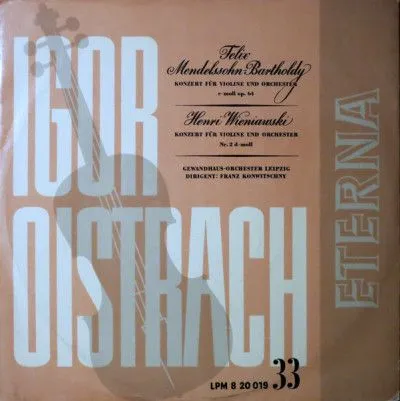
门德尔松《e小调小提琴协奏曲》 /维尼亚夫斯基《d小调第二号小提琴协奏曲》 /奥依斯特拉赫小提琴 ,康维茨舒尼指挥 ,莱比锡格万特豪斯管弦乐团
Felix Mendelssohn
,Henryk Wieniawski
,Igor Oistrach
,Leipzig Gewandhaus Orchestra
,Franz Konwitschny
GenreAlbum
Year1956
Introduction
Felix Mendelssohn’sViolin Concertoin E minor, Op. 64, is his last large orchestral work. It forms an important part of the violin repertoire and is one of the most popular and most frequently performed violin concertos in history.A typical performance lasts just under half an hour.
Mendelssohn originally proposed the idea of the violin concerto to Ferdinand David, a close friend and then concertmaster of the Leipzig Gewandhaus Orchestra. Although conceived in 1838, the work took another six years to complete and was not premiered until 1845. During this time, Mendelssohn maintained a regular correspondence with David, who gave him many suggestions. The work itself was one of the foremost violin concertos of the Romantic era and was influential on many other composers.
Although the concerto consists of three movements in a standard fast–slow–fast structure and each movement follows a traditional form, the concerto was innovative and included many novel features for its time. Distinctive aspects include the almost immediate entrance of the violin at the beginning of the work (rather than following an orchestral preview of the first movement’s major themes, as was typical in Classical-era concertos) and the through-composed form of the concerto as a whole, in which the three movements are melodically and harmonically connected and played attacca (each movement immediately following the previous one).
The concerto was well received and soon became regarded as one of the greatest violin concertos of all time. The concerto remains popular to this day and has developed a reputation as an essential concerto for all aspiring concert violinists to master, and usually one of the first Romantic era concertos they learn. Many professional violinists have recorded the concerto and the work is regularly performed in concerts and classical music competitions.
Mendelssohn also wrote a virtuoso Concerto for Violin and String Orchestra in D minor between 1821 and 1823, when he was 12 to 14 years old, at the same time that he produced his twelve string symphonies.This work was “rediscovered” and first recorded in 1951 by Yehudi Menuhin.
摘自:https://potterviolins.com/product/violin-concerto-e-minor-op-64-mendelssohn/
Violin Concerto No. 2in D minor, Op. 22, by thePolishviolinvirtuoso,Henryk Wieniawski, may have been started in 1856, but the first performance did not take place until November 27, 1862, when he played it inSt. PetersburgwithAnton Rubinsteinconducting. It was published in 1879, inscribedto his dear friendPablo de Sarasate. The work is in threemovements:
Allegro moderato in D minor/F major
Romance: Andante non troppo in B flat major
Allegro con fuoco – Allegro moderato (à la Zingara) in D minor/D major
Written during the relatively stable period of Wieniawski’s residence in St Petersburg, the second Violin Concerto in D minor, op.22 is generally considered as his finest work. Richly melodic and highly idiomatic the work balances the elements of style dispassionately and serenely. Wieniawski first played the work in St Petersburg on 27 November 1862 under the baton of Anton Rubinstein.
Both main elements of the first movement, its sombre, restless first subject, and its lyrical pendant (begun by a solohorn) are discussed freely and subject to dazzling embellishments by the solo violin. This movement includes a demanding variety of technique, includingchromaticglissandi, double stops,arpeggios, sixths, octaves, thirds, chromatic scales, andartificial harmonics, not to mention a myriad of bowing techniques. The beat is based on a 4/4 or common time. The first movement uses a half-sonata formwhere the orchestral coda after the exposition transitions into the second movement instead of a development section.
The slow movement, aRomance, follows without a break. It is based on a lilting tune in 12/8 time and rises to an impassioned central climax.
A rhapsodic passage markedAllegro con fuocoand mainly a solocadenza, leads to the finale, a dashing rondo in thegypsystyle, which quotes the first movement's subsidiary theme in the course of its second and third episodes. The final movement implements a 2/4 time, which allows the violinists to emphasize certain notes in the beginning of some measures.
Wieniawski's second Violin Concerto remains one of the most popular violin concertos of the Romantic era, memorable for its lush and moving melodies and harmonies.
摘自:https://en.wikipedia.org/wiki/Violin_Concerto_No.2(Wieniawski)