
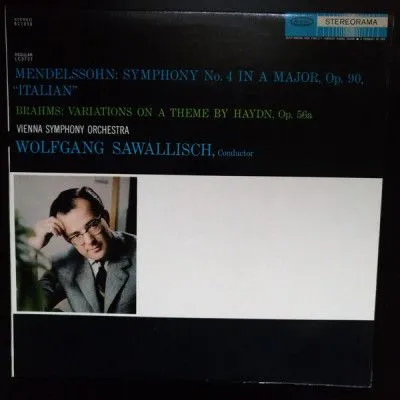
门德尔松《第4交响曲“意大利”》 /勃拉姆斯《降B大调根据海顿主题为管弦乐队而作的变奏曲(圣安东尼变奏曲)》
GenreAlbum
Year1960
Introduction
Symphony No. 4 (Mendelssohn)
TheSymphony No. 4in A major,Op.90, commonly known as theItalian,[1]is an orchestral symphony written by German composerFelix Mendelssohn.
History
The work has its origins (as had the composer'sScottish3rd SymphonyandThe Hebridesoverture) in the tour of Europe which occupied Mendelssohn from 1829 to 1831. Its inspiration is the colour and atmosphere of Italy, where Mendelssohn made sketches but left the work incomplete. Below is a snippet of a letter he wrote to his father:
This is Italy! And now has begun what I have always thought... to be the supreme joy in life. And I am loving it. Today was so rich that now, in the evening, I must collect myself a little, and so I am writing to you to thank you, dear parents, for having given me all this happiness.[2]
In February he wrote from Rome to his sisterFanny,
TheItaliansymphony is making great progress. It will be the jolliest piece I have ever done, especially the last movement. I have not found anything for the slow movement yet, and I think that I will save that for Naples.
TheItalian Symphonywas finished in Berlin on 13 March 1833, in response to an invitation for a symphony from theLondon (now Royal) Philharmonic Society; he conducted the first performance himself in London on 13 May 1833 at a London Philharmonic Society concert. The symphony's success, and Mendelssohn's popularity, influenced the course of British music for the rest of the century.[3]TheGermania Musical Societyof Boston gave the first performance in the United States, on 1 November 1851, withCarl Bergmannconducting.[4]
Mendelssohn himself, however, remained dissatisfied with the composition, which cost him, he said, some of the bitterest moments of his career; he revised it in 1834[5]and even planned to write alternative versions of the second, third, and fourth movements. He never published the symphony, and it appeared in print only in 1851;[6]thus it is numbered as his "Symphony No. 4", even though it was in fact the third he composed.
摘自:https://en.wikipedia.org/wiki/Symphony_No.4(Mendelssohn)
Variations on a Theme by Haydn
For the work byCarl Czernysometimes called "Variations on a Theme by Haydn", seeVariations on "Gott erhalte Franz den Kaiser" (Czerny).
TheVariations on a Theme by Joseph Haydn, (German:Variationen über ein Thema von Jos. Haydn), now also called theSaint Anthony Variations, is a work in the form of athemeandvariations, composed byJohannes Brahmsin the summer of 1873 atTutzinginBavaria. It consists of a theme in B♭major based on a "Chorale St Antoni", eight variations, and a finale. The work was published in two versions: for twopianos, written first but designated Op.56b; and fororchestra, designated Op.56a.
The orchestral version is better known and much more often heard than the two-piano version. It is often said to be the first independent set of variations for orchestra in the history of music,[1]although there is at least one earlier piece in the same form,Antonio Salieri'sTwenty-six Variations on 'La folia di Spagna'written in 1815.[citation needed]
Brahms's orchestral variations are scored forpiccolo, 2flutes, 2oboes, 2clarinets, 2bassoons,contrabassoon, 4horns(2 in E♭, 2 in B♭), 2trumpets,timpani,triangle, and the normal string section of first and secondviolins,violas,cellosanddouble basses. The piece usually takes about 18 minutes to perform.
The first performance of the orchestral version was given on 2 November 1873 by theVienna Philharmonic Orchestraunder Brahms's baton.
Origin of the theme
Brahms composed the work on a theme entitled "Chorale St. Antoni", which Brahms found in awind ensemblecomposition. When Brahms discovered it, the wind ensemble piece carried an attribution to the composerJoseph Haydn. Brahms titled his own composition accordingly, crediting Haydn for the theme. However, music publishers in the early nineteenth century often attached the names of famous composers to works by unknown or lesser-known composers, to make the pieces more saleable. Subsequent research has concluded that the wind piece Brahms used as a source does not fit Haydn's style. The wind ensemble piece remains without clear attribution.
As a result, Brahms's piece is sometimes referred to today, in recordings and concert programs, as theSt. Anthony Variations, in addition to the original title that Brahms gave it.
A detailed survey of the controversy can be found in Douglas Yeo's 2004 edition of the "Haydn" piece (ISMN M-57015-175-1).[2]In 1870, Brahms's friend Carl Ferdinand Pohl, the librarian of theVienna Philharmonic Society, who was working on a Haydn biography at the time, showed Brahms a transcription he had made of a piece attributed to Haydn titledDivertimento No. 1. The second movement bore the heading "St. Anthony Chorale", and it is this movement which, in its entirety, forms the theme on which the variations are based. Brahms's statement of the theme varies in small but significant ways from the original, principally with regard to instrumentation. Some sources state the Divertimento was probably written byIgnaz Pleyel, but this has not been definitively established. A further question is whether the composer of the divertimento actually wrote the "St. Anthony Chorale" or simply quoted an older theme taken from an unknown source. To date, no other mention of a "St. Anthony Chorale" has been found.
摘要:https://en.wikipedia.org/wiki/Variations_on_a_Theme_by_Haydn