
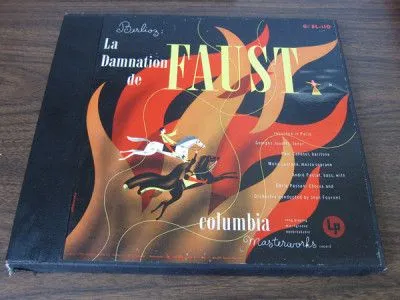
柏辽兹《浮士德的天谴》 /乔阿特男高音 ,富内特指挥 ,Emile Passani Choir,Emile Passani Orchestra
GenreAlbum
Year1951
Introduction
La damnation de Faust
La damnation de Faust(English:The Damnation of Faust),Op. 24 is a work for four solo voices, full seven-part chorus, large children's chorus and orchestra[1]by the French composerHector Berlioz. He called it a "légende dramatique" (dramatic legend).[2]It was first performed at theOpéra-Comiquein Paris on 6December 1846.
Background and composition history
The French composer was inspired by a translation ofGoethe's dramatic poemFaustand produced a musical work that, like the masterpiece on which it is based, defies easy categorisation. Conceived at various times as a free-formoratorioand as anopera(Berlioz ultimately called it a "légende dramatique") its travelogue form and cosmic perspective have made it an extreme challenge to stage as an opera. Berlioz himself was eager to see the work staged, but once he did, he conceded that the production techniques of his time were not up to the task of bringing the work to dramatic life. Most of the work's fame has come through concert performances.
Berlioz readGoethe'sFaust, Part Onein 1828, inGérard de Nerval's translation; "this marvellous book fascinated me from the first", he recalled in hisMemoirs. "I could not put it down. I read it incessantly, at meals, in the theatre, in the street." He was so impressed that asuiteentitledEight Scenes from Faustbecame his Opus 1 (1829), though he later recalled all the copies of it he could find. He returned to the material in 1845, to make a larger work, with some additional text byAlmire Gandonnièreto Berlioz's specifications, that he first called a "concert opera", and as it expanded, finally a "dramatic legend".
He worked on the score during his concert tour of 1845, adding his own text for "Nature immense, impénétrable et fière"—Faust's climactic invocation of all nature—and incorporating theRákóczi March, which had been a thunderous success at a concert inPest, Hungary, on 15 February 1846.[3]
Performance history
Its first performance at theOpéra-Comique, Paris, 6 December 1846, did not meet with critical acclaim, perhaps due to its halfway status betweenoperaandcantata; the public was apathetic, and two performances (and a cancelled third) rendered a financial setback for Berlioz: "Nothing in my career as an artist wounded me more deeply than this unexpected indifference", he remembered.[4]
La damnation de Faustis performed regularly in concert halls, since its first successful complete performance in concert in Paris, in 1877; it is occasionally staged as an opera, for the first time inOpéra de Monte-Carloon 18 February 1893, where it was produced by its directorRaoul GunsbourgwithJean de Reszkesinging the role of Faust andRose Caron, Marguerite. TheMetropolitan Operapremiered it first in concert (2 February 1896) and then on stage (the United States stage premiere on 7 December 1906) and revived it in concert atCarnegie Hallon 10 November 1996 (repeated on tour in Tokyo the next year). The company presented a staged production on 7 November 2008, produced and directed byRobert Lepage, with innovative techniques of computer-generated stage imagery that responds to the performers' voices.[5]FilmmakerTerry Gilliammade his opera debut at London'sEnglish National Operain May 2011, directingThe Damnation of Faust.[6]The production received positive reviews in the British press.[7][8][9]In 2015 theOpéra National de Parisreimagined the role of Faust by assuming the persona of English scientistStephen Hawkingfor that role. This version of the work also reinterpreted the metaphysical journey Faust is sent on by Méphistophélès in relation to theMars Oneproject; portraying the dilemma of man leaving earth to populate Mars.[10]The Paris Opera cooperated withNASA,ESA,CNES. and film companies which produce environmental films for the production of Berlioz's work.[11]
Three instrumental passages, theMarche Hongroise(Hungarian March),Ballet des sylphes, andMenuet des folletsare sometimes extracted and performed as "Three Orchestral Pieces fromLa damnation de Faust."[12]
摘自:https://en.wikipedia.org/wiki/La_damnation_de_Faust#Part_IV