
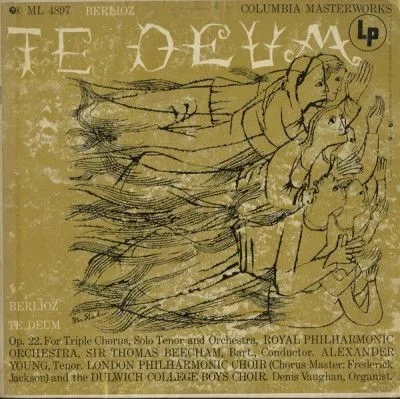
柏辽兹《感恩赞(为男高音独唱,合唱队(女高音,男高音,男低音;女低音,男高音,男低音)和女高音,女低音(儿童)及管弦乐队和管风琴而作。)》 //扬男高音 ,沃恩管风琴 ,杰克逊指挥 ,伦敦爱乐合唱团
GenreAlbum
Year1954
Introduction
Te Deum (Berlioz)
TheTe Deum(Op. 22 / H.118) byHector Berlioz(1803–1869) was completed in 1849. Like the earlier and more famousGrande Messe des Morts, it is one of the works referred to by Berlioz in his Memoirs as "the enormous compositions which some critics have called architectural or monumental music." While the orchestral forces required for theTe Deumare not as titanic as those of theRequiem, the work calls for an organ that can compete on equal terms with the rest of the orchestra. It lasts approximately fifty minutes and derives its text from the traditionalLatinTe Deum, although Berlioz changed the word order for dramatic purposes.
Background and premiere
TheTe Deumwas originally conceived as the climax of a grand symphony celebratingNapoleon Bonaparte.[1]The finished work was dedicated toAlbert, Prince Consort, husband ofQueen Victoria.[1]Some of the material used by Berlioz in the piece was originally written for hisMesse Solennelleof 1824,[2]thought to have been destroyed by the composer but rediscovered in 1991. The first performance of the work was on 30 April 1855, at the Church ofSaint-Eustache, Paris; Berlioz conducted an ensemble of 900 or 950 performers.[3]