亨利·威廉·恩斯特 Heinrich Wilhelm Ernst
亨利·威廉·恩斯特
H·W·Ernst / H·W·恩斯特RegionFrance
TypeSolo
ProfessionComposer
Artist Profile
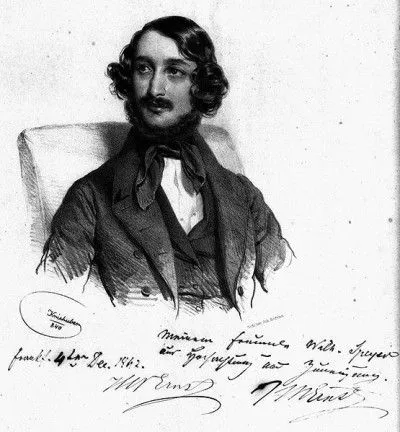
Heinrich Wilhelm Ernst(8 June 1812– 8 October 1865) was aMoravian-Jewishviolinist,violistand composer. He was widely seen as the outstanding violinist of his time and one ofNiccolò Paganini's greatest successors.
He was a highly esteemed artist in his day. Many saw him as the superior violinist of his time and Paganini's greatest successor. Not only did he contribute topolyphonicplaying, but he also discovered new idiomatic ways to compose polyphonically conceived violin music. His friends includedHector BerliozandFelix Mendelssohn.
Biography
Ernst was born inBrno,Moraviaon 8 June 1812.At the age of 9, he began to study violin. Ernst was a child prodigy, educated at theVienna Conservatoryof theGesellschaft der Musikfreunde, studying violin underJoseph Böhm, starting in 1825, andJoseph Mayseder, and composition underIgnaz von Seyfried.
In 1828,Niccolò Paganinivisited Vienna. Ernst heard him and was deeply impressed by his violin playing. It's said that Ernst then played for Paganini who predicted a brilliant career for him. Paganini gave 14 concerts in Vienna, and Ernst attended many of these to observe the master. In April 1829, Ernst left Vienna for Munich for an employment in the royal orchestra, but Paganini advised him to aim for something higher. After that, Ernst played concerts in the same cities as Paganini. These concerts were appreciated, but he still stood in Paganini's shadow. This depressed him to the degree that he locked himself into his room for five days. Later in Frankfurt in the spring of 1830, Ernst met Paganini again. There, Ernst gave a concert where he played Paganini'sNel cor pìù non mi sentowith an accuracy that stunned both the audience and Paganini himself. This work, as with most of Paganini's compositions, was unpublished at that time, which meant that Ernst must have learned it by ear at Paganini's concerts. Some days after, Ernst visited Paganini, who was sitting composing on his guitar. Paganini immediately rose up, threw the manuscript under the bed sheet, and said that he had to protect his composition not only from Ernst's ears, but also his eyes.
In the following years, Ernst made several tours through France. When he heard that Paganini was to play concerts in Marseille in January 1837, he went there to hear his master again. Ernst was determined to learn the secrets of Paganini's complex technique. With help from relatives of his secretary, he rented a room next to Paganini's. He hid there day and night, listening to Paganini rehearse and writing down what he heard. That must have been difficult, because Paganini did not practice much during his tours, and when he did, he used a mute.Ernst also managed, secretly, to attend all of Paganini's rehearsals in Marseille in pursuit of his goal. He too played concerts in Marseille and managed to get these and the concerts Paganini played to become some sort of competition between the two. He tried to organize two concerts before Paganini arrived, and these concerts were well appreciated by the audience. Then, when Paganini was about to play his first concert, the demands on him were greater because of the comparison to Ernst's playing. Paganini couldn't meet the demands of the audience who thought that Ernst's playing had spoken more to the heart. Paganini then organized another concert and challenged the audience by playing hisMoïses,variations on the G string, moving some to tears. After that concert, opinions were divided. Some said Paganini mastered the difficulties better, but Ernst played with more sentiment. Ernst learned this composition through the wall from his room next to Paganini.
Perhaps out of respect for Paganini, Ernst later composed his own set of variations on the themeCarnaval de Venise,which he often played at the end of his concert. He also usedscordaturain the same manner as Paganini did in his variations. This piece was most popular among Ernst's audience everywhere where he played, and it became his signature. All his professional life, he was on tour around Europe playing concerts and also composed many violin pieces and formed his own style. One piece,Elegie, Opus 10, is mentioned in Chapter 23 of theLeo Tolstoynovella, "The Kreutzer Sonata," where it follows Beethoven's sonata in the crucial concert at the Pozdnyshev home.
Ernst also played theviola. He performed the solo viola part ofBerlioz'sHarold en Italiemultiple times, the first in September 1842 inBrusselsunder the direction of the composer.[4]After 1844 he lived chiefly in England. He joined theBeethoven Quartet Societyin London, where he chiefly playedBeethovenString quartetswithJoseph Joachim,Henryk WieniawskiandCarlo Alfredo Piatti.
In 1862, his health failed fromneuralgiaof a most severe kind, which made him unable to play. He spent the last seven years of his life in retirement, chiefly inNice, where he spent time composing, e.g., thePolyphonic Studies,Othello-FantasieandConcerto pathétiquein F-sharp minor, Op. 23. Today, his most widely performed composition is the sixth and last of hisPolyphonic Studies, "Die letzte Rose", an infamously difficult set of variations on the Irish folk melody to which Thomas Moore's poem "The Last Rose of Summer" is usually set.
Ernst died in Nice on 8 October 1865.
Notes
^Most articles concerning Heinrich Wilhelm Ernst say he was born on 6 May 1814. Mark W. Rowe, in his 2008 work, concluded that this date could not be correct. The pressure, as a prodigy, to be young, coupled with the absence of a birth certificate and unreliability of the marriage certificate, makes Rowe think that Ernst was actually born on 8 June 1812, and was therefore nearly two years older than is normally thought.
References
^M. W. Rowe,Heinrich Wilhelm Ernst: Virtuoso Violinist,Ashgate (2008), p. 20.
^Fan Elun,The life and works of Heinrich Wilhelm Ernst (1814–1865) with emphasis on his reception as violinist and composer,Cornell University (1993), p. x.
^Metzner, Paul (1998).Crescendo of the virtuoso: spectacle, skill, and self-promotion in Paris during the Age of Revolution. Victoria E. Bonnell & Lynn Hunt. p.132.ISBN0-520-20684-3.
^Holoman, D. Kern (1989), "Appendix C, Concerts",Berlioz, Cambridge, Massachusetts: Harvard University Press, pp.616–623
This articleincorporates text from a publication now in thepublic domain:Chisholm, Hugh, ed. (1911)."Ernst, Heinrich Wilhelm".Encyclopædia Britannica.9(11th ed.).Cambridge University Press. p.753.