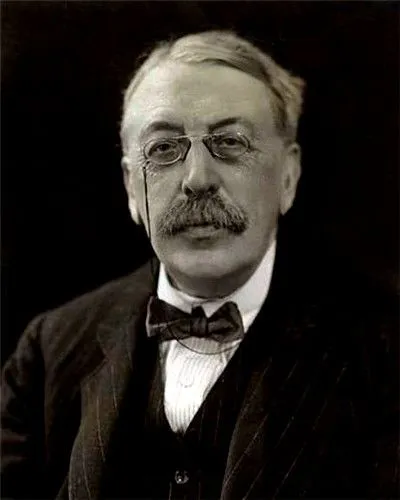
查尔斯·维利尔斯·斯坦福 Charles Villiers Stanford
查尔斯·维利尔斯·斯坦福
C·V·Stanford / C·V·斯坦福RegionIreland
TypeSolo
ProfessionComposer
Artist Profile
爱尔兰作曲家,音乐教育家。生于都柏林的一个业余音乐家家庭。1862年到伦敦学习,后来进入剑桥大学。1883年出任皇家音乐学院教授,后来又到剑桥大学任教,许多英国的知名作曲家都是他的弟子。1902年受封爵士。由于斯坦福的脾气很大,常常以自我为中心,所以和同时代的其他英国作曲家如帕里和埃尔加都关系很差,常常发生争吵。他创作的体裁多样,其中影响较大的是合唱作品等。
Charles Villiers Stanford(30 September 1852– 29 March 1924) was an Irish composer, music teacher, and conductor. Born to a well-off and highly musical family inDublin, Stanford was educated at theUniversity of Cambridgebefore studying music inLeipzigand Berlin. He was instrumental in raising the status of theCambridge University Musical Society, attracting international stars to perform with it.
While still an undergraduate, Stanford was appointed organist of Trinity College, Cambridge. In 1882, aged 29, he was one of the founding professors of the Royal College of Music, where he taught composition for the rest of his life. From 1887 he was also Professor of Music at Cambridge. As a teacher, Stanford was sceptical about modernism, and based his instruction chiefly on classical principles as exemplified in the music of Brahms. Among his pupils were rising composers whose fame went on to surpass his own, such as Gustav Holst and Ralph Vaughan Williams. As a conductor, Stanford held posts with the Bach Choir and the Leeds triennial music festival.
Stanford composed a substantial number of concert works, including seven symphonies, but his best-remembered pieces are his choral works for church performance, chiefly composed in the Anglican tradition. He was a dedicated composer of opera, but none of his nine completed operas has endured in the general repertory. Some critics regarded Stanford, together with Hubert Parry and Alexander Mackenzie, as responsible for a renaissance in music from the British Isles. However, after his conspicuous success as a composer in the last two decades of the 19th century, his music was eclipsed in the 20th century by that of Edward Elgar as well as former pupils.
Stanford was born in Dublin, the only son of John James Stanford and his second wife, Mary, née Henn. John Stanford was a prominent Dublin lawyer, Examiner to the Court of Chancery in Ireland and Clerk of the Crown for County Meath. His wife was the third daughter of William Henn, Master of the High Court of Chancery in Ireland, and granddaughter of the judge William Henn.Both parents were accomplished amateur musicians; John Stanford was a cellist and a noted bass singer who was chosen to perform the title role in Mendelssohn's Elijah at the Irish premiere in 1847. Mary Stanford was an amateur pianist, capable of playing the solo parts in concertos at Dublin concerts.
The young Stanford was given a conventional education at a private day school in Dublin run by Henry Tilney Bassett, who concentrated on the classics to the exclusion of other subjects. Stanford's parents encouraged the boy's precocious musical talent, employing a succession of teachers in violin, piano, organ and composition. Three of his teachers were former pupils of Ignaz Moscheles, including his godmother Elizabeth Meeke, of whom Stanford recalled, "She taught me, before I was twelve years old, to read at sight. ... She made me play every day at the end of my lesson a Mazurka of Chopin: never letting me stop for a mistake. ... By the time I had played through the whole fifty-two Mazurkas, I could read most music of the calibre my fingers could tackle with comparative ease." One of the young Stanford's earliest compositions, a march in D♭ major, written when he was eight years old, was performed in the pantomime at the Theatre Royal, Dublin three years later. At the age of seven, Stanford gave a piano recital for an invited audience, playing works by Beethoven, Handel, Mendelssohn, Moscheles, Mozart and Bach. One of his songs was taken up by the University of Dublin Choral Society and was well received.
In the 1860s Dublin received occasional visits from international stars, and Stanford was able to hear famous performers such as Joseph Joachim, Henri Vieuxtemps and Adelina Patti.The annual visit of the Italian Opera Company from London, led by Giulia Grisi, Giovanni Matteo Mario and later Thérèse Tietjens, gave Stanford a taste for opera that remained with him all his life. When he was ten, his parents took him to London for the summer, where he stayed with his mother's uncle in Mayfair. While there he took composition lessons from the composer and teacher Arthur O'Leary, and piano lessons from Ernst Pauer, professor of piano at the Royal Academy of Music (RAM). On his return to Dublin, his godmother having left Ireland, he took lessons from Henrietta Flynn, another former Leipzig Conservatory pupil of Moscheles, and later from Robert Stewart, organist of St Patrick's Cathedral, as well as from a third Moscheles pupil, Michael Quarry. During his second spell in London two years later, he met the composer Arthur Sullivan and the musical administrator and writer George Grove, who later played important parts in his career.
John Stanford hoped that his son would follow him into the legal profession but accepted his decision to pursue music as a career. However, he stipulated that Stanford should have a conventional university education before going on to musical studies abroad. Stanford tried unsuccessfully for a classics scholarship at Trinity Hall, Cambridge, but gained an organ scholarship, and later a classics scholarship, at Queens' College. By the time he went up to Cambridge in 1870 he had written a substantial number of compositions, including vocal music, both sacred and secular, and orchestral works (a rondo for cello and orchestra and a concert overture).
From:https://en.wikipedia.org/wiki/Charles_Villiers_Stanford