Gamble & Huff (甘布尔和里昂赫夫)
甘布尔和里昂赫夫
TypeSolo
ProfessionComposer
Artist Profile
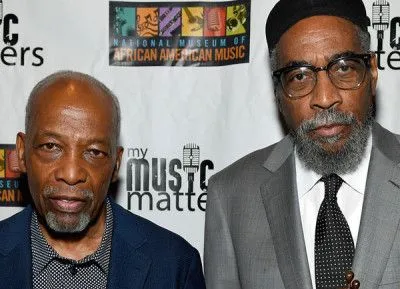
Kenneth Gamble(born August 11, 1943,Philadelphia,Pennsylvania)andLeon A. Huff(born April 8, 1942,Camden, New Jersey)are an American songwriting and production team credited for developing thePhiladelphia soulmusic genre (also known as Philly sound) of the 1970s. In addition to forming their own label,Philadelphia International Records, Gamble and Huff have written and produced 175 gold and platinum records, earning them an induction into theRock and Roll Hall of Famein thenon-performer categoryin March 2008.
History
Early years
Gamble's childhood in Philadelphia shaped his adult life: he recorded himself on variousarcaderecording machines, assisted the morning show DJs onWDAS, operated a record store, and sang with The Romeos. In 1964, before there was "Gamble & Huff" there was "Gamble & Ross." Gamble was discovered and managed byJerry Rosswhen Gamble was only 17 years old and they collaborated for many years. Gamble teamed up with Leon Huff (keyboards) for the first time on a recording for Candy & The Kisses. Ross then signed Gamble toColumbia Recordsin 1963 as a solo recording artist, releasing "You Don't Know What You Got Until You Lose It". Gamble & Ross & Huff collaborated on the hit song "I'm Gonna Make You Love Me", originally recorded by Jay & The Techniques, who were a Jerry Ross group, and later covered byDee Dee Warwickand later byDiana Ross & The SupremesandThe Temptations.
In 1967 they produced their first Top 5 hit: "Expressway to Your Heart" byThe Soul Survivors.In the spring of 1968, for their own Gamble Records label, they wrote and produced the top 10 hit "Cowboys to Girls" for the Philadelphia groupthe Intruders. They subsequently worked withAtlantic RecordsartistsArchie Bell & the Drells,Wilson Pickett,Aretha Franklin,Dusty Springfield, andThe Sweet Inspirations,as well as withMercuryartistsJerry ButlerandDee Dee Warwick, scoring numerous hits along the way.
Philadelphia International
With a solid track record now behind them, Gamble and Huff formedPhiladelphia International Recordsin 1971 as a rival toBerry GordyandMotown. They originally approachedAtlantic Records, which passed on the deal as being too expensive.CBS Records, headed at the time byClive Davis, backed the venture and distributed Philadelphia International's records. Aided and abetted by in-house arrangersThom Bell, Bobby Martin,andNorman Harris, Philadelphia International released a number of the most popularsoul musichits of the 1970s, including "If You Don't Know Me by Now" byHarold Melvin & the Blue Notes, "Back Stabbers", "For the Love of Money", and "Love Train" byThe O'Jays, as well as theGrammy-winning "Me and Mrs. Jones" byBilly Paul. According to an interview onBBC Radio 4on June 28, 2006, Gamble and Huff were inspired to write "Me and Mrs. Jones" after seeing someone they knew who appeared to be involved in anaffair, meeting a woman in a cafe frequented by the songwriters.
Gamble and Huff'sPhiladelphia soulsound evolved from the simplerarrangementsof the late-1960s into a style featuring lushstrings, thumpingbasslines, and slidinghi-hatrhythms—elements that soon became the distinguishing characteristics of a new style of music calleddisco. By 1975, Philadelphia International and the Philadelphia soul genre it helped define had largely eclipsed Motown and theMotown Soundin popularity, and Gamble and Huff were the premiere producers of soul.
Nearly all of the Philadelphia International records featured the work of the label's in-house band of studio musicians,MFSB(Mother Father Sister Brother). MFSB cut a number of successful instrumental albums and singles written and produced by the Gamble & Huff team and arranged by Bobby Martin including the 1974 number-one hit "TSOP (The Sound of Philadelphia)", now best known as the theme song from the Americantelevision showSoul Train.
Political activism
Throughout the 1970s, Gamble and Huff made music that addressed political and social issues faced by the African American community. Many of their songs articulated the theme ofblack prideand highlighted theBlack PowerMovement's struggle for power and self-determination. Representative examples includeBilly Paul's "Am I Black Enough for You?" (1972), theO'Jays' "Give the People What They Want" (1975), and the star-studded "Let's Clean Up the Ghetto" (1977), the later of which was the title track from an album that characterizedPhiladelphia International's broader political and social designs. Scholar James B. Stewart wrote of the album and initiative: "The record company's ability to mount this type of community empowerment venture, while functioning essentially as a component ofCBS's black music department, is an interesting contrast to the more traditional style of corporate control of lyrical content ... The title song ... implores listeners to participate in a physical clean up effort 'because the ghetto is our home.' The titles of several of the other songs on the album convey the album's broader thrust including, 'Now Is the Time to Do It,' 'Year of Decision,' 'New Day, New World Comin',' and 'Save the Children.'"
The album cover prominently displayed Gamble's message: "The only way we can clean up thephysicalghetto is to first clean up thementalghetto. With the help of almighty God, we will be able to turn this community into a positive system. Our first step is cleanliness, 'cause it's the closest thing to godliness." The album jacket also noted that all profits from the LP would be donated to charity for five years.
Gamble's "Clean Up The Ghetto" project, which involves the youth of blighted communities to help clean-up and repair damaged or neglected properties, started in Philadelphia, and has spread toLos Angeles,Atlanta, andChicagowith similar events being held throughout the country. Gamble has also contributed his time and energy to the T. J. Martell Foundation and The AMC Cancer Research Center and Hospital. He has served on the board of directors for the Philadelphia Music Foundation, which honors the artists, songwriters, and producers from Philadelphia. He founded the organization Universal Companies which has opened a restaurant, a bookstore, amosque, low-income housing, and several charter schools. These buildings, mostly built by locally hired labor, have served as springboards to revitalizing neighborhoods. For example, in 2003 Gamble and Universal Companies partnered with others for a $100 million plan to construct and renovate 400 homes in south Philadelphia.
Later years
In 1975, Philadelphia International became involved in apayola-related scandal; Gamble was fined and Huff was not. By the late 1970s, however, the popularity of the Philadelphia soul sound began to decline. Disco had suffered a backlash, R&B was going back toward theballad, androckhad returned to the American charts. Still, the label had its share of late 1970s success. Among the later hits were "Enjoy Yourself" byThe Jacksonsin 1976, and "Ain't No Stoppin' Us Now" byMcFadden & Whiteheadin 1979. One song they wrote, called "My Mood" was adopted in 1980 as the close ofWRC's Friday Night 6pm newscasts. As of 2018, WRC was still using this music.
In 1982, Philadelphia International's biggest star, former Blue Notes singerTeddy Pendergrass, became paralyzed from the waist down in a car accident, and the future of the label came to be in doubt. That year, Philadelphia broke its ties withCBSand made a new deal withEMI. Although the hits had by now dried up, Gamble and Huff continued to write and produce for the label's artists.
1990 finally saw Gamble and Huff recognized with aGrammy Award for Best R&B Song, awarded forSimply Red's cover of the Blue Notes' 1972 hit "If You Don't Know Me By Now". In 1999, Gamble and Huff were honored with theGrammy Trustees Award, joining musical luminaries likeFrank Sinatra,The Beatles, andWalt Disney. Their career output of over 3,000 songs places them among the most prolific professional songwriters of all time.
Today,Kenneth Gamble continues to write, often with Leon Huff, and Philadelphia International continues. He still lives inSouth Philadelphia, and remains active in his community. Gamble owns the shutteredRoyal Theaterand surrounding properties.
On September 19, 2005, Gamble and Huff were inducted into theDance Music Hall of Famefor their outstanding achievements as producers at a ceremony held inNew York City.
In 2008, Gamble and Huff were the first recipients of the newly created "Ahmet ErtegünAward" by theRock and Roll Hall of Fame. The award replaces the former "non-performer" inductee category.[3]On May 20, 2009, Gamble & Huff were namedBMIIcons at the 57th annual BMI Pop Awards. Together, the duo has collected an astounding 86 BMI Pop and R&B Awards.
In May 2010, Kenneth Gamble and Leon Huff were each awarded an Honorary Doctorate of Music fromBerklee College of Music. The ceremony was held at Boston University's Agganis Arena, where the songwriting duo gave the commencement address.
On March 16, 2012, thePhiladelphia Inquirerpublished an obituary for Ruby Gamble, the 96-year-old mother of Gamble, in which he attributes his success to her influence.