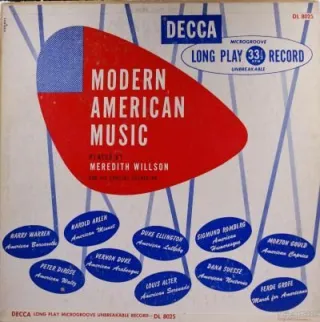
Meredith Willson (梅雷迪思·威尔森)
梅雷迪思·威尔森
M·Willson / M·威尔森RegionUSA
TypeSolo
ProfessionConductor
Artist Profile
Meredith Willson (May 18, 1902 – June 15, 1984) was an American composer, songwriter, flutist, conductor andplaywright, best known for writing the book, music and lyrics for the hit Broadway musical The Music Man. He wrote three other Broadway musicals, composed symphonies and popular songs, and his film scores were twice nominated for Academy AwardsWillson was born in Mason City, Iowa, to John David Willson and Rosalie Reiniger Willson, and he had a brother two years his senior, John Cedrick, and a sister 12 years his senior, the children's author Dixie Willson. He attended Frank Damrosch's Institute of Musical Art (later theJuilliard School) in New York City. He married his high school sweetheart, Elizabeth "Peggy" Wilson, on August 29, 1920. A flute and piccolo player, Willson was a member of John Philip Sousa's band (1921–1923), and the New York Philharmonic Orchestra under Arturo Toscanini (1924–1929). Willson then moved to San Francisco, California, as the concert director for radio station KFRC, and then as a musical director for the NBC radio network in Hollywood. His on-air radio debut came on KFRC in 1928 on Blue Monday Jamboree.His work in films included composing the score for Charlie Chaplin's The Great Dictator (1940) (Academy Award nomination for Best Original Score), and arranging music for the score of William Wyler's The Little Foxes (1941) (Academy Award nomination for Best Music Score of a Dramatic Picture). During World War II, he worked for the United States' Armed Forces Radio Service. His work with the AFRS teamed him with George Burns, Gracie Allen and Bill Goodwin. He would work with all three as the bandleader, and a regular character, on the Burns and Allen radio program. He played a shy man, always trying to get advice on women. His character was dizzy as well, basically a male version of Gracie Allen's character. In 1942, Willson had his own program on NBC. Meredith Willson's Music was a summer replacement for Fibber McGee and Molly.Sparkle Time, which ran on CBS in 1946-47, was Willson's first full-season radio program. Returning to network radio after WWII, he created the Talking People, a choral group that spoke in unison while delivering radio commercials. He also became the musical director for The Big Show, a prestigious comedy-variety program hosted by actress Tallulah Bankhead and featuring some of the world's most respected entertainers. Willson himself became part of one of the show's very few running gags, beginning replies to Bankhead's comments or questions with, "Well, sir, Miss Bankhead...." Willson wrote the song, "May the Good Lord Bless and Keep You" for the show. Bankhead spoke the lyrics over the music at the end of each show. He also worked on Jack Benny's radio program, and hosted his own program in 1949. For a few years in the early 1950s, Willson was a regular panelist on the Goodson-Todman game show The Name's the Same. In 1950 Willson served as Musical Director for The California Story, the Golden State's centennial production at the Hollywood Bowl. Through working on this production, Willson met writer Franklin Lacey who proved instrumental in developing the story line for a musical Willson had been working on, soon to be known asThe Music Man. The California Story spectacular was followed by two more state centennial collaborations with stage director Vladimir Rosing: The Oregon Story in 1959 and The Kansas Story in 1961. Willson's most famous work, The Music Man, premiered on Broadway in 1957, and was adapted twice for film (in 1962 and 2003). He referred to the show as "an Iowan's attempt to pay tribute to his home state". It took Willson some eight years and thirty revisions to complete the musical, for which he wrote more than forty songs. The cast recording of The Music Man won the first Grammy Award for Best Original Cast Album (Broadway or TV). In 1959, Willson and his wife Rini recorded an album called "...and Then I Wrote The Music Man", in which they review the history of, and sing songs from, the show. In 2010, Brian d'Arcy James and Kelli O'Haraplayed Willson and Rini in an off-Broadway entertainment based on this album. His second musical, The Unsinkable Molly Brown, ran on Broadway for 532 performances from 1960 to 1962 and was made into a 1964 motion picture starring Debbie Reynolds. His third Broadway musical was an adaptation of the film Miracle On 34th Street, called Here's Love (1963). His fourth, last, and least successful musical was 1491, which told the story of Columbus's attempts to finance his famous voyage. It was produced by the Los Angeles Civic Light Opera Association in 1969, but was never produced on Broadway.