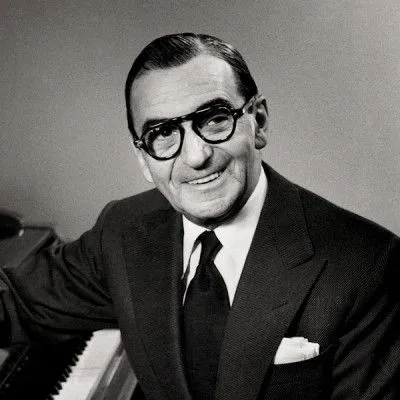
Irving Berlin (欧文·柏林)
欧文·柏林
I·Berlin / I·柏林RegionUSA
TypeSolo
ProfessionComposer
Artist Profile
Irving Berlin (born Israel Beilin; May 11, 1888 – September 22, 1989) was an American composer andlyricist, widely considered one of the greatest songwriters in American history. His music forms a great part of the Great American Songbook. Born inImperial Russia, Berlin arrived in the United States at the age of five. He published his first song, "Marie from Sunny Italy", in 1907, receiving 33 cents for the publishing rights,and had his first major international hit, "Alexander's Ragtime Band" in 1911. He also was an owner of the Music Box Theatre on Broadway.
"Alexander's Ragtime Band" sparked an international dance craze in places as far away as Berlin's native Russia, which also "flung itself into the ragtime beat with an abandon bordering on mania." Over the years he was known for writing music and lyrics in the American vernacular: uncomplicated, simple and direct, with his stated aim being to "reach the heart of the average American," whom he saw as the "real soul of the country."In doing so, said Walter Cronkite, at Berlin's 100th birthday tribute, he "helped write the story of this country, capturing the best of who we are and the dreams that shape our lives."
He wrote hundreds of songs, many becoming major hits, which made him a legend before he turned thirty. During his 60-year career he wrote an estimated 1,500 songs, including the scores for 19 Broadway shows and 18 Hollywood films, with his songs nominated eight times for Academy Awards. Many songs became popular themes and anthems, including "Easter Parade", "White Christmas", "Happy Holiday", "This Is the Army, Mr. Jones", and "There's No Business Like Show Business". His Broadway musical and 1942 film, This is the Army, with Ronald Reagan, had Kate Smith singing Berlin's "God Bless America" which was first performed in 1938.
Berlin's songs have reached the top of the charts 25 times and have been extensively re-recorded by numerous singers including Eddie Fisher, Al Jolson, Fred Astaire, Ethel Merman,Louis Armstrong, Frank Sinatra, Dean Martin, Deana Martin, Ethel Waters, Elvis Presley, Judy Garland, Barbra Streisand, Linda Ronstadt, Rosemary Clooney, Cher, Diana Ross, Bing Crosby,Rita Reys, Frankie Laine, Johnnie Ray, Billy Eckstine, Sarah Vaughan, Nat King Cole, Billie Holiday, Doris Day, Jerry Garcia, Willie Nelson, Bob Dylan and Ella Fitzgerald. ComposerDouglas Moore sets Berlin apart from all other contemporary songwriters, and includes him instead with Stephen Foster, Walt Whitman, and Carl Sandburg, as a "great American minstrel"—someone who has "caught and immortalized in his songs what we say, what we think about, and what we believe." Composer George Gershwin called him "the greatest songwriter that has ever lived",and composer Jerome Kern concluded that "Irving Berlin has noplace in American music—he is American music.".
Berlin was born on May 11, 1888, in Tolochin, Russian Empire.He was one of eight children of Moses (1848–1901) and Lena Lipkin Beilin (1850–1922). His father, a cantor in a synagogue, uprooted the family to America, as did many other Jewish families in the late 19th century. In 1893 they settled in New York City. As of the 1900 census, the name "Beilin" had changed to "Baline". According to his biographer, Laurence Bergreen, as an adult Berlin admitted to no memories of his first five years in Russia except for one: "he was lying on a blanket by the side of a road, watching his house burn to the ground. By daylight the house was in ashes." As an adult, Berlin said he was unaware of being raised in abject poverty since he knew no other life.
Tsar Alexander III of Russia and then Tsar Nicholas II, his son, had revived with utmost brutality the anti-Jewish pogroms, which created the spontaneous mass exodus to America. The pogroms were to continue until 1906, with thousands of other Jewish families also needing to escape, including those of George and Ira Gershwin, Al Jolson, Sophie Tucker, L. Wolfe Gilbert, Jack Yellen, Louis B. Mayer (of MGM), and the Warner brothers. When they reached Ellis Island, Israel was put in a pen with his brother and five sisters until immigration officials declared them fit to be allowed into the city.
His Yiddish-speaking family eventually settled onCherry Street, in a windowless cold-water basement flat in the Theater District of the Lower East Side. His father, unable to find comparable work as a cantor in New York, took a job at a koshermeat market and gave Hebrew lessons on the side, to support his family. He died a few years later when Irving was thirteen years old.
Now, with only a few years of schooling, eight-year-old Irving found it necessary to take to the streets to help support his family. He became a newspaper boy, hawking The Evening Journal. On his first day of the job, according to Berlin’s biographer and friend, Alexander Woollcott, he stopped to look at a ship departing for China and became so entranced that he didn't see a swinging crane, which knocked him into the river. When he was fished out after going down for the third time, he was still holding in his clenched fist the five pennies he earned that day.
His mother took a job as a midwife, and three of his sisters worked wrapping cigars, common for immigrant girls. His older brother worked in a sweatshop assembling shirts. Each evening, when the family came home from their day's work, Bergreen writes, "they would deposit the coins they had earned that day into Lena's outspread apron."
Music historian Philip Furia writes that when eight-year-old "Izzy" quit school to sell newspapers in the Bowery, he was exposed to the music and sounds coming from saloons and restaurants that lined the crowded streets. Young Berlin sang some of the songs he heard while selling papers, and people would toss him some coins. He confessed to his mother one evening that his newest ambition in life was to become a singing waiter in a saloon.
However, before Berlin was fourteen his meager income was still adding less than his sisters' to the family's budget, which made him feel worthless. He then decided to leave home and join the city's ragged army of other young immigrants. He lived in the Bowery, taking up residence in one of the lodging houses that sheltered the thousands of other homeless boys in the Lower East Side. Bergreen describes them as being uncharitable living quarters, "Dickensian in their meanness, filth, and insensitivity to ordinary human beings."
With few survival skills having left school at twelve, he realized that formal employment was out of the question. His only ability was acquired from his father's vocation as a singer, and he joined with a few other youngsters who went to saloons on the Bowery and sing to customers. Itinerant young singers like them were common on the Lower East Side. Berlin would sing a few of the popular ballads he heard on the street, hoping people would pitch him a few pennies. From these seamy surroundings he became street wise, with a real and lasting education. Music was his only source of income and he picked up the language and culture of the ghetto lifestyle.
Berlin learned what kind of songs appealed to audiences, writes Begreen: "well-known tunes expressing simple sentiments were the most reliable." He soon beganplugging songs at Tony Pastor's Music Hall in Union Square and in 1906, when he was 18, got a job as a singing waiter at the Pelham Cafe in Chinatown. Besides serving drinks, he sang made-up "blue" parodies of hit songs to the delight of customers.
Biographer Charles Hamm writes that in Berlin's free time after hours, he taught himself to play the piano. Never having lessons, after the bar closed for the night, young Berlin would sit at a piano in the back and begin improvising tunes.His first attempt at actual songwriting was "Marie From Sunny Italy," written in collaboration with the Pelham's resident pianist, Mike Nicholson. A spelling error on the sheet music to the published song included the spelling of his name as 'I. Berlin.'He sold the rights to this, his first song, for 37 cents.
Berlin continued writing and playing music at Pelham Cafe and developing an early style. He liked the words to other people's songs but sometimes the rhythms were "kind of boggy," and he might change them. One night he delivered some hits composed by his friend, George M. Cohan, another kid who was getting known on Broadway with his own songs. When Berlin ended with Cohan's "Yankee Doodle Boy," notes Whitcomb, "everybody in the joint applauded the feisty little fellow."
Nobel Prize-winning author Rudyard Kipling, living up the coast during that period, said he "was shocked and intrigued by the screeching squalor he found in the dirty gray tenement canyons of immigrant New York." He described it as worse than the slums of Bombay, but was nonetheless "impressed and moved by the Jews," says Whitcomb, noting how the songs by the little immigrant boys "saluted the Stars and Stripes." Kipling wrote, "For these immigrant Jews are a race that survives and thrives against all odds and flags."
Max Winslow (c. 1883–1942), a staff member at music publisher Harry Von Tilzer Company, noticed Berlin's singing on many occasions and became so taken with his talent that he tried to get him a job with his firm. Von Tilzer said that Max claimed to have "discovered a great kid," and raved about him so much that Von Tilzer hired Berlin.
Later, in 1908, when he was 20, Berlin took a new job at a saloon in the Union Square neighborhood. There, he was able to collaborate with other young songwriters, such as Edgar Leslie, Ted Snyder, Al Piantadosi, and George A. Whiting. In 1909, the year of the premiere of Israel Zangwill's The Melting Pot, he got another big break as a staff lyricist with theTed Snyder Company.
Berlin rose as a songwriter in Tin Pan Alley and then on Broadway, where in 1911 he introduced his first world-famous hit, "Alexander's Ragtime Band," at the Friars' Frolic. He became an instant celebrity, and the featured performer later that year at Oscar Hammerstein's vaudeville house, where he introduced dozens of other songs. The New York Telegraph described how two hundred of his street friends came to see "their boy" on stage: "All the little writer could do was to finger the buttons on his coat while tears ran down his cheeks—in a vaudeville house!"
Richard Corliss, in a Time magazine profile of Berlin, described "Alexander's Ragtime Band" as a march, not a rag, "its savviest musicality comprised quotes from abugle call and "Swanee River." The tune revived the ragtime fervor that Scott Joplin had begun a decade earlier, and made Berlin a songwriting star. From its first and subsequent releases, the song was near the top of the charts as others sang it: Bessie Smith, in 1927, and Louis Armstrong, in 1937; no. 1 by Bing Crosby and Connee Boswell; Al Jolson, in 1947, Johnny Mercer in 1945, and Nellie Lutcher in 1948. Add Ray Charles's big-band version in 1959, and "Alexander" had a dozen hit versions in just under a half century.
Initially the song was not recognized as a hit, however; Broadway producer Jesse Lasky was uncertain about using it, although he did include it in his “Follies” show. It was performed as an instrumental but did not impress audiences, and was soon dropped from the show’s score. Berlin regarded it as a failure. He then wrote lyrics to the score, played it again in another Broadway Review, and this time Variety news weekly called it "the musical sensation of the decade." Composer George Gershwin, foreseeing its influence, said it was "the first real American musical work," adding, "Berlin had shown us the way; it was now easier to attain our ideal."
Berlin was "flabbergasted" by the sudden international popularity of the song, and wondered why it became a sudden hit. He decided it was partly because the lyrics, "silly though it was, was fundamentally right...[and] the melody... started the heels and shoulders of all America and a good section of Europe to rocking."
Furia writes that the international success of "Alexander's Ragtime Band" gave ragtime "new life and sparked a national dance craze." Two dancers who expressed that craze were Irene and Vernon Castle. In 1914, Berlin wrote a ragtime revue, "Watch Your Step," which starred the couple and showcased their talents on stage. That musical revue became Berlin's first complete score with songs that "radiated musical and lyrical sophistication." Berlin's songs signified modernism, and they signified the cultural struggle between Victorian gentility and the "purveyors of liberation, indulgence, and leisure," says Furia. The song "Play a Simple Melody" became the first of his famous "double" songs in which two different melodies and lyrics are counterpointed against one another.
Variety called "Watch Your Step" the "first syncopated musical," where the "sets and the girls were gorgeous." Berlin was then twenty-six, and the success of the show was riding on his name alone. Variety said the show was a "terrific hit" from its opening night. It compared Berlin's newfound status as a composer with that of the Times building: "That youthful marvel of syncopated melody is proving things in "Watch Your Step", firstly that he is not alone a rag composer, and that he is one of the greatest lyric writers America has ever produced."
Whitcomb also points out the irony that Russia, the country Berlin's family was forced to leave, flung itself into "the ragtime beat with an abandon bordering on mania." Prince Felix Yusupov, for instance, a recent Oxford undergraduate of Russian noble lineage and heir to the largest estate in Russia, was described by his dance partner as "wriggling around the ballroom like a demented worm, screaming for 'more ragtime and more champagne'."
Some of the songs Berlin created came out of his own sadness. For instance, in 1912 he married Dorothy Goetz, the sister of songwriter E. Ray Goetz. She died six months later of typhoid fever contracted during their honeymoon in Havana. The song he wrote to express his grief, "When I Lost You," was his first ballad. It was an immediate popular hit and sold more than a million copies.
He began to realize that ragtime was not a good musical style for serious romantic expression, and over the next few years adapted his style by writing more love songs. In 1915 he wrote the hit, "I Love a Piano", a comical and erotic ragtime love song.
By 1918 he had written hundreds of songs, mostly topical, which enjoyed brief popularity. Many of the songs were for the new dances then appearing, such as the "grizzly bear", "chicken walk", or fox trot. After a Hawaiian dance craze began, he wrote "That Hula-Hula", and then did a string of southern songs, such as "When the Midnight Choo-Choo Leaves for Alabam". During this period, he was creating a few new songs every week, including songs aimed at the various immigrant cultures arriving from Europe. On one occasion, Berlin, whose face was still not known, was on a train trip and decided to entertain the fellow passengers with some music. They asked him how he knew so many hit songs, and Berlin modestly replied, "I wrote them."
An important song that Berlin wrote during his transition from writing ragtime to lyrical ballads was "A Pretty Girl is Like a Melody," which became one of Berlin's "first big guns," says historian Alec Wilder. The song was written for Ziegfeld's Follies of 1919 and became the musical's lead song. Its popularity was so great that it later became the theme for all of Ziegfeld's revues, and the theme song in the 1936 film The Great Ziegfeld. Wilder puts it on the same level as Jerome Kern's "pure melodies," and in comparison with Berlin's earlier music, says it's "extraordinary that such a development in style and sophistication should have taken place in a single year."
On April 1, 1917, after President Woodrow Wilson declared that America would enter World War I, Berlin felt that Tin Pan Alley should do its duty and support the war with inspirational songs. Berlin wrote the song, "For Your Country and My Country", stating that "we must speak with the sword not the pen to show our appreciation to America for opening up her heart and welcoming every immigrant group." He also co-wrote a song aimed at ending ethnic conflict, "Let's All Be Americans Now."
In 1917, Berlin was drafted into theUnited States Army, and the news of his induction became headline news, with one paper headline reading, "Army Takes Berlin!" But the Army only wanted Berlin, now aged 30, to do what he knew best: write patriotic songs. While stationed with the 152nd Depot Brigade at Camp Upton, he then composed an all-soldier musical revue titled "Yip Yip Yaphank", written to be patriotic tribute to the United States Army.
Berlin's mother, having seen her son perform for the first (and last) time in her life, was shocked. By the following summer, the show was taken to Broadway where it also included a number of hits, including "Mandy" and "Oh! How I Hate to Get Up in the Morning", which he performed himself.
The shows earned $150,000 for a camp service center. One song he wrote for the show but decided not to use, he would introduce twenty years later: "God Bless America."
Berlin returned to Tin Pan Alley after the war and in 1921 created a partnership with Sam Harris to build the Music Box Theater. He maintained an interest in the theater throughout his life, and even in his last years was known to call the Shubert Organization, his partner, to check on the receipts. In its early years, the theater was a showcase for revues by Berlin. As theater owner, producer and composer, he looked after every detail of his shows, from the costumes and sets to the casting and musical arrangements.
According to Berlin biographer David Leopold, the theater, located at 239 West 45th St., was the only Broadway house built to accommodate the works of a songwriter. It was the home of Berlin's "Music Box Revue" from 1921 to 1925 and "As Thousands Cheer" in 1933 and today includes an exhibition devoted to Berlin in the lobby.
By 1926, Berlin had written the scores to two editions of the Ziegfeld Follies and four "Music Box Revues."Life magazine called him the "Lullaby Kid", noting that "couples at country-club dances grew misty-eyed when the band went into "Always", because they were positive that Berlin had written it just for them. When they quarreled and parted in the crepuscular bitter-sweetness of the 1920s, it was Berlin who gave eloquence to their heartbreak by way of "What'll I Do" and "Remember" and "All Alone."
This ballad of love and longing was a hit record forPaul Whiteman and had several other successful recordings in 1924. Twenty-four years later, the song went to no. 22 for Nat Cole and no. 23 for Frank Sinatra.
Written when he fell in love with Ellin Mackay, who later became his wife. The song became a hit twice (for Vincent Lopez and George Olsen) in its first incarnation. There were four more hit versions in 1944–45. In 1959, Sammy Turner took the song to no. 2 on the R&B chart. It became Patsy Cline's postmortem anthem and hit no. 18 on the country chart in 1980, 17 years after her death, and a tribute musical called "Always... Patsy Cline", played a two-year Nashville run that ended in 1995.
Written after his first daughter's birth as a song just for her. In it he distilled his feelings about being married and a father for the first time: "Blue days, all of them gone; nothing but blue skies, from now on." A hit recording for Ben Selvin and one of several Berlin hits in 1927, it was performed by Al Jolson in the first feature sound film, The Jazz Singer, that same year. In 1946, it returned to the top 10 on the charts with Count Basieand Benny Goodman. In 1978, Willie Nelson made the song a no. 1 country hit, 52 years after it was written.
This waltz-time song was a hit for Rudy Vallee in 1929, and in 1937, updated to a four-quarter-time swing arrangement, was a top hit for Tommy Dorsey. It was on the charts at no. 13 in 1953 for The Four Tunes and at no. 15 for the Bachelors in 1965, 36 years after its first appearance.
An instant standard with one of Berlin's most "intricately syncopated choruses", this song is associated with Fred Astaire, who danced to it in the 1946 film Blue Skies. It was first sung by Harry Richman in 1930 and became a hit. In 1939, Clark Gable sang it in the movieIdiot's Delight. In 1974 it was featured in the movie Young Frankenstein by Mel Brooks, and was a no. 4 hit for the techno artist Taco in 1983. In 2012 it was used for a flash mobwedding event in Moscow.
Rudy Vallee performed it on his radio show, and the song was a hit for George Olsen, Connee Boswell (she was still known as Connie), and Ozzie Nelson's band. Aretha Franklin produced a single of the song in 1963, 31 years later. Furia notes that when Rudy Vallee first introduced the song on his radio show, the "song not only became an overnight hit, it saved Vallee's marriage: The Vallees had planned to get a divorce, but after Vallee sang Berlin's romantic lyrics on the air, "both he and his wife dissolved in tears" and decided to stay together.
Performed by Dick Powell in the 1937 film On the Avenue. Later it had four top-12 versions, including by Billie Holiday and Les Brown, who took it to no. 1.
The song was written by Berlin twenty years earlier, but he filed it away until 1938 when Kate Smith needed a patriotic song to mark the 20th anniversary ofArmistice Day, celebrating the end ofWorld War I. Its release near the end of the Depression, which had by then gone on for nine years enshrined a "strain of official patriotism intertwined with a religious faith that runs deep in the American psyche," stated the New York Times.
Berlin's daughter, Mary Ellin Barrett, states that the song was actually "very personal" for her father, and was intended as an expression of his deep gratitude to the nation for merely "allowing" him, an immigrant raised in poverty, to become a successful songwriter. "To me," said Berlin, "'God Bless America' was not just a song but an expression of my feeling toward the country to which I owe what I have and what I am." The Economist magazine writes that "Berlin was producing a deep-felt paean to the country that had given him what he would have said was everything."
It quickly became the second National Anthem after America entered World War II a few years later. Over the decades it has earned millions for the Boy Scouts andGirl Scouts, to whom Berlin assigned all royalties. In 1954, Berlin received a specialCongressional Gold Medal from President Dwight D. Eisenhower for contributing the song.
The song was heard after September 11, 2001, as U.S. senators and congressmen stood on the capitol steps and sang it after the terrorist attacks on the World Trade Center. It is often played by sports teams such as major league baseball. The Philadelphia Flyers hockey team started playing it before crucial contests. When the 1980 U.S. Olympic hockey team pulled off the "greatest upset in sports history," referred to as the "Miracle on Ice", the players spontaneously sang it as Americans were overcome by patriotism.
Though most of his works for the Broadway stage took the form of revues—collections of songs with no unifying plot—he did write a number of book shows. The Cocoanuts (1929) was a light comedy with a cast featuring, among others, the Marx Brothers. Face the Music (1932) was a political satire with a book by Moss Hart, and Louisiana Purchase (1940) was a satire of a Southern politician obviously based on the exploits of Huey Long. As Thousands Cheer(1933) was a revue, also with book by Moss Hart, with a theme: each number was presented as an item in a newspaper, some of them touching on issues of the day. The show yielded a succession of hit songs, including "Easter Parade" sung by Marilyn Miller and Clifton Webb, "Heat Wave" (presented as the weather forecast), "Harlem on My Mind", and "Supper Time", a song about racial bigotry that was sung by Ethel Waters.
When the United States joined World War II after theattack on Pearl Harbor in December 1941, Berlin immediately began composing a number of patriotic songs. Treasury Secretary Henry Morgenthau requested a song to inspire Americans to buy war bonds, for which he wrote "Any Bonds Today?" He assigned all royalties to theUnited States Treasury Department. He then wrote songs for various government agencies and likewise assigned all profits to them: "Angels of Mercy" for the American Red Cross; "Arms for the Love of America", for the Army Ordnance Department; and "I Paid My Income Tax Today," again to Treasury.
But his most notable and valuable contribution to the war effort was a stage show he wrote called "This is the Army". It was taken to Broadway and then on to Washington, D.C. (where President Franklin D. Roosevelt attended). It was eventually shown at military bases throughout the world, including London, North Africa, Italy, Middle East, and Pacific countries, sometimes in close proximity to battle zones. Berlin wrote nearly three dozen songs for the show which contained a cast of 300 men. He supervised the production and traveled with it, always singing "Oh! How I Hate to Get Up in the Morning". The show kept him away from his family for three and a half years, during which time he took neither salary nor expenses, and turned over all profits to the Army Emergency Relief Fund.
The play was adapted into a movie of the same name in 1943, directed by Michael Curtiz, co-starring Joan Leslie and Ronald Reagan, who was then an army lieutenant. Kate Smith also sang "God Bless America" in the film with a backdrop showing families anxious over the coming war. The show became a hit movie and a morale-boosting road show that toured the battlefronts of Europe. The shows and movie combined raised more than $10 million for the Army, and in recognition of his contributions to troop morale, Berlin was awarded the Medal of Merit by President Harry S. Truman. His daughter, Mary Ellin Barrett, who was 15 when she was at the opening-night performance of "This is the Army" on Broadway, remembered that when her father, who normally shunned the spotlight, appeared in the second act in soldier's garb to sing "Oh, How I Hate to Get Up in the Morning," he was greeted with a standing ovation that lasted 10 minutes. She adds that he was in his mid-50's at the time, and later declared those years with the show were the "most thrilling time of his life."
The grueling tours Berlin did performing "This Is The Army" left him exhausted, but when his old and close friend Jerome Kern, who was the composer for "Annie Get Your Gun", died suddenly, producers Richard Rodgers and Oscar Hammerstein II persuaded Berlin to take over composing the score.
Loosely based on the life of sharpshooterAnnie Oakley, the music and lyrics were written by Berlin, with a book by Herbert Fields and his sister Dorothy Fields, and directed by Joshua Logan. At first Berlin refused to take on the job, claiming that he knew nothing about "hillbilly music", but the show ran for 1,147 performances and became his most successful score. It is said that the showstopper song, "There's No Business Like Show Business", was almost left out of the show altogether because Berlin mistakenly thought that Rodgers and Hammerstein didn't like it. However, it became the "ultimate uptempo show tune."
On the origin of another of the play's leading songs, Logan described how he and Hammerstein privately discussed wanting another duet between Annie and Frank. Berlin overheard their conversation, and although the show was to go into rehearsal with days, he wrote the score to "Anything You Can Do" a few hours later.
One reviewer commented about the play's score, that "its tough wisecracking lyrics are as tersely all-knowing as its melody, which is nailed down in brassy syncopated lines that have been copied—but never equaled in sheer melodic memorability—by hundreds of theater composers ever since." McCorkle writes that the score "meant more to me than ever, now that I knew that he wrote it after a grueling world tour and years of separation from his wife and daughters." Historian and composer Alec Wilder says that the perfection of the score, when compared to his earlier works, was "a profound shock."
Apparently the "creative spurt" in which Berlin turned out several songs for the score in a single weekend was an anomaly. According to his daughter, he usually "sweated blood" to write his songs. Annie Get Your Gun is considered to be Berlin's best musical theatre score not only because of the number of hits it contains, but because its songs successfully combine character and plot development. The song "There's No Business Like Show Business" became "Ethel Merman's trademark."
Berlin's next show, Miss Liberty (1949), was disappointing, but Call Me Madam in 1950, starring Ethel Merman as Sally Adams, a Washington, D.C. socialite, loosely based on the famous Washington hostess Perle Mesta, fared better, giving him his second greatest success. After a failed attempt at retirement, in 1962, at the age of 74, he returned to Broadway with Mr. President. Although it ran for eight months, (with the premiere attended by President John F. Kennedy), it was not one of his successful plays.
Afterwards, Berlin officially announced his retirement and spent his remaining years in New York. He did, however, write a new song, "An Old-Fashioned Wedding," for the 1966 Broadwayrevival of Annie Get Your Gun starring Ethel Merman.
In 1922, Madame Butterfly was his first composing film debut. In 1927, his song "Blue Skies", was featured in the first feature-length talkie, The Jazz Singer, with Al Jolson. Later, movies like Top Hat (1935) became the first of a series of distinctive film musicals by Berlin starring performers likeBing Crosby, Fred Astaire, Judy Garland, Ginger Rogers, andAlice Faye. They usually had light romantic plots and a seemingly endless string of his new and old songs. Similar films included On the Avenue (1937), Gold Diggers in Paris(1938), Holiday Inn (1942), Blue Skies (1946) and Easter Parade(1948), with Judy Garland and Fred Astaire.
The 1942 film Holiday Inn introduced "White Christmas", one of the most recorded songs in history. First sung in the film by Bing Crosby (along withMarjorie Reynolds), it has sold over 50 million records and stayed no. 1 on the pop and R&B charts for 10 weeks. Crosby's version is the best-selling single of all time. Music criticStephen Holden credits this partly to the fact that "the song also evokes a primal nostalgia—a pure childlike longing for roots, home and childhood—that goes way beyond the greeting imagery."
Richard Corliss also notes that the song was even more significant having been released soon after America entered World War II: [it] "connected with... GIs in their first winter away from home. To them it voiced the ache of separation and the wistfulness they felt for the girl back home, for the innocence of youth...." Poet Carl Sandburg said, "Way down under this latest hit of his, Irving Berlin catches us where we love peace."
"White Christmas" won Berlin the Academy Award for Best Music in an Original Song, one of seven Oscar nominations he received during his career. In subsequent years, it was re-recorded and became a top-10 seller for numerous artists: Frank Sinatra, Jo Stafford, Ernest Tubb, The Ravens and The Drifters. It would also be the last time a Berlin song went to no. 1 upon its release.
Berlin is the only Academy Award presenter and Academy Award winner to open the "envelope" and read his or her own name (for "White Christmas"). This result was so awkward for Berlin (since he had to present the Oscar to himself) that the Academy changed the rules of protocol the following year to prevent this situation from arising again.
Talking about Irving Berlin's "White Christmas", composer–lyricist Garrison Hintz stated that although songwriting can be a complicated process, its final result should sound simplistic. Considering the fact that "White Christmas" has only eight sentences in the entire song, lyrically Mr. Berlin achieved all that was necessary to eventually sell over 100 million copies and capture the hearts of the American public at the same time.
According to Saul Bornstein (aka Sol Bourne, Saul Bourne), Berlin's publishing company manager, "It was a ritual for Berlin to write a complete song, words and music, every day." Berlin has said that he "does not believe in inspiration," and feels that although he may be gifted in certain areas, his "most successful compositions were the "result of work." He said he did most of work under pressure. He would typically begin writing after dinner and continue until 4 or 5 in the morning. "Each day I would attend rehearsals," he said, "and at night write another song and bring it down the next day."
Not always certain about his own writing abilities, he once asked a songwriter friend,Victor Herbert, whether he should study composition. "You have a natural gift for words and music," Mr. Herbert told him. "Learning theory might help you a little, but it could cramp your style." Berlin took his advice. Herbert later became a moving force behind the creation of ASCAP, the American Society of Composers, Authors and Publishers. In 1914, Berlin joined him as a charter member of the organization that has protected the royalties of composers and writers ever since.
In later years, Berlin emphasized his conviction, saying that "it's the lyrics that makes a song a hit, although the tune, of course, is what makes it last." He played almost entirely in the key of F sharp so that he could stay on the black notes and owned two transposing pianos so as to change keys. Since Berlin never learned to write music, he paid a professional musician (referred to as a "musical secretary") to harmonize and transcribe the music.
As a result, Wilder says that many admirers of the music of Jerome Kern, Richard Rodgers and Cole Porter were unlikely to consider Berlin's work in the same category because they forgot or never realized that Berlin wrote many popular tunes, such as "Soft Lights and Sweet Music," "Supper Time," and "Cheek to Cheek." Some are even more confused because he also wrote more romantic melodies, such as "What'll I Do?" and "Always."Wilder adds that "in his lyrics as in his melodies, Berlin reveals a constant awareness of the world around him: the pulse of the times, the society in which his is functioning. There is nothing of the hothouse about his work, urban though it may be."
Composer Jerome Kern recognized that the essence of Irving Berlin's lyrics was his "faith in the American vernacular" and was so profound that his best-known songs "seem indivisible from the country's history and self-image." Kern, along withGeorge Gershwin, Richard Rodgers, Oscar Hammerstein II and Cole Porter brought together Afro-American, Latin American, rural pop, and European operetta.
Berlin, however, did not follow that method. Instead, says music critic Stephen Holden, Berlin's songs were always simple, "exquisitely crafted street songs whose diction feels so natural that one scarcely notices the craft....they seem to flow straight out of the rhythms and inflections of everyday speech." It led composer George Gershwin to claim that he learned from Berlin that ragtime, which later became jazz, "was the only musical idiom in existence that could aptly express America."
Among Berlin's contemporaries was Cole Porter, whose music style was often considered more "witty, sophisticated, [and] dirty," according to musicologist Susannah McCorkle. Of the five top songwriters, only Porter and Berlin wrote both their own words and music. However, she notes that Porter, unlike Berlin, was a Yale-educated and wealthy Midwesterner whose songs were not successful until he was in his thirties. She notes further that it was "Berlin [who] got Porter the show that launched his career."
The New York Times, after his death in 1989, wrote, "Irving Berlin set the tone and the tempo for the tunes America played and sang and danced to for much of the 20th century." An immigrant from Russia, his life became the "classic rags-to-riches story that he never forgot could have happened only in America." During his career he wrote an estimated 1,500 songs and was a legend by the time he turned 30. He went on to write the scores for 19 Broadway shows and 18 Hollywood films, with his songs nominated for Academy Awards on eight occasions. Music historian Susannah McCorkle writes that "in scope, quantity, and quality his work was amazing."Others, such as Broadway musician Anne Phillips, says simply that "the man is an American institution."
During his six-decade career, from 1907 to 1966, he produced sheet music, Broadway shows, recordings, and scores played on radio, in films and on television, and his tunes continue to evoke powerful emotions for millions around the world. He wrote songs like "Alexander's Ragtime Band," "Cheek to Cheek", "There's No Business Like Show Business", "Blue Skies" and "Puttin' On the Ritz." Some of his songs have become holiday anthems, such as "Easter Parade", "White Christmas" and "Happy Holiday". "White Christmas" alone sold over 50 million records, the top single selling song in recording history, won an ASCAP and an Academy Award, and is one of the most frequently played songs ever written.
In 1938, "God Bless America" became the unofficial national anthem of the United States, and on September 11, 2001, members of the House of Representatives stood on the steps of the Capitol and solemnly sang "God Bless America" together. The song returned to no. 1 shortly after 9/11, when Celine Dion recorded it as the title track of a 9/11 benefit album. The following year, the Postal Service issued a commemorative stamp of Berlin. By then, the Boy Scouts and Girl Scouts of New York had received more than $10 million in royalties from "God Bless America" as a result of Berlin's donation of royalties. According to music historian Gary Giddins, "No other songwriter has written as many anthems.... No one else has written as many pop songs, period... [H]is gift for economy, directness, and slang, presents Berlin as an obsessive, often despairing commentator on the passing scene."
In 1934, Life put him on its cover and inside hailed "this itinerant son of a Russian cantor" as "an American institution." And again in 1943 the same magazine described his songs as follows:
They possess a permanence not generally associated with Tin Pan Alley products and it is more than remotely possible that in days to come Berlin will be looked upon as the Stephen Foster of the 20th century.
At various times, his songs were also rallying cries for different causes: He produced musical editorials supporting Al Smith and Dwight Eisenhower as presidential candidates, he wrote songs opposing Prohibition, defending the gold standard, calming the wounds of theGreat Depression, and helping the war against Hitler, and in 1950 he wrote an anthem for the state of Israel. Biographer David Leopold adds that "We all know his songs... they are all part of who we are."
At his 100th-birthday celebration in May 1988, violinist Isaac Stern said, "The career of Irving Berlin and American music were intertwined forever—American music was born at his piano," while songwriter Sammy Cahn pointed out: "If a man, in a lifetime of 50 years, can point to six songs that are immediately identifiable, he has achieved something. Irving Berlin can sing 60 that are immediately identifiable... [Y]ou couldn't have a holiday without his permission." Composer Douglas Moore added:
It's a rare gift which sets Irving Berlin apart from all other contemporary songwriters. It is a gift which qualifies him, along with Stephen Foster, Walt Whitman, Vachel Lindsay and Carl Sandburg, as a great American minstrel. He has caught and immortalized in his songs what we say, what we think about, and what we believe.
ASCAP's records show that 25 of Berlin's songs reached the top of the charts and were re-recorded by dozens of famous singers over the years, such as Eddie Fisher, Al Jolson, Bing Crosby, Frank Sinatra, Barbra Streisand, Linda Ronstadt, Rosemary Clooney, Doris Day, Diana Ross, Nat King Cole and Ella Fitzgerald. In 1924, when Berlin was 36, his biography, The Story of Irving Berlin, was being written by Alexander Woollcott. In a letter to Woollcott,Jerome Kern offered what one writer said "may be the last word" on the significance of Irving Berlin:
Irving Berlin has no place in American music—he is American music. Emotionally, he honestly absorbs the vibrations emanating from the people, manners and life of his time and, in turn, gives these impressions back to the world—simplified, clarified and glorified.
Composer George Gershwin (1898–1937) also tried to describe the importance of Berlin's compositions:
I want to say at once that I frankly believe that Irving Berlin is the greatest songwriter that has ever lived.... His songs are exquisite cameos of perfection, and each one of them is as beautiful as its neighbor. Irving Berlin remains, I think, America's Schubert. But apart from his genuine talent for song-writing, Irving Berlin has had a greater influence upon American music than any other one man. It was Irving Berlin who was the very first to have created a real, inherent American music.... Irving Berlin was the first to free the American song from the nauseating sentimentality which had previously characterized it, and by introducing and perfecting ragtime he had actually given us the first germ of an American musical idiom; he had sown the first seeds of an American music.
The following list includes scores mostly produced by Berlin. Although some of the plays using his songs were later adapted to films, the list will not include the film unless he was the primary composer.