
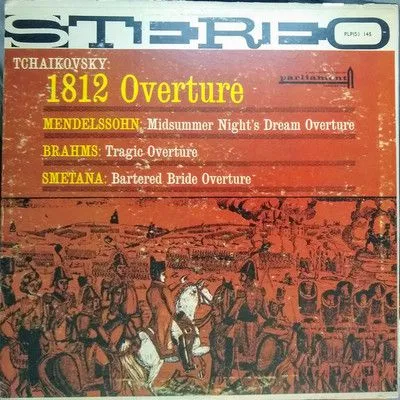
《勃拉姆斯《d小调为管弦乐队而作的悲剧序曲》 /斯美塔那《被出卖的新娘》 /柴可夫斯基《1812序曲》 /门德尔松《仲夏夜之梦》 /拉杰特指挥、舍尔兴指挥、沃格尔指挥、指挥 ,斯洛伐克爱乐乐团,维也纳国家歌剧院室内乐团,国家歌剧院管弦乐团,布拉格交响乐团,瑞典皇家陆军乐团 》
藝人
Johannes Brahms
,Bedrich Smetana
,Pyotr Ilyich Tchaikovsky
,Felix Mendelssohn
,Orchestra of the Theater National de L’Opera
,Jaroslav Vogel
,Slovak Philharmonic Orchestra
,František Satupk
,Royal Swedish Army Band (The Band Of The Royal Swedish Army)
,Prague Symphony Orchestra
,Ľudovít Rajter
,Chamber Orchestra of the Vienna State Opera
,Hermann Scherchen
類型专辑
年份1961
簡介
1812 Overture
The Year 1812 Solemn Overture, Op. 49, popularly known as the1812 Overture,[1]is aconcert overtureinE♭majorwritten in 1880 byRussiancomposerPyotr Ilyich Tchaikovskyto commemoratethe successful Russian defenseagainstNapoleon's invadingGrande Arméein 1812. The overture debuted in Moscow on 20 August 1882,[2]conducted byIppolit Al'taniunder a tent near the then-unfinishedCathedral of Christ the Saviour, which also memorialized the 1812 defense of Russia.[3]Tchaikovsky himself conducted another performance at the dedication ofCarnegie HallinNew York City.[4]That was one of the first times a major European composer visited the United States.[5] The 15-minute overture is best known for its climactic volley ofcannonfire, ringingchimes, and abrassfanfarefinale. It has also become a common accompaniment tofireworksdisplays on the United States'Independence Day. The1812 Overturewent on to become one of Tchaikovsky's most popular works, along with his ballet scores toThe Nutcracker,The Sleeping Beauty, andSwan Lake.摘自:https://en.wikipedia.org/wiki/1812_Overture
The Bartered Bride
The Bartered Bride(Czech:Prodaná nevěsta,The Sold Bride) is acomic operain three acts by the Czech composerBedřich Smetana, to alibrettobyKarel Sabina. The work is generally regarded as a major contribution towards the development ofCzech music. It was composed during the period 1863 to 1866, and first performed at theProvisional Theatre, Prague, on 30 May 1866 in a two-act format withspoken dialogue. Set in a country village and with realistic characters, it tells the story of how, after a late surprise revelation, true love prevails over the combined efforts of ambitious parents and a schemingmarriage broker. The opera was not immediately successful, and was revised and extended in the following four years. In its final version, premiered in 1870, it rapidly gained popularity and eventually became a worldwide success. Until this time, the Czech national opera had only been represented by minor, rarely performed works. This opera, Smetana's second, was part of his quest to create a truly Czech operatic genre. Smetana's musical treatment made considerable use of traditional Bohemian dance forms, such as thepolkaandfuriant, and, although he largely avoided the direct quotation offolksong, he nevertheless created music considered by Czechs to be quintessentially Czech in spirit. The overture, often played as a concert piece independently from the opera, was, unusually, composed before almost any of the other music had been written. After a performance at the Vienna Music and Theatre Exhibition of 1892, the opera achieved international recognition. It was performed in Chicago in 1893, London in 1895 and reached New York in 1909, subsequently becoming the first, and for many years the only, Czech opera in thegeneral repertory. Many of these early international performances were in German, under the titleDie verkaufte Braut, and the German-language version continues to be played and recorded.A German filmof the opera was made in 1932 byMax Ophüls. Context Until the middle 1850s Bedřich Smetana was known in Prague principally as a teacher, pianist and composer of salon pieces. His failure to achieve wider recognition in the Bohemian capital led him to depart in 1856 for Sweden, where he spent the next five years.[1]During this period he extended his compositional range to large-scale orchestral works in the descriptive style championed byFranz LisztandRichard Wagner.[2]Liszt was Smetana's long-time mentor; he had accepted a dedication of the latter's Opus 1:Six Characteristic Pieces for Pianoin 1848, and had encouraged the younger composer's career since then.[3]In September 1857 Smetana visited Liszt inWeimar, where he metPeter Cornelius, a follower of Liszt's who was working on a comic opera,Der Barbier von Bagdad.[4]Their discussions centred on the need to create a modern style of comic opera, as a counterbalance to Wagner's new form ofmusic drama. A comment was made by the Viennese conductorJohann von Herbeckto the effect that Czechs were incapable of making music of their own, a remark which Smetana took to heart: "I swore there and then that no other than I should beget a native Czech music."[4] Smetana did not act immediately on this aspiration. The announcement that a Provisional Theatre was to be opened in Prague, as a home for Czech opera and drama pending the building of a permanent National Theatre, influenced his decision to return permanently to his homeland in 1861.[5]He was then spurred to creative action by the announcement of a prize competition, sponsored by the Czech patriot Jan von Harrach, to provide suitable operas for the Provisional Theatre. By 1863 he had writtenThe Brandenburgers in Bohemiato a libretto by the Czech nationalist poetKarel Sabina, whom Smetana had met briefly in 1848.[5][6]The Brandenburgers, which was awarded the opera prize, was a serious historical drama, but even before its completion Smetana was noting down themes for use in a future comic opera. By this time he had heard the music of Cornelius'sDer Barbier, and was ready to try his own hand at the comic genre.摘自:https://en.wikipedia.org/wiki/The_Bartered_Bride
A Midsummer Night's Dream(Mendelssohn)
At two separate times,Felix Mendelssohncomposed music forWilliam Shakespeare's playA Midsummer Night's Dream(in GermanEin Sommernachtstraum). First in 1826, near the start of his career, he wrote aconcert overture(Op. 21). Later, in 1842, only a few years before his death, he wroteincidental music(Op. 61) for a production of the play, into which he incorporated the existing overture. The incidental music includes the famousWedding March. Overture The overture inE major, Op. 21, was written by Mendelssohn at 17 years and 6 months old (it was finished on 6 August 1826).Contemporary music scholarGeorge Grovecalled it "the greatest marvel of early maturity that the world has ever seen in music".It was written as a concert overture, not associated with any performance of the play. The overture was written after Mendelssohn had read a German translation of the play in 1826. The translation was byAugust Wilhelm Schlegel, with help fromLudwig Tieck. There was a family connection as well: Schlegel's brotherFriedrichmarried Felix Mendelssohn'sAunt Dorothea. While aromanticpiece in atmosphere, the overture incorporates manyclassicalelements, being cast insonata formand shaped by regular phrasings and harmonic transitions. The piece is also noted for its striking instrumental effects, such as the emulation of scampering 'fairy feet' at the beginning and the braying of Bottom as an ass (effects which were influenced by the aesthetic ideas and suggestions of Mendelssohn's friend at the time,Adolf Bernhard Marx).Heinrich Eduard Jacob, in his biography of the composer, surmised that Mendelssohn had scribbled the opening chords after hearing an evening breeze rustle the leaves in the garden of the family's home. The overture begins with four chords in the winds. Following the first theme in the parallel minor (E minor) representing the dancing fairies, a transition (the royal music of the court of Athens) leads to a second theme, that of the lovers. This is followed by the braying of Bottom with the "hee-hawing" being evoked by the strings. A final group of themes, reminiscent of craftsmen and hunting calls, brings theexpositionto a close. The fairies dominate most of thedevelopmentsection, while the Lover's theme is played in a minor key. The recapitulation begins with the same opening four chords in the winds, followed by the Fairies theme and the other section in the second theme, including Bottom's braying. The fairies return, and ultimately have the final word in thecoda, just as in Shakespeare's play. The overture ends once again with the same opening four chords by the winds. The overture was premiered in Stettin (then inPrussia; nowSzczecin,Poland) on 20 February 1827,at a concert conducted byCarl Loewe. Mendelssohn had turned 18 just over two weeks earlier. He had to travel 80 miles through a raging snowstorm to get to the concert,which was his first public appearance. Loewe and Mendelssohn also appeared as soloists in Mendelssohn's Concerto in A-flat major for two pianos and orchestra, and Mendelssohn alone was the soloist forCarl Maria von Weber'sKonzertstück in F minor. After the intermission, he joined the first violins for a performance ofBeethoven'sNinth Symphony. The first British performance of the overture was conducted by Mendelssohn himself, on 24 June 1829, at theArgyll Roomsin London, at a concert in benefit of the victims of the floods inSilesia, and played by an orchestra that had been assembled by Mendelssohn's friend SirGeorge Smart.摘自:https://en.wikipedia.org/wiki/A_Midsummer_Night%27s_Dream_(Mendelssohn)