
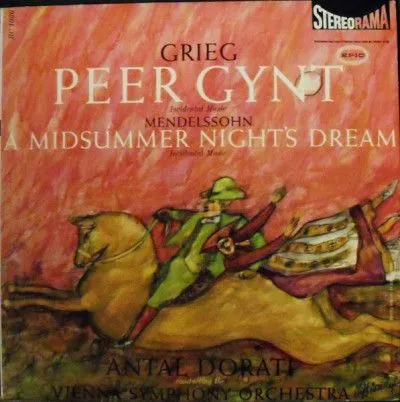
《门德尔松《仲夏夜之梦》 /格里格《培尔·金特,配乐》 /多拉蒂指挥 ,维也纳爱乐交响乐团 》
簡介
Peer Gynt(Grieg)
Peer Gynt,Op.23, is theincidental musictoHenrik Ibsen's 1867play of the same name, written by the Norwegian composerEdvard Griegin 1875. It premiered along with the play on 24February 1876 inChristiania(now Oslo).
Grieg later created twosuitesfrom his Peer Gynt music. Some of the music from these suites has received coverage in popular culture; seeGrieg's music in popular culture.
Background
Edvard Grieg(1843-1907) was one of the definitive leaders of Scandinavian music and his influence was great. Although composing many short piano pieces and chamber works, the work Grieg did forHenrik Ibsenstood out. Originally composing 90 minutes of orchestral music for the play, he later went back and extracted certain sections for the suites. Peer Gynt's travels around the world and distant lands are represented by the instruments Grieg chooses to use.
When Ibsen asked Grieg to write music for the play in 1874, he reluctantly agreed. However, it was much more difficult for Grieg than he imagined. "Peer Gyntprogresses slowly," he wrote to a friend in August 1874, “and there is no possibility of having it finished by autumn. It is a terribly unmanageable subject.”
Letter from Henrik Ibsen to Grieg, January 23, 1874.
"The more he saturated his mind with the powerful poem, the more clearly he saw that he was the right man for a work of such witchery and so permeated with the Norwegian spirit,"his wifewrote of him and his music.Even though the premiere was a "triumphant success", it prompted Grieg to complain bitterly that the Swedish management of the theatre had given him specifications as to the duration of each number and its order: "I was thus compelled to do patchwork... In no case had I opportunity to write as I wanted... Hence the brevity of the pieces," he said.
For many years, the suites were the only parts of the music that were available, as the original score was not published until 1908, one year after Grieg's death, byJohan Halvorsen.
摘自:https://en.wikipedia.org/wiki/Peer_Gynt_(Grieg)
A Midsummer Night's Dream(Mendelssohn)
At two separate times,Felix Mendelssohncomposed music forWilliam Shakespeare's playA Midsummer Night's Dream(in GermanEin Sommernachtstraum). First in 1826, near the start of his career, he wrote aconcert overture(Op. 21). Later, in 1842, only a few years before his death, he wroteincidental music(Op. 61) for a production of the play, into which he incorporated the existing overture. The incidental music includes the famousWedding March.
Overture
The overture inE major, Op. 21, was written by Mendelssohn at 17 years and 6 months old (it was finished on 6 August 1826).Contemporary music scholarGeorge Grovecalled it "the greatest marvel of early maturity that the world has ever seen in music".It was written as a concert overture, not associated with any performance of the play. The overture was written after Mendelssohn had read a German translation of the play in 1826. The translation was byAugust Wilhelm Schlegel, with help fromLudwig Tieck. There was a family connection as well: Schlegel's brotherFriedrichmarried Felix Mendelssohn'sAunt Dorothea.
While aromanticpiece in atmosphere, the overture incorporates manyclassicalelements, being cast insonata formand shaped by regular phrasings and harmonic transitions. The piece is also noted for its striking instrumental effects, such as the emulation of scampering 'fairy feet' at the beginning and the braying of Bottom as an ass (effects which were influenced by the aesthetic ideas and suggestions of Mendelssohn's friend at the time,Adolf Bernhard Marx).Heinrich Eduard Jacob, in his biography of the composer, surmised that Mendelssohn had scribbled the opening chords after hearing an evening breeze rustle the leaves in the garden of the family's home.
The overture begins with four chords in the winds. Following the first theme in the parallel minor (E minor) representing the dancing fairies, a transition (the royal music of the court of Athens) leads to a second theme, that of the lovers. This is followed by the braying of Bottom with the "hee-hawing" being evoked by the strings. A final group of themes, reminiscent of craftsmen and hunting calls, brings theexpositionto a close. The fairies dominate most of thedevelopmentsection, while the Lover's theme is played in a minor key. The recapitulation begins with the same opening four chords in the winds, followed by the Fairies theme and the other section in the second theme, including Bottom's braying. The fairies return, and ultimately have the final word in thecoda, just as in Shakespeare's play. The overture ends once again with the same opening four chords by the winds.
The overture was premiered in Stettin (then inPrussia; nowSzczecin,Poland) on 20 February 1827,at a concert conducted byCarl Loewe. Mendelssohn had turned 18 just over two weeks earlier. He had to travel 80 miles through a raging snowstorm to get to the concert,which was his first public appearance. Loewe and Mendelssohn also appeared as soloists in Mendelssohn's Concerto in A-flat major for two pianos and orchestra, and Mendelssohn alone was the soloist forCarl Maria von Weber'sKonzertstück in F minor. After the intermission, he joined the first violins for a performance ofBeethoven'sNinth Symphony.
The first British performance of the overture was conducted by Mendelssohn himself, on 24 June 1829, at theArgyll Roomsin London, at a concert in benefit of the victims of the floods inSilesia, and played by an orchestra that had been assembled by Mendelssohn's friend SirGeorge Smart.
摘自:https://en.wikipedia.org/wiki/A_Midsummer_Night%27s_Dream_(Mendelssohn)#cite_note-5