
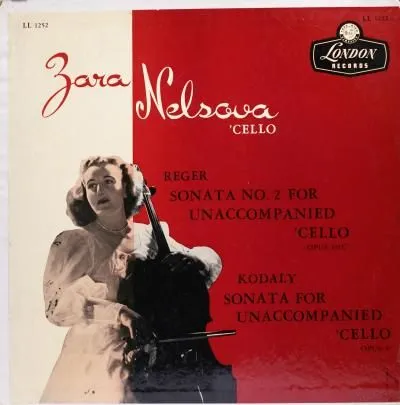
《柯达伊、雷格&巴赫:无伴奏大提琴作品》
類型专辑
年份未知
簡介
专辑介绍:COLIN MASON
it to be the regular part of our experience that it deserves to be.
miracle—but a miracle that too few ’cellists will ever be able to perform for
masterpiece. As a solo ’cello sonata it is more than a masterpiece, it is a
string quartet, or at any rate of a string trio, it would be a popular
distributed among the instruments of a
it belongs beside his Second String Quartet, and if its content were
consisting of a more loosely linked succession of dance-like episodes. In style
movement, all passionate rhapsodic melody, and a strongly rhythmic finale
concentrated and highly original sonata-form first movement, an expansive slow
chamber-music period, a big sonata design, with a lyrical but terse,
the other hand wrote a work completely characteristic of his early
Reger, to the language of it). Kodaly on
the Bachian model of the solo sonata (though not, like
too, a quarter of a century after his slighting comment on Reger, reverted to
instead of the suite-like succession of Bartok’s four movements. For Bartók
greater, since his work is divided into three sustained sonata-type movements
still larger scale, is equally “all right”, and his achievement is perhaps even
afraid it would be too much. But it was all right”. Kodaly’s Sonata too, on a
friend: “Imagine, nearly twenty-five minutes of unaccompanied violin. I was
Bartók is apt. After finishing his Sonata for solo violin, he wrote to a
distract from the pure musical enjoyment of the work. Again a quotation from
and amazing variety of the sound, with never a hint of a tour de force to
demands, we can forget it, out ear delighting in the natural fullness, richness
medium, but here, when the player commands the full technique that the work
completely unaware of the composer’s struggles with the limitations of the
rarely, in listening to an unaccompanied string work, that we can remain
achievement is to do all this without betraying any sense of strain. It is
compass, to a height undreamt of by Bach or Reger. But his greatest technical
string player. He also takes the instrument to the extreme limits of its
glissandos, besides many subtleties of technique that would occur only to a
left-hand pizzicato notes against sustained bowed notes or passages, pizzicato
frequently in the other two. Other devices include a liberal use of .harmonics,
open strings occurs frequently throughout the first movement, and less
minor. The principal key of the work is B minor, and this tonic chord on the
is drawn across the three lower strings, unstopped, they give a chord of B
strings of the instrument from G and C to F sharp and B, so that when the bow
with a rich and varied background. One of them is to tune down the two lower
almost inconceivable ones (“incredible” as Bartók calls them), to provide it
melody unaccompanied, but exploits every conceivable technical device, and some
making full use of the melodic nature of the instrument, rarely leaves the
consistently even than Bach, for a single line of pure melody. Kodaly, while
misleading. It is Reger rather than Kodaly who usesthe ’cello in this way, more
reference to (the simplest possible means, a single melodic instrument', is
slow movement and 50 bars in the last movement). In one sense Bartok’s
scope and in duration (in this performance there are cuts of 23 bars in the
repertory. For unlike the Reger suite it is a serious work, immense both in
when properly played the most effective) serious work in tile entire ’cello
possibilities to the full, in what is almost certainly the most difficult (but
consulted Kerpely, the virtuoso ’cellist to whom the work is dedicated. He uses all these
naturally aware of far greater technical possibilities, and no doubt he also
be recognized as the same instrument. As a ’cellist himself Kodaly was
on the other side of the record is so entirely different that it is hardly to
complete the side.What Kodaly does with the same technical means at his disposal
Suite for unaccompanied ’cello, which
bourrées from Bach’s own Third
figuration. Just how close may be verified by comparing them with the two
pastiche, sticking very closely to Bach’s musical language both in harmony and
direct reference to Bach, they make no pretence of being anything but light
movements (Prelude, Largo and Gigue) are not specifically humorous and make no
the clue to the character of the whole work, and although the other three
dotted about the movement also add to its humorous effect. This movement gives
mode, as of a humorous wrong note. The sudden pizzicato chords and bass notes
movement, with the effect not so much of a modulation, still less of a Lydian
jocularity is confirmed in the persistent sharpening of the fourth throughout this
E major Partita for unaccompanied violin. It is a jocular reference, and the
which makes an unmistakable reference in its first bar to the Gavotte in Bach’s
anything else, as is immediately clear from the second movement, a Gavotte,
imitation that this suite is. The Suite for its part is not intended to be
is the beginning and end of all music”, not all his own music is the pure Bach
revolutionary in his treatment of tonality. Although he once said “For me Bach
according to Kodaly, studied his works carefully), but was also considered a
as it can ever be. But at that time he was not only important (Bartok himself,
reputation declined quickly after his early death, and is now probably as low
unaccompanied ’cello, and (d) Three Suites for unaccompanied viola. Reger’s
for unaccompanied violin, (b) Three Duos for two violins, (c) Three Suites for
is No. 2 of Op. 131c. Opus 131 complete consists of (a) Six Preludes and Fugues
dignified every little song with a separate opus number. This suite, for instance,
taking account of his works without opus numbers. Nor was he a composer who
forty-three, the list of his opus numbers was only a few short of 150—not
prolific composers since Schubert. When Reger died in 1916 at the age of
whereas Reger’s suite is a rather minor work in the output of one of the most
a composer who has produced relatively little in over seventy years of life,
two works. Kodaly’s Sonata is one of the most important works in the output of
any comparison of Reger’s and Kodaly’s relative stature on the basis of these
and rather conservatively represented. But it would be unfair to try to make
such a struggle to free itself, and which Reger’s music completely, faithfully
nineteenth century “Teutonic’ musical ideals from which Hungarian music was having
possible to detect in this a trace of his and Kodaly’s dislike of the
dismissal of Reger’s ‘Bach imitations’ entirely unjustified, although it is
enthusiasm for the Kodaly is fully justified. Nor is his rather slighting
Bartok’s
repertory, otherwise so poor in original works”.
incredible instrumental effects, is a very valuable contribution to the ’cello
This three-movement sonata, abounding in formidable technical difficulties and
is a completely new handling of the instrument, with new and original material.
imitation of Bach’s polyphonic style, like Reger’s Sonata for solo violin, it
particularly want to stress the word (today’. This work is in no sense an
music of today with the simplest possible means, a single melodic instrument. I
Sonata, he says: “The aim of this composition was to fulfil the demands of the
’cello suites, which Bartók evidently did not yet know. Writing of the Kodaly
as well as sixteen preludes and fugues), but it would apply equally to the
he mentions is a sonata for unaccompanied violin (of winch Reger wrote eleven,
that Kodaly’s great friend and compatriot Bartók wrote in 1920. The Reger work
medium was more unusual than it is today. We may quote, for example, a passage
comparisons. It did so even more when these works were new, and their choice of
such a chance similarity as the use of the same medium inevitably invites
Kodaly was attracted to this problem.In spite of these essential differences,
a difficult and fascinating technical problem, it was as a ’cellist himself that
it was probably written partly out of a desire on the composer’s part to tackle
music. The ’Cello Sonata shows no trace of it, and although like Reger’s suites
any medium. Bach’s influence on Kodaly on the other hand went mainly into his choral
recent quintessentially German composer Hindemith, to exercise his invention in
prolific all-round musician-composer, like Bach himself, or that still more
and the viola) was simply an example of his readiness and ability, as an immensely
choosing the ’cello here (as for other unaccompanied works he chose the violin
for unaccompanied ’cello. Reger’s ‘personal’ instrument was the piano, and his
his admiration for Bach that led Reger to try to imitate the example of his suites
of Bach. Even this influenced them in completely different ways. It was solely
set out. Their composers had equally little in common—nothing beyond their love
1915, all that they have in common, apart from their identity of medium, has been
it has been said that the two main works of this record belong to the same year,
When
Zara Nelsova Cello
SUITE No. 3 IN C MAJOR
BACH: Bourrées I and II from
4th Mov. Gigue (Vivace)
3rd Mov. Largo
2nd Mov. Gavotte (Allegretto)
1st Mov. Prelüde (Largo)
’ÇELLO, Op. 131C
REGER: SUITE No. 2 FOR UNACCOMPANIED
Side 2
3rd Mov. Allegro molto vivace
2nd Mov. Adagio (Con gran espressione)
1st Mov. Allegro maestoso ma appassionato
Op. 8
KODÁLY: SONATA FOR UNACCOMPANIED ’CELLO,
Side 1
KODÁLY、REGER&BACH:CELLO LL 1152