
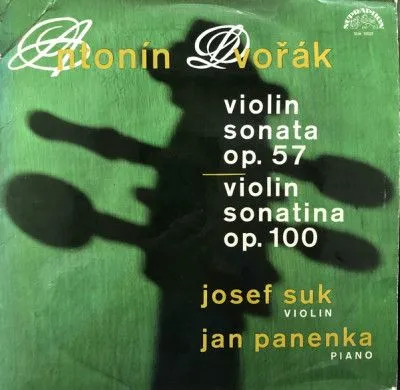
《德沃夏克《F大调为小提琴和钢琴而作的奏鸣曲》《G大调为小提琴和钢琴而作的小奏鸣曲》/钢琴J·帕年卡小提琴J·苏克》
類型专辑
年份1963
簡介
Antonín Dvořák's String Quartet No. 8. in E major, Op.80 (B.57), is a chamber composition, written between 20 January and 4 February 1876 in Prague.
The work, originally marked as Op.27, was composed shortly after finishing the Piano Trio in G minor, Op. 26, and before the beginning of the sketchings for the Stabat Mater cantata.
The quartet was published in 1888 by Fritz Simrock in Berlin as Op.80, although Dvořák protested.[1] The first performance took place on 29 December 1890 at the concert of the Joachim Quartet in Berlin, played by Joachim, Hegemeister, Wirth and Diepert.
The recent loss of Dvořák's second child is apparent in his works from this period.[1] The quartet, like the Stabat Mater and Piano Trio No.2, is sad and nostalgic. Although nominally in a major key, themes are often presented in a minor key. The expression of melancholy and sorrow is apparent throughout the work.[1]
A typical performance lasts about 28 minutes.
The Sonatina in G major for violin and piano (Czech: Sonatina G dur pro housle a klavír),Op.100, B.183, was written by Antonín Dvořák between November 19 and December 3, 1893, in New York City. It was the last chamber composition he wrote during his sojourn in the United States. Dvořák catered the sonatina to the gradually developing musical abilities of his children, especially those of his 15-year-old daughter Ottilie and 10-year-old son Toník. In a letter toFritz Simrock on January 2, 1894, Dvořák conceived the piece in the following terms: "It is intended for youths (dedicated to my two children), but even grown-ups, adults, should be able to converse with it..."[1] The sonatina was published by Simrock in Berlin in 1894. It also exists in a version for cello and piano.
The four short movements of the sonatina each exhibit a simple and clear, formal structure (hence the diminutive, cf. sonata). They all contain themes, which, like those already found in his other American chamber works (the String Quartet in F and the String Quintet in E♭), owe their inspiration to Indian melodies and Negro spirituals, which are characterized by pentatonic scales and syncopated rhythm, among other traits. The mood of the composition is fresh and joyful. Only the second movement and part of the last movement are nostalgic; they are inspired by the composer's longing for his home country.[2]
The slow movement Larghetto was hurriedly noted down on Dvořák's shirt sleeve while on a visit to Minnehaha Falls, in Minneapolis, Minnesota.[3] Simrock sold this movement separately, without the composer's permission, and Fritz Kreisler often performed it as Indian Lament. It also appeared as Indian Canzonetta; such romantic titles were not the composer's, but were added subsequently by publishers.
摘自:https://en.wikipedia.org/wiki/String_Quartet_No.8(Dvo%C5%99%C3%A1k)、https://en.wikipedia.org/wiki/Violin_Sonatina_(Dvo%C5%99%C3%A1k)