
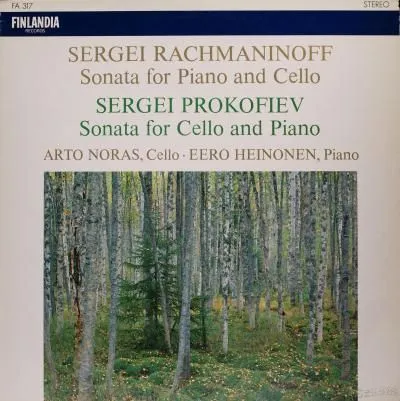
《拉赫玛尼诺夫&普罗科菲耶夫:大提琴奏鸣曲》
類型专辑
年份未知
簡介
专辑介绍:instructor of piano at the Sibelius Academy in Helsinki.
performed and recorded, both in Finland and abroad. He is also active as a senior
Competition in Moscow and made it into the finals. Eero Heinonen has frequently
national Maj Lind Piano Competition in 1966, Heinonen entered the 1974 Tchaikovsky
Moscow Conservatory, where his teacher was Dimitri Bashkirov. Having won the
pianists. Upon completion of his studies in Finland. Heinonen continued at the
Eero Heinonen (b. 1950) is one of Finland's most renowned and respected
Noras has recorded extensively, both in Finland and abroad.
Europe, North and South America, where he continues to appear regularly. Arto
Competition in Moscow. This opened his way to the most important concert halls in
in 1964. Two years later he was awarded Second Prize at the Tchaikovsky
Paul Tortelier at the Paris Conservatoire, where he received the "Premier Prix”
completing his studies at the Sibelius Academy, Noras went to Paris to study with
instrumentalist, one of the most outstanding cellists of his generation. After
Arto Noras (b. 1942) is in addition to being the most celebrated Finnish
Kevin Klelnmann
altering it in the coda.
material from the main theme of the first movement, enlarging and rhythmically
The finale is, like the first movement, in the classical spirit and utilizes
Wolf, while its trio (Andante dolce) recalls a love scene from Romeo and Juliet.
scherzo (Moderato), reminds us of the playful Prokofiev who composed Peter and the
marked by strong dramatic contrasts and lyrical qualities. The second movement's
The long first movement (Andantegrave), in sonata form, is a slow movement
1933-38.
earlier compositions, notably the First Cello Concerto, Op. 58, composed between
Sinfonía Concertante, it is full of clean-cut harmonies that differ from his
passion, but maintains a tendency towards lyricism and simplification. Like the
Cello Sonata, whose sharply contrasted writing alternates between reverie and
The serenity that imbues the Ninth Plano Sonata, Op. 103 is absent from the
recorded it
propagation in the Western world is credited to Gregor Piatigorsky, who also
Moscow during March 1950 and performed it frequently thereafter! Its initial
Rostropovich and Sviatoslav Richter gave the Cello Sonata its public première in
unaccompanied sonata were left unfinished upon his death in 1953. Mstislav
as well as a Sonata for Cello Unaccompanied. Op. 134. Both the Concertino and the
Concertante. Op. 125 and planned the Concertino for Cello and Orchestra, Op. 132
he revised the Second Cello Concerto, which was to become the Sinfonía
spring of 1949. This close cooperative work was in a way a revelation; soon after
assistance of cellist Mstislav Rostropovich, the Sonata was completed in the
inspiration for the composition of a Sonata for Cello and Piano. With the
appease the Soviet authorities, he was reserving the best of his artistic
At the same time as Prokofiev was composing these and other works with themes to
fraternize to save civilization, our children and our future.”
and peace and the certainty that there will be no more war, that all peoples will
the people ... In this work I have tried to express my thoughts and ideas on war
of mothers and orphans, of towns destroyed by fire and the terrible sufferings of
Prokofiev's words, "... of the difficult days of the Second World War. the tears
a most educative oratorio. Guarding the Peace. The latter work tells in
complied and sought redemption by composing a popular ballet. The Stone Flower and
the Communist Party and the Congress of the Soviet Composer's Union, the composer
Following the violent attacks on Prokofiev in 1948 by the Central Commilee of
works.
making a suitable conclusion to one of the cello literature's most rapturous
finale. Allegro mosso, is large in its conception and dramatic in its expression,
recalling the composer’s sombre state of mind the preceding year. The rondo-like
movement. Andante, in ABA song form is tinged with a bitter-sweet melancholy
scherzando (scherzo-trio-scherzo) of remarkable craftsmanship. The lyrical third
allegro with a slow introduction. The second movement is a brooding Allegro
the sonata form’s basic laws. The first movement. Allegro moderato, is a sonata-
Structurally the Sonata could not be more traditional, as it adheres to all of
composing in a realm that we generally don’t associate with him.
partners throughout and this work serves to prove the composer’s great talent for
of well proportioned late-Romantic ensemble writing. The piano and cello are equal
which became Rachmaninoff's trademark, it is one of the last and finest examples
though the piano writing is immense, characterized by that gargantuan piano sound
not lead one to believe that here we have a Sonata for Piano with Cello. Even
obvious, but this fact, and its title which gives precedence to the piano, should
work is dedicated. The Sonata’s resemblance to the Second Piano Concerto is
on December 2, 1901 by the composer and cellist Anatoli Brandukov, to whom the
work on the Sonata for Piano and Cello. The Sonata received its première in Moscow
completed the Second Piano Concerto (dedicated to Dr. Dahl) and immediately set to
hypnosis in Moscow. The sessions with Dr. Dahl proved successful and Rachmaninoff
his desperation Rachmaninoff turned to Dr. Nikolai Dahl, a practitioner of
work that saw creation alter a long bout with depression and morbid pessimism. In
interesting, when we note that it follows the Second Plano Concerto. Op. 18; a
The opus number and date of composition make this sonata especially
youthful work, written when the composer was twenty-eight years old.
during the summer of 1901 and completed during December of that year. It is a
The RachmaninofT Sonata for Piano and Cello in G minor. Op. 19 was composed
no option other than to adapt to circumstances and comply.
Prokofiev would have wanted to retract that statement later on, but in 1949 he had
contemporaries, but has no hope of surviving his own generation.” Perhaps
is not a master but a pupil Such a composer is easily accepted by his
simply according to the rules established by previous classics signifies that one
This work is by the same Prokofiev who some years earlier boldly stated, "To write
regime, who in 1948 accused him offormalism, decadence and artistic delusions.
change dictated not so much by his own artistic sense as by that of the Soviet
radical change towards great simplicity, melodic richness and classicism. It was a
the 1920’s, his Sonata for Cello and Plano. Op. 119, composed in 1949, marked a
vogue. For Sergei Prokofiev, a composer closely associated with the avant-garde of
as the schools of the recently deceased Tchaikovsky and Brahms were very much in
for Piano and Cello in 1901 was one of choice with respect to prevailing tastes,
twentieth-century. The style Sergei Rachmaninoff used when composing his Sonata
Romanticism and adherence to classical principles during the first half of the
The two sonatas on this record are excellent contrasting examples of laie-
Eero Heinonen, Piano
Arto Noras, Cello
Allegro ma non troppo [8’02]
4.(III) Allegro ma non troppo - Andantino
Moderato primo[3’48]
3.(II) Moderato - Andante dolce-
- Lento - Allegro moderato [11 ’52]
2.(I) Andante grave - Moderato animato
Sonate für Violoncello und Klavier op. 119
Sonat för violoncell och piano op. 119
Sonaatti sellolle ja pianolle op. 119
Sonata for Cello and Piano, Op. 119
(1891-1953)
Sergei Prokofiev
1.(IV) Allegro mosso[10’54]
Side 2:
3.(III) Andante[6’04]
2.(II) Allegro scherzando[5’44]
1.(I) Lento - Allegro moderato [13’29]
Sonate für Klavier und Violoncello g-moll op. 19
Sonat for piano och violoncell, g-moll op. 19
Sonaatti pianolle ja sellolle g-molli op. 19
Sonata for Piano and Cello in G minor, Op. 19
(1873-1943)
Sergei Rachmaninoff
Side 1:
ARTO NORAS, Cello • EERO HEINONEN, Piano
RACHMANINOFF&PROKOFIEV:Cello Sonata