
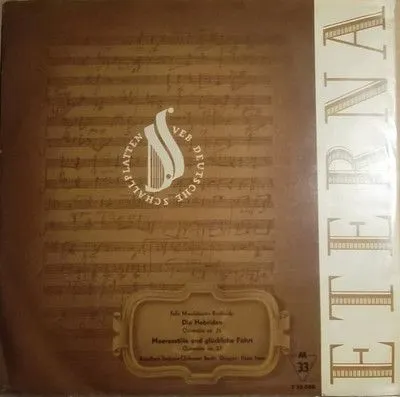
《门德尔松《赫布里底群岛“芬格尔山洞” b小调为管弦乐队而作的音乐会序曲 第2序曲》 《平静的海与幸福的航行(音乐会序曲,D大调为管弦乐队而作)(根据约翰·沃尔夫冈·冯·歌德的诗歌而作 )第3序曲》》
簡介
The Hebrides(overture)
Felix Mendelssohn'sconcert overtureThe Hebrides(/ˈhɛbrɪdiːz/;German:Die Hebriden) was composed in 1830, revised in 1832, and published the next year as hisOp.26. Some consider it an earlytone poem.[1][2] It was inspired by one of Mendelssohn's trips to the British Isles, specifically an 1829 excursion to the Scottish island ofStaffa, with its basalt sea cave known asFingal's Cave. It was reported that the composer immediately jotted down the opening theme for his composition after seeing the island. He at first called the workTo the Lonely IslandorZur einsamen Insel, but then settled on the present title. However, in 1834, the year after the first publication,Breitkopf & Härtelissued an edition with the nameFingalshöhle(Fingal's Cave) and this title stuck, causing some confusion. Being a concert overture,The Hebridesdoes not precede a play oropera, but is instead a standalone composition in a form common for theRomantic period. Dedicated to KingFrederick William IV of Prussia, then Crown Prince of Prussia, the B minor work became part of the standard orchestral repertoire and retains this position to the present day. Background Mendelssohn's first visit to England in 1829 resulted from invitations bySir George Smartand thePhilharmonic Society.[3]Following his tour of England, Mendelssohn proceeded toScotland, where he began work on hisSymphony No. 3,Scottish.[4]He was engaged on a tour of Scotland with his travelling companion Karl Klingemann when he sent a postcard to his family with the opening phrase of the overture written on it. In a note to his sisterFanny, he said: "In order to make you understand how extraordinarily the Hebrides affected me, Isend you the following, which came into my head there."[5]The cave at that time was approximately 35 feet (11m) high and over 200 feet (61m) deep, and contained blackbasaltpillars.[5] The work was completed on 16 December 1830[6]and was originally entitledDie einsame Insel(The Lonely Island). However, Mendelssohn later revised the score and renamed the pieceDie Hebriden(The Hebrides). Despite this, the title ofFingal's Cavewas also used: on the orchestral parts he labelled the musicThe Hebrides, but on the score Mendelssohn labelled the musicFingal's Cave.[5]This revision of the overture was premiered on 14 May 1832 inLondon[6]in a concert conducted byThomas Attwood, that also featured Mendelssohn'sOverture to A Midsummer Night's Dream. The final revision was completed by 20 June 1832.[6]and premiered on 10 January 1833 in Berlin under the composer's own baton.摘自:https://en.wikipedia.org/wiki/The_Hebrides_(overture)
Calm Sea and Prosperous Voyage(Mendelssohn)
Calm Sea and Prosperous Voyage(Meeresstille und glückliche Fahrt), Op. 27, is an orchestralconcert overturebyFelix Mendelssohninspired by the same verses that inspiredBeethoven's 1815cantata of the same title(and indeed inspired by Beethoven's version, which is in the samekey,D major)[citation needed]. Mendelssohn's work was first performed on 7 September 1828 inBerlin. The titles ofGoethe's two poems are not synonymous: in the days before steam, a totally calm sea was cause for alarm; it is only when the wind at last rises that the ship can continue on its journey.[1]Mendelssohn's version concludes with a fanfare of trumpets suggesting the ship's final arrival at its port of destination. Scored forpiccolo, 2flutes, 2oboes, 2clarinets, 2bassoons,double bassoon,serpent, 2horns, 3trumpets,timpaniandstrings,[2]the piece is programmatic for its reference of the two poems by Goethe. These two poems were extremely popular, and at the time of the premiere, Mendelssohn could have assumed that the audience would have been familiar with both poems and able to follow the programme of the music with minimal aid. The work is a concert overture - meaning that it is not intended as a prelude to a larger work such as an opera (as 'overture', deriving from the French for 'opening', more often implies). Instead, the piece is performed as an independent piece in a symphonic concert. The term overture here refers to the use of melody and form. However, it could also be considered as an early form oftone poem. Edward Elgarquotes a theme from the overture in the 13th variation of hisEnigma Variationsto represent one of his "friends pictured within" on a ship bound for Australia or New Zealand.摘自:https://en.wikipedia.org/wiki/Calm_Sea_and_Prosperous_Voyage_(Mendelssohn)