
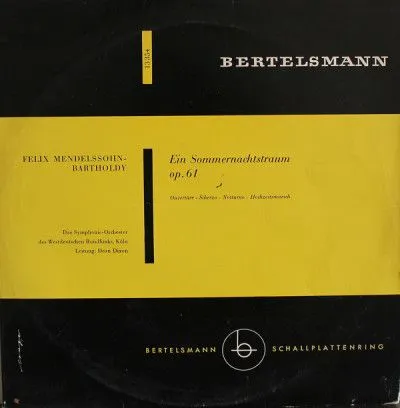
《门德尔松《仲夏夜之梦》 /迪克森指挥 ,科隆广播交响乐团 》
簡介
A Midsummer Night's Dream(Mendelssohn)
At two separate times,Felix Mendelssohncomposed music forWilliam Shakespeare's playA Midsummer Night's Dream(in GermanEin Sommernachtstraum). First in 1826, near the start of his career, he wrote aconcert overture(Op. 21). Later, in 1842, only a few years before his death, he wroteincidental music(Op. 61) for a production of the play, into which he incorporated the existing overture. The incidental music includes the famousWedding March.
Overture
The overture inE major, Op. 21, was written by Mendelssohn at 17 years and 6 months old (it was finished on 6 August 1826).[1]Contemporary music scholarGeorge Grovecalled it "the greatest marvel of early maturity that the world has ever seen in music".[2]It was written as a concert overture, not associated with any performance of the play. The overture was written after Mendelssohn had read a German translation of the play in 1826. The translation was byAugust Wilhelm Schlegel, with help fromLudwig Tieck. There was a family connection as well: Schlegel's brotherFriedrichmarried Felix Mendelssohn'sAunt Dorothea.[3]
While aromanticpiece in atmosphere, the overture incorporates manyclassicalelements, being cast insonata formand shaped by regular phrasings and harmonic transitions. The piece is also noted for its striking instrumental effects, such as the emulation of scampering 'fairy feet' at the beginning and the braying of Bottom as an ass (effects which were influenced by the aesthetic ideas and suggestions of Mendelssohn's friend at the time,Adolf Bernhard Marx).Heinrich Eduard Jacob, in his biography of the composer, surmised that Mendelssohn had scribbled the opening chords after hearing an evening breeze rustle the leaves in the garden of the family's home.[3]
The overture begins with four chords in the winds. Following the first theme in the parallel minor (E minor) representing the dancing fairies, a transition (the royal music of the court of Athens) leads to a second theme, that of the lovers. This is followed by the braying of Bottom with the "hee-hawing" being evoked by the strings. A final group of themes, reminiscent of craftsmen and hunting calls, brings theexpositionto a close. The fairies dominate most of thedevelopmentsection, while the Lover's theme is played in a minor key. The recapitulation begins with the same opening four chords in the winds, followed by the Fairies theme and the other section in the second theme, including Bottom's braying. The fairies return, and ultimately have the final word in thecoda, just as in Shakespeare's play. The overture ends once again with the same opening four chords by the winds.
The overture was premiered in Stettin (then inPrussia; nowSzczecin,Poland) on 20 February 1827,[4]at a concert conducted byCarl Loewe. Mendelssohn had turned 18 just over two weeks earlier. He had to travel 80 miles through a raging snowstorm to get to the concert,[5]which was his first public appearance. Loewe and Mendelssohn also appeared as soloists in Mendelssohn's Concerto in A-flat major for two pianos and orchestra, and Mendelssohn alone was the soloist forCarl Maria von Weber'sKonzertstück in F minor. After the intermission, he joined the first violins for a performance ofBeethoven'sNinth Symphony.
The first British performance of the overture was conducted by Mendelssohn himself, on 24 June 1829, at theArgyll Roomsin London, at a concert in benefit of the victims of the floods inSilesia, and played by an orchestra that had been assembled by Mendelssohn's friend SirGeorge Smart.[4]
Incidental music[edit]
Portrait of Mendelssohn by James Warren Childe, 1839
Mendelssohn wrote theincidental music, Op. 61, forA Midsummer Night's Dreamin 1842, 16 years after he wrote the overture. It was written to a commission from KingFrederick William IV of Prussia. Mendelssohn was by then the music director of the King's Academy of the Arts and of theLeipzig Gewandhaus Orchestra.[6]A successful presentation ofSophocles'Antigoneon 28 October 1841 at the New Palace inPotsdam, withmusic by Mendelssohn (Op. 55)led to the King asking him for more such music, to plays he especially enjoyed.A Midsummer Night's Dreamwas produced on 14 October 1843, also at Potsdam. The producer wasLudwig Tieck. This was followed by incidental music for Sophocles'Oedipus at Colonus(Potsdam, 1 November 1845; published posthumously as Op. 93) andJean Racine'sAthalie(Berlin, 1December 1845; Op. 74).[1]
TheA Midsummer Night's Dreamoverture, Op. 21, originally written as an independent piece 16 years earlier, was incorporated into the Op. 61 incidental music as its overture, and the first of its 14 numbers. There are also vocal sections and other purely instrumental movements, including the Scherzo, Nocturne andWedding March. The vocal numbers include the song "Ye spotted snakes" and the melodramas "Over hill, over dale", "The Spells", "What hempen homespuns", and "The Removal of the Spells". The melodramas served to enhance Shakespeare's text.
Act 1 was played without music. TheScherzo, with its sprightly scoring, dominated by chattering winds and dancing strings, acts as an intermezzo between acts 1 and 2. The Scherzo leads directly into the first melodrama, a passage of text spoken over music. Oberon's arrival is accompanied by a fairy march, scored with triangle and cymbals.
The vocal piece "Ye spotted snakes" ("Bunte Schlangen, zweigezüngt") opens act 2's second scene. The second intermezzo comes at the end of the second act. Act 3 includes a quaint march for the entrance of the Mechanicals. We soon hear music quoted from the overture to accompany the action. TheNocturneincludes a solo horn doubled by bassoons, and accompanies the sleeping lovers between acts 3 and 4. There is only one melodrama in act 4. This closes with a reprise of theNocturneto accompany the mortal lovers' sleep.
The intermezzo between acts 4 and 5 is the famousWedding March, probably the most popular single piece of music composed by Mendelssohn, and one of the most ubiquitous pieces of music ever written.
Act 5 contains more music than any other, to accompany the wedding feast. There is a brief fanfare for trumpets and timpani, a parody of a funeral march, and aBergamaskdance. The dance uses Bottom's braying from the overture as its main thematic material.
The play has three brief epilogues. The first is introduced with a reprise of the theme of theWedding Marchand the fairy music of the overture. AfterPuck's speech, the final musical number is heard – "Through this house give glimmering light" („Bei des Feuers mattem Flimmern“), scored forsoprano,mezzo-sopranoand women'schorus. Puck's famous valedictory speech "If we shadows have offended" is accompanied, as day breaks, by the four chords first heard at the very beginning of the overture, bringing the work full circle and to a fitting close.
摘自:https://en.wikipedia.org/wiki/A_Midsummer_Night%27s_Dream_(Mendelssohn)