
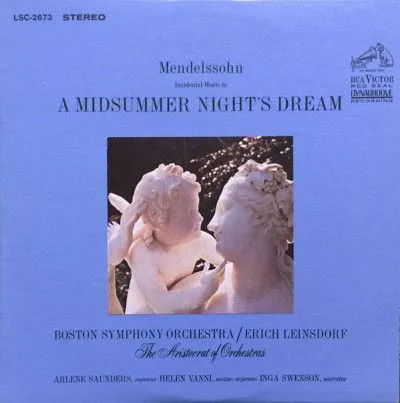
《门德尔松《仲夏夜之梦》-莱因斯多夫指挥波士顿交响乐团&合唱团/阿琳·桑德斯,女高音/海伦·瓦尼,女中音演唱》
簡介
A Midsummer Night's Dream(Mendelssohn)
At two separate times,Felix Mendelssohncomposed music forWilliam Shakespeare's playA Midsummer Night's Dream(in GermanEin Sommernachtstraum). First in 1826, near the start of his career, he wrote aconcert overture(Op. 21). Later, in 1842, only a few years before his death, he wroteincidental music(Op. 61) for a production of the play, into which he incorporated the existing overture. The incidental music includes the famousWedding March.
Overture
The overture inE major, Op. 21, was written by Mendelssohn at 17 years and 6 months old (it was finished on 6 August 1826).Contemporary music scholarGeorge Grovecalled it "the greatest marvel of early maturity that the world has ever seen in music".It was written as a concert overture, not associated with any performance of the play. The overture was written after Mendelssohn had read a German translation of the play in 1826. The translation was byAugust Wilhelm Schlegel, with help fromLudwig Tieck. There was a family connection as well: Schlegel's brotherFriedrichmarried Felix Mendelssohn'sAunt Dorothea.
While aromanticpiece in atmosphere, the overture incorporates manyclassicalelements, being cast insonata formand shaped by regular phrasings and harmonic transitions. The piece is also noted for its striking instrumental effects, such as the emulation of scampering 'fairy feet' at the beginning and the braying of Bottom as an ass (effects which were influenced by the aesthetic ideas and suggestions of Mendelssohn's friend at the time,Adolf Bernhard Marx).Heinrich Eduard Jacob, in his biography of the composer, surmised that Mendelssohn had scribbled the opening chords after hearing an evening breeze rustle the leaves in the garden of the family's home.
The overture begins with four chords in the winds. Following the first theme in the parallel minor (E minor) representing the dancing fairies, a transition (the royal music of the court of Athens) leads to a second theme, that of the lovers. This is followed by the braying of Bottom with the "hee-hawing" being evoked by the strings. A final group of themes, reminiscent of craftsmen and hunting calls, brings theexpositionto a close. The fairies dominate most of thedevelopmentsection, while the Lover's theme is played in a minor key. The recapitulation begins with the same opening four chords in the winds, followed by the Fairies theme and the other section in the second theme, including Bottom's braying. The fairies return, and ultimately have the final word in thecoda, just as in Shakespeare's play. The overture ends once again with the same opening four chords by the winds.
The overture was premiered in Stettin (then inPrussia; nowSzczecin,Poland) on 20 February 1827,at a concert conducted byCarl Loewe. Mendelssohn had turned 18 just over two weeks earlier. He had to travel 80 miles through a raging snowstorm to get to the concert,which was his first public appearance. Loewe and Mendelssohn also appeared as soloists in Mendelssohn's Concerto in A-flat major for two pianos and orchestra, and Mendelssohn alone was the soloist forCarl Maria von Weber'sKonzertstück in F minor. After the intermission, he joined the first violins for a performance ofBeethoven'sNinth Symphony.
The first British performance of the overture was conducted by Mendelssohn himself, on 24 June 1829, at theArgyll Roomsin London, at a concert in benefit of the victims of the floods inSilesia, and played by an orchestra that had been assembled by Mendelssohn's friend SirGeorge Smart.
摘自:https://en.wikipedia.org/wiki/A_Midsummer_Night%27s_Dream_(Mendelssohn)