
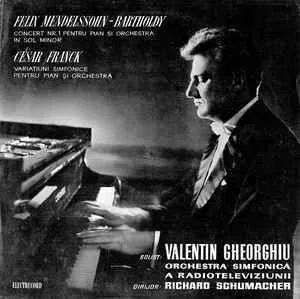
《弗朗克《交响变奏曲,为钢琴和管弦乐队而作》 /门德尔松《g小调为钢琴和管弦乐队而作音乐会曲,第1协奏曲》 /格奥尔基钢琴 ,舒马赫(2)指挥 ,罗马尼亚广播电视交响乐团 》
César Franck
,Felix Mendelssohn
,Richard Schumacher
,Valentin Gheorghiu
,Orchestra Simfonică A Radioteleviziunii Române
類型专辑
年份1963
簡介
Piano Concerto No. 1 (Mendelssohn)
Mendelssohn'sPiano Concerto No. 1inG minor,Op.25, was written in 1830–31, around the same time as hisfourth symphony("Italian"), and premiered inMunichin October 1831. This concerto was composed in Rome during a travel in Italy after the composer met a pianist in Munich. Mendelssohn attended one party after another in Munich in October 1831, the month of the premiere, but he also playedchamber musicand taughtdouble counterpoint. He performed the piece himself at the premiere, which also included performances of hisSymphony No. 1and the Overture fromMidsummer Night's Dream.[1]He had already written a piano concerto in A minor with string accompaniment (1822) and two concertos with two pianos (1823–24).
Structure
The three connected movements use several relatively new formal techniques in their brief span — for example, the piano enters very soon after the opening of the first movement, with little of an orchestraltuttito contrast with.[2]The concerto quickly obtained popularity, and contains many sections of improvisation, one of Mendelssohn's specialities; it is scored for 2 flutes, 2 oboes, 2 clarinets, 2 bassoons, 2 horns, 2 trumpets, timpani and strings.
1.Molto allegro con fuocoin G minor
2.Andantein E major
3.Presto—Molto allegro e vivacein G major
摘自:https://en.wikipedia.org/wiki/Piano_Concerto_No.1(Mendelssohn)
Symphonic Variations(Franck)
TheSymphonic Variations(Variations symphoniques), M. 46, is a work for piano and orchestra written in 1885 byCésar Franck. It has been described as "one of Franck's tightest and most finished works",[2]"a superb blending of piano and orchestra",[3]and "a flawless work and as near perfection as a human composer can hope to get in a work of this nature".[4]It is a fine example of Franck's use ofcyclic unity, with one theme growing into various others.[5]The piano and orchestra share equally in the continuous evolution of ideas.[4]The work is inF♯minor(with the last movement inF♯major). Duration in performance is about fifteen minutes, and the instrumentation is piano solo and orchestra: pairs of flutes, oboes, clarinets, and bassoons; four horns; two trumpets; timpani; and strings.[6]
History
The work was dedicated toLouis Diémer, who on 15March 1885 had premieredLes Djinns, a symphonic poem for piano and orchestra that brought Franck one of his rare critical successes. He promised to reward Diémer with "a little something", and the similarly scoredSymphonic Variationswas the result.[7]Franck started work in the summer of 1885, and completed the piece on 12December.
Premiere
The premiere on 1 May 1886, at the annual orchestral concert of the Société Nationale de Musique, went almost unnoticed. The soloist was Diémer, and the composer conducted. The second performance was not until 30January 1887, at a concert devoted entirely to Franck under the conductorJules Pasdeloup, with Diémer again as soloist. It still failed to impress.[7]Before and after Franck's death, however, his works were championed by his students, includingVincent d'Indy,Henri Duparc,Paul Dukas, andErnest Chausson; and theSymphonic Variationssoon entered the repertoire of major pianists. It was mainly through theSymphony in D minorand theSymphonic Variationsthat Franck became posthumously famous.[3]The work is now regularly performed, and has been recorded many times. It was later arranged for two pianos, four hands.[8]
摘自:https://en.wikipedia.org/wiki/Symphonic_Variations_(Franck)