
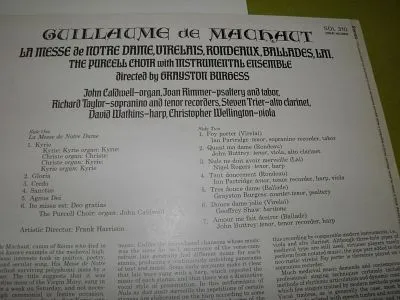
《马肖《圣母院弥撒曲,为4人声而作》 《定量夫人》《第24叙事曲,特雷斯夫人》 《第四维勒莱,温柔夫人多美丽》 /伯吉斯指挥 ,普赛尔音乐会合奏团合唱团 》
簡介
This recording is very much a 'house' product. It uses Schrade's edition, from Oiseau-Lyre's Poly-phonic Music of the Fourteenth Century,and is scries,Frank Ll. Harrison. The performance is very different from Safford Cape's Archive recording of 1956: gone are the instrumental'interludes', the vocal preciosities, the ritardandi.Cape, and similarly John McCarthy in his recent Nonesuch recording, mingled vocal with instrumental timbres (viols, recorder,lute);Harrison employs four voices, unaccompanicd, but inserts solo organ sections (played by John Caldwell) into the first movement, to contrive an alternating ninefold Kyrie. Cape's singers 'ecclesiasticalized'their Latin; the Purcell Choir has adapted its tone quality and enunciation to 14th-century French practice, under the guidance of Dr Daffyd Evans. The result is at times exciting. I suspect, however, that rehearsal and recording time was short, To execute Machaut's elaborate rhythms incisively,and to pitch his treacherous lines using a hard vocal sound without vibrato, is a tall order in itself.(And clearly the singers had an ideal in mind which they came near to achieving.)But add to this an engineered two-second echo, and fast tempi approximating to contemporary 'stress-patterns of literate pronunciation',and the prospect of keeping the textures clear is formidable. I feel sure that these last two factors are mutually exclu-sive, for the rapid hocketing is quite blurred by the resonance, Surely Machaut was envisaging either slower tempi or a private-chapel acoustic. At the opposite extreme, Cape chose both of these: he took his tempi from the contemporary theorists (ad-mittedly' elusive in their instructions), and used a dryish acoustic. Thus his Kyrie Il moves at breve 48, whereas Harrison's(now Kyrie IV)moves at breve=96, It is a marvel that Cape sustained the intensity of the music at such slow tempi(though in truth he speeded up several of the slowest passages on dubious grounds), For all its mannerisms, Cape's performance is the more lucid, and better rehearsed.
摘自:http://www.jstor.org/stable/953276