
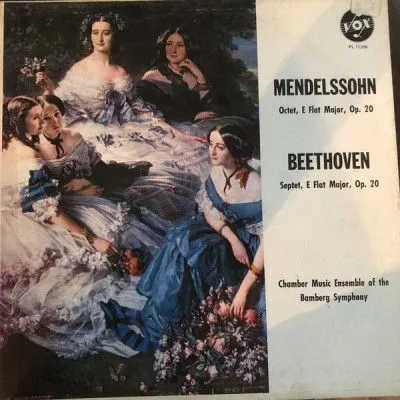
《贝多芬《降E大调七重奏》 /门德尔松《降E大调八重奏》 》
類型专辑
年份1961
簡介
Octet (Mendelssohn)
Felix Mendelssohn'sOctetinE-flat major,Op.20, was composed in the autumn of 1825 and completed on October 15,[1]when the composer was 16. He wrote theoctetas a birthday gift for his friend and violin teacherEduard Ritz[de]; it was slightly revised in 1832 before the first public performance on 30 January 1836 at theLeipzigGewandhaus.[2]Conrad Wilsonsummarizes much of its reception ever since: "Its youthful verve, brilliance and perfection make it one of the miracles of nineteenth-century music."
Structure
The work comprises fourmovements:
1.Allegro moderato ma con fuoco(E-flat major)
2.Andante(C minor)
3.Scherzo: Allegro leggierissimo(G minor)
4.Presto(E-flat major)
A typical performance of the work lasts around thirty minutes, with the first movement usually comprising roughly half of this.
The scherzo, later scored for orchestra as a replacement for the minuet in the composer'sFirst Symphonyat its premiere, is believed to have been inspired by a section ofGoethe'sFaustentitled "Walpurgis Night's Dream".[4]Fragments of this movement recur in the finale, as a precursor to the "cyclic" technique employed by later 19th-century composers. The entire work is also notable for its extended use of counterpoint, with the finale, in particular, beginning with an eight-part fugato. In this section, Mendelssohn quotes the melody of "And he shall reign forever and ever" from the "Hallelujah Chorus" ofHandel'sMessiah.[5][6]
The work has been compared toLouis Spohr's 1823Double Quartet No. 1 in D minor, Op. 65.
摘自:https://en.wikipedia.org/wiki/Octet_(Mendelssohn)
Septet (Beethoven)
TheSeptetinE-flat major, Opus 20, byLudwig van Beethoven, was sketched out in 1799, completed, and first performed in 1800 and published in 1802.[1]The score contains the notation: "Der Kaiserin Maria Theresia gewidmet", or translated, "Dedicated to theEmpress Maria Theresa."
Structure and analysis
The composition is in six movements and runs approximately 40 minutes in performance:
1.Adagio–Allegrocon brio(inE-flat major) (approx. 10 min.)
2.Adagio cantabile(inA-flat major) (approx. 9 min.)
3.Tempo dimenuetto(inE-flat major) (approx. 3 min.)
4.Tema convariazioni:Andante(inB-flat major) (approx. 7 min.)
5.Scherzo: Allegro molto e vivace(inE-flat major) (approx. 3 min.)
6.Andante con moto alla marcia(inE-flat minor) –Presto(inE-flat major) (approx. 7 min.)
Analysis
The overall layout resembles aserenadeand is in fact more or less the same as that ofMozart'sstring trio, K. 563in the same key, but Beethoven expands the form by the addition of substantial introductions to the first and last movements and by changing the secondminuetto ascherzo. The main theme of the third movement had already been used in Beethoven'sPiano Sonata No. 20 (Op. 49 No. 2), which was an earlier work despite its higher opus number. The finale features a violincadenza.
The scoring of the Septet for a single clarinet, horn and bassoon (rather than for pairs of these wind instruments) was innovative. So was the unusually prominent role of theclarinet, as important as the violin, quite innovative.
The Septet was one of Beethoven's most successful and popular works and circulated in many editions and arrangements for different forces. In about 1803 Beethoven himself arranged the work as a Trio for clarinet (or violin), cello and piano, and this version was published as his Op. 38 in 1805.
ConductorArturo Toscaninirearranged the string section of the Septet so that it could be played by the full string section of the orchestra, but he did not change the rest of the scoring. He recorded the Septet forRCA Victorwith theNBC Symphony Orchestraon November 26, 1951, inCarnegie Hall.