
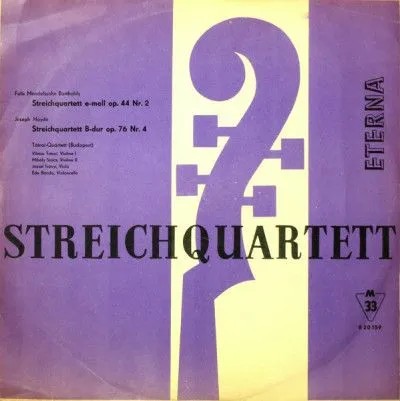
《海顿《bB大调为弦乐组而作的四重奏“日出”(第4厄多蒂)》 /门德尔松《e小调为弦乐组而作的四重奏,第4四重奏》 /伊万中提琴 ,班达大提琴 ,苏奇小提琴 ,塔特拉小提琴 ,Tátrai四重奏 》
Franz Joseph Haydn
,Felix Mendelssohn
,Mihály Szűcs
,József Iványi
,Tátrai Quartet
,Vilmos Tatrai
,Ede Banda
類型专辑
年份1960
簡介
String Quartet No. 4 (Mendelssohn)
TheString Quartet No. 4 in E minor,Op. 44, No. 2, was composed byFelix Mendelssohnin 1837, and revised in 1839.[1]
This work was premièred on 29 October 1837 atLeipzigwith great success, and published as a full score in 1840.[2]The piece is part of the Op. 44 set of 3 string quartets that Mendelssohn dedicated to theCrown Prince of Sweden.[3]While Mendelssohn'sfirstandsecond quartetwere written under the influence ofBeethoven, Op.44 exhibits a clear sprouting of the composer's originality in style.[1]
Movements
Like all of Mendelssohn'sstring quartets, this work has fourmovements:
1.Allegro assai appassionato
2.Scherzo: Allegro di molto
3.Andante
4.Presto agitato
A typical performance just under 30 minutes.
摘自:https://en.wikipedia.org/wiki/String_Quartet_No.4(Mendelssohn)
String Quartets, Op. 76, No. 4 ("Sunrise")
TheQuartet No. 63inB♭major, Op. 76, No. 4, is nicknamedSunrisedue to the rising theme over sustained chords that begins the quartet. It consists of four movements:
1.Allegrocon spirito
2.Adagio
3.Menuetto. Allegro
4.Finale. Allegro, ma non-troppo
Exposition
The opening of the movement begins in a way that seemingly contradicts the allegro con spirito marking. Violin II, viola, and cello sustain atonicchord while the first violin plays the melody (the "sunrise"motif) on top. In measure 7, the same instruments sustain adominant seventh chordwhile the first violin again plays a rising solo on top. In measure 22, all instruments reachforte, and allegro con spirito character is apparent through the sixteenth-note movement and livelystaccatoeighth notes trading off between the parts. In measure 37, the opening sunrise theme returns, this time with the solo in the cello and the sustained chords in the violins and viola. The lively sixteenth-note section returns in measure 50, beginning with sixteenth notes in the cello which move to the viola, and finally, the violins. In measure 60, all instruments drop topianofor a six-measure staccato eighth-note section before jumping to an all sixteenth-notefortissimoin measure 66 to finish off theexposition.
摘自:https://en.wikipedia.org/wiki/String_Quartets,_Op.76(Haydn)#Opus_76,_No.4(%22Sunrise%22)