
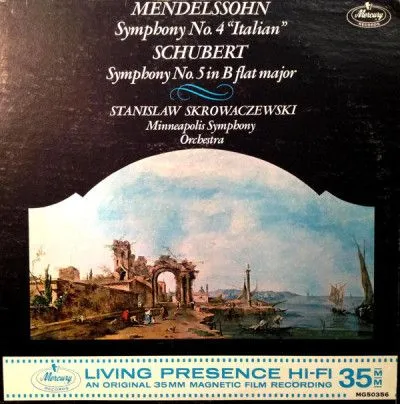
《舒伯特《降B大调第5交响曲》 /门德尔松《第4交响曲“意大利”》 /斯克罗瓦切夫斯基指挥 ,明尼阿波利斯交响乐团 》
簡介
Symphony No. 4 (Mendelssohn)
TheSymphony No. 4in A major,Op.90, commonly known as theItalian,[1]is an orchestral symphony written by German composerFelix Mendelssohn.
History
The work has its origins (as had the composer'sScottish3rd SymphonyandThe Hebridesoverture) in the tour of Europe which occupied Mendelssohn from 1829 to 1831. Its inspiration is the colour and atmosphere of Italy, where Mendelssohn made sketches but left the work incomplete. Below is a snippet of a letter he wrote to his father:
This is Italy! And now has begun what I have always thought... to be the supreme joy in life. And I am loving it. Today was so rich that now, in the evening, I must collect myself a little, and so I am writing to you to thank you, dear parents, for having given me all this happiness.[2]
In February he wrote from Rome to his sisterFanny,
TheItaliansymphony is making great progress. It will be the jolliest piece I have ever done, especially the last movement. I have not found anything for the slow movement yet, and I think that I will save that for Naples.
TheItalian Symphonywas finished in Berlin on 13 March 1833, in response to an invitation for a symphony from theLondon (now Royal) Philharmonic Society; he conducted the first performance himself in London on 13 May 1833 at a London Philharmonic Society concert. The symphony's success, and Mendelssohn's popularity, influenced the course of British music for the rest of the century.[3]TheGermania Musical Societyof Boston gave the first performance in the United States, on 1 November 1851, withCarl Bergmannconducting.[4]
Mendelssohn himself, however, remained dissatisfied with the composition, which cost him, he said, some of the bitterest moments of his career; he revised it in 1834[5]and even planned to write alternative versions of the second, third, and fourth movements. He never published the symphony, and it appeared in print only in 1851;[6]thus it is numbered as his "Symphony No. 4", even though it was in fact the third he composed.
摘自:https://en.wikipedia.org/wiki/Symphony_No.4(Mendelssohn)
Symphony No. 5 (Schubert)
Franz Schubert'sSymphony No. 5inB♭major,D.485, was written mainly in September 1816 and completed on October 3, 1816.[1]It was finished six months after the completion of hisprevious symphony.
Scoring
Scored for oneflute, twooboes, and twobassoons, along with twohornsin B♭and E♭andstrings. Of all of Schubert's symphonies, it is scored for the smallest orchestra. It is the only one of his symphonies which does not includeclarinets,trumpetsortimpanias part of the instrumentation.
Mozartean influence
In character, the writing is often said to resembleMozart; Schubert was infatuated with the composer at the time he composed it, writing in his diary on June 13 of the year of composition, "O Mozart! immortal Mozart! what countless impressions of a brighter, better life hast thou stamped upon our souls!"[2]This is reflected particularly in the lighter instrumentation, as noted above. Indeed, the instrumentation matches that of the first version (without clarinets) of Mozart's40th symphony.[3]For another example, there is a strong similarity between the opening themes of the second movement of D. 485 and the last movement of Mozart's Violin Sonata in F major, K. 377.