
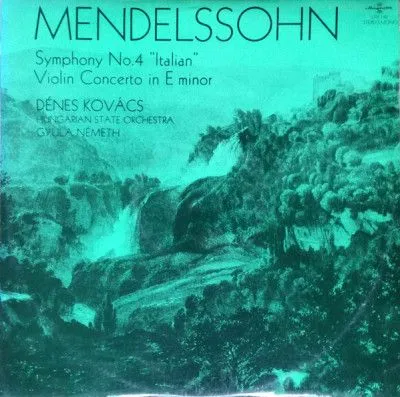
《门德尔松《第4交响曲“意大利”》 《e小调小提琴协奏曲》 /科瓦奇小提琴 ,内梅特指挥 ,匈牙利国家交响乐团 》
簡介
Symphony No. 4 (Mendelssohn)
TheSymphony No. 4in A major,Op.90, commonly known as theItalian,[1]is an orchestral symphony written by German composerFelix Mendelssohn. History The work has its origins (as had the composer'sScottish3rd SymphonyandThe Hebridesoverture) in the tour of Europe which occupied Mendelssohn from 1829 to 1831. Its inspiration is the colour and atmosphere of Italy, where Mendelssohn made sketches but left the work incomplete. Below is a snippet of a letter he wrote to his father: This is Italy! And now has begun what I have always thought... to be the supreme joy in life. And I am loving it. Today was so rich that now, in the evening, I must collect myself a little, and so I am writing to you to thank you, dear parents, for having given me all this happiness.[2] In February he wrote from Rome to his sisterFanny, TheItaliansymphony is making great progress. It will be the jolliest piece I have ever done, especially the last movement. I have not found anything for the slow movement yet, and I think that I will save that for Naples. TheItalian Symphonywas finished in Berlin on 13 March 1833, in response to an invitation for a symphony from theLondon (now Royal) Philharmonic Society; he conducted the first performance himself in London on 13 May 1833 at a London Philharmonic Society concert. The symphony's success, and Mendelssohn's popularity, influenced the course of British music for the rest of the century.[3]TheGermania Musical Societyof Boston gave the first performance in the United States, on 1 November 1851, withCarl Bergmannconducting.[4] Mendelssohn himself, however, remained dissatisfied with the composition, which cost him, he said, some of the bitterest moments of his career; he revised it in 1834[5]and even planned to write alternative versions of the second, third, and fourth movements. He never published the symphony, and it appeared in print only in 1851;[6]thus it is numbered as his "Symphony No. 4", even though it was in fact the third he composed.摘自:https://en.wikipedia.org/wiki/Symphony_No.4(Mendelssohn)
Violin Concerto (Mendelssohn)
Felix Mendelssohn'sViolin ConcertoinE minor,Op.64, is his last large orchestral work. It holds an important place in theviolinrepertoire and is one of the most popular and most frequently performedviolin concertosin history.A typical performance lasts just under half an hour. Mendelssohn originally proposed the idea of the violin concerto toFerdinand David, a close friend and thenconcertmasterof theLeipzig Gewandhaus Orchestra. Although conceived in 1838, the work took another six years to complete and was notpremiereduntil 1845. During this time, Mendelssohn maintained a regular correspondence with David, who gave him many suggestions. The work itself was one of the foremost violin concertos of theRomanticera and was influential on many other composers. Although the concerto consists of threemovementsin a standard fast–slow–fast structure and each movement follows a traditionalform, the concerto was innovative and included many novel features for its time. Distinctive aspects include the almost immediate entrance of the violin at the beginning of the work (rather than following an orchestral preview of the first movement's major themes, as was typical inClassical-era concertos) and thethrough-composedform of the concerto as a whole, in which the three movements are melodically and harmonically connected and playedattacca(each movement immediately following the previous one without any pauses).(citation needed) The concerto was well received and soon became regarded as one of the greatest violin concertos of all time. The concerto remains popular to this day and has developed a reputation as an essential concerto for all aspiring concert violinists to master, and usually one of the first Romantic era concertos they learn. Many professional violinists have recorded the concerto and the work is regularly performed in concerts andclassical music competitions. Mendelssohn also wrote a virtuosoConcerto for Violin and String Orchestra in D minorbetween 1821 and 1823, when he was 12 to 14 years old, at the same time that he produced histwelve string symphonies.This work was "rediscovered" and first recorded in 1951 byYehudi Menuhin. History Following his appointment in 1835 as principalconductorof theLeipzig Gewandhaus Orchestra,[6]Mendelssohn named his childhood friendFerdinand Davidas the orchestra'sconcertmaster.The work's origins derive from this professional collaboration. In a letter dated 30 July 1838, Mendelssohn wrote to David: "I should like to write a violin concerto for you next winter. One in E minor runs through my head, the beginning of which gives me no peace." The concerto took another six years to complete. There are many possible reasons for the delay, including self-doubt,[9]histhird symphony and an unhappy period in Berlin after a request from KingFrederick William IV of Prussia.Nevertheless, Mendelssohn and David kept up a regular correspondence during this time,with Mendelssohn seeking technical and compositional advice. Indeed, this violin concerto was the first of many to have been composed with the input of a professional violinist, and would influence many future collaborations.The autographed score is dated 16 September 1844, but Mendelssohn was still seeking advice from David until its premiere.The concerto was first performed inLeipzigon 13 March 1845 with Ferdinand David as soloist. Mendelssohn was unable to conduct due to illness and the premiere was conducted by the Danish composerNiels Gade.Mendelssohn first conducted the concerto on 23 October 1845 again with Ferdinand David as soloist. An autograph manuscript of the concerto re-emerged in 1989 in theBiblioteka JagiellonskainKraków, leading to some scholarly scepticism of the veracity ofBreitkopf & Härtel's 1862 edition of the published score. Some notable differences include the tempo character of the first movement being written as "Allegro con fuoco" rather than the commonplace "Allegro molto appassionato" as well as significant alterations of the solo violin's passage-work.摘自:https://en.wikipedia.org/wiki/Violin_Concerto_(Mendelssohn)